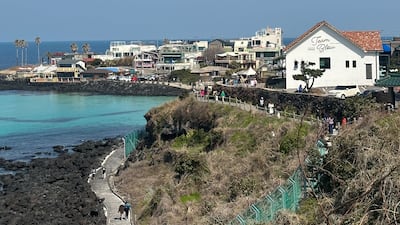

“Moving here was the best decision I ever made,” says Amy Sunyoung Lee as she walks down the Handam Coastal Walk on South Korea's Jeju Island – a picturesque trail perfect for seaside strolls and sunset views.
“I have a computer science degree and worked at one of Seoul’s biggest banks for 15 years, but I left it all behind to be a farmer here,” the mother of two tells The National. “I wanted a fresh start, I wanted to spread my wings, and Jeju was the perfect place to do so.”
With its breathtaking coastline, pristine beaches and striking volcanic landscapes, Jeju has been called the “Hawaii of Asia”. But a closer look at the island reveals a unique heritage and an identity entirely of its own.

“Jeju is known for three things,” says Governor Oh Young-hun. “Its rocks, winds and women,” he continues, referring to the three forces of nature that shape the island’s past, present and future.
The Governor was addressing a group who were invited to South Korea for the World Journalists Conference 2025. The event – organised by the Journalists Association of Korea and supported by South Korea’s Ministry of Culture, Sports and Tourism, Ministry of Foreign Affairs and the Korea Press Foundation – aimed to display the country's culture, history and development to an international audience. Jeju was one of several destinations on the itinerary, but clearly a crowd favourite.
Jeju’s past: A legacy of fire and water
The black basalt rocks on the island's coast show its origins. Jeju was created through millions of years of volcanic activity, explains Ms Lee – a process that has shaped the island’s landscape and identity.
Jeju’s natural and cultural significance has earned it three Unesco designations in a world-first. Jeju Volcanic Island and Lava Tubes were named a Unesco World Heritage site, honouring its extraordinary formations. This includes the Geomunoreum Lava Tube System, an underground network of tunnels and caverns that offers a glimpse into the island’s fiery birth.
Jeju has also been recognised as a Unesco Global Geopark for landmarks such as Seongsan Ilchulbong (Sunrise Peak) – a crater rising from the sea, formed by a volcanic eruption more than 5,000 years ago – and was designated a Unesco Biosphere Reserve in 2002, protecting its volcanic landscapes and marine ecosystems.

The island’s acclaimed natural wonders are only part of its heritage. In the depth of its pristine waters, an age-old tradition still takes place to this day. The Haenyeo, or “sea women”, have been diving in Jeju’s waters for centuries, gathering marine treasures and harvesting seafood for a living, without oxygen tanks.
The Haenyeo free-dive while holding their breath for up to two minutes. Some of them are in their 80s, says Ms Lee, and have yet to retire from the generational practice. In recognition of their cultural significance, Unesco designated the Haenyeo tradition as an Intangible Cultural Heritage of Humanity.
Jeju’s rich history and cultural heritage attract more than 14 million visitors annually. The once-hidden gem is now a popular holiday destination, making domestic and international tourism a key pillar of Jeju’s economy. A rise in K-dramas, or Korean dramas, has also generated renewed interest in Jeju, as the island’s stunning landscapes have served as a backdrop for many hit series.
When Life Gives you Tangerines, a 2025 K-drama that topped Netflix's top 10 list in the non-English category for three consecutive weeks last month, was filmed at several locations in Jeju. The island’s Hallabong tangerines are known for their sweet, rich, aromatic flavour.
Rather than fall victim to overtourism, as many of the world’s natural wonders have, Jeju has implemented stringent sustainable policies to protect its past and shape the future.
From historic origins to high-tech horizons
Jeju is at the forefront of South Korea’s renewable energy movement, with ambitious sustainability goals. While much of the world is aiming at 2050 for net-zero emissions, Jeju aims to achieve complete carbon neutrality by 2035, advancing South Korea’s national target by 15 years.
But that is not the island's only environmental milestone. It holds the title of top electric vehicle city in South Korea, is home to one of the country’s largest wind farms, and last year began the nation's first commercial sales of green hydrogen.
Jeju’s ambitions go beyond ecotourism and sustainability: it is also emerging as a centre for the private space industry.
The island is home to South Korea’s first private satellite ground station, established by space startup Contec in 2019. In March 2024, Contec successfully launched its first satellite, ContecSat-1, aboard a SpaceX Falcon 9 rocket, marking a major milestone in Jeju’s growing role in the aerospace sector.
By the end of 2025, South Korea's business conglomerate Hanwha Systems will complete construction of the Jeju Hanwha Space Centre for the development, making and testing of satellites.

Jeju’s ambitions come at a significant time for the island. This week marked 77 years since the start of an uprising by Jeju islanders against US military-led rule after Korea's liberation from Japan. An estimated 30,000 people were killed in a violent crackdown on the protests between April 3, 1948, and 1954.
Governor Oh paid tribute to the victims in his address to journalists. He said the island’s wounds were only just beginning to heal.
“We are resilient people,” he said. “This is how we heal the wounds of the past, by building a better future.”

