Postcard from Bihar: Foxnut farmers reap rewards of 'superfood' crop


Taniya Dutta
  • English
  • Arabic

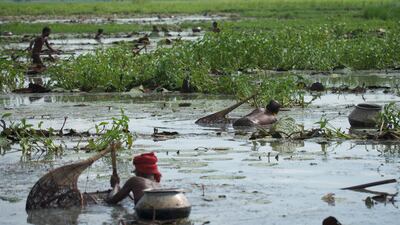
By a rickety road in a remote village in eastern India, dozens of men stand waist-deep in murky water to harvest a prized seed whose consumption has become a global fad.

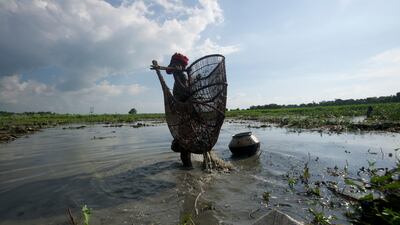
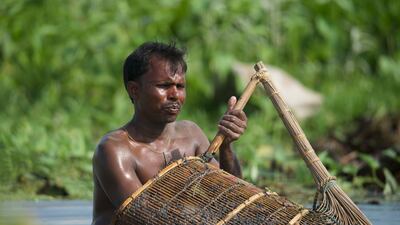
The workers carry long sticks and a horn-shaped cane basket, called a gaja, to collect black seeds from prickly water lilies, Euryale ferox. These seeds will be transformed into foxnuts, touted as a superfood.

Foxnuts are usually eaten as snacks in roasted and puffed form. Traditionally they were consumed in northern and eastern India during religious festivals and fasts, but have recently gained popularity around the world for their nutritional properties. They are a dense carbohydrate and protein source and also contain magnesium and potassium.

However, the tedious process of procuring foxnuts makes them one of the most expensive seeds. On average, 100 grams are sold for between 200 and 400 rupees ($2.50 to $5).

India exports about 90 per cent of the world’s foxnut produce to at least 100 countries across Europe, the Americas and Middle East, including the UAE. The eastern state of Bihar is the largest producer and contributes 80 per cent of the country's harvest.

It grows about 10,000 tonnes of foxnuts annually, according to government data. This has earned the state India's coveted Geographical Indication tag. Unprecedented demand for the snack has provided an opportunity for farmers to move from traditional crops to fox nuts to improve their livelihoods.

More people are switching to foxnuts, even though they involve a lot of work, Lallan Mahaldar, who works on a farm in the district of Purnea, told The National. “Everyone benefits, from farmers to labourers and those who roast the seeds.”

Insects and thorns

Bihar is one of the most disadvantaged Indian states with poverty rates at 33 per cent in 2023, according to government data.

A large proportion of the population lacks education, health facilities and employment, forcing many people to migrate to neighbouring states. While 80 per cent of the population is engaged in farming, four out of five people leave Bihar for work after the harvesting season.

The state has traditionally grown rice, wheat and maize, but farmers say their earnings from these crops are not enough to make ends meet.

  • A farm labourer harvests fox nuts, the seeds of prickly waterlilies, in Purnea, in India's eastern Bihar state. All photos: Taniya Dutta / The National
    A farm labourer harvests fox nuts, the seeds of prickly waterlilies, in Purnea, in India's eastern Bihar state. All photos: Taniya Dutta / The National
  • Labourers work waist-deep in murky water collecting the black seeds from ponds
    Labourers work waist-deep in murky water collecting the black seeds from ponds
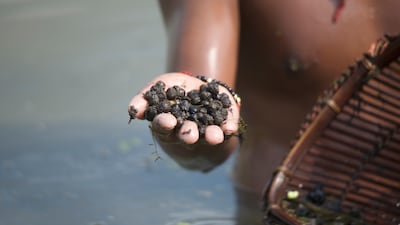
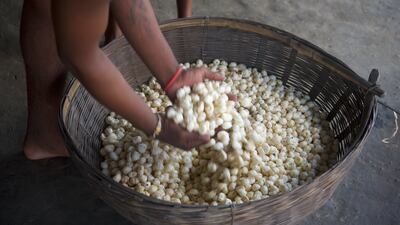
  • A labourer with a handful of the fox nuts. They are roasted and puffed and then eaten as snacks
    A labourer with a handful of the fox nuts. They are roasted and puffed and then eaten as snacks
  • The labourers collect the seeds in horn-shaped cane baskets
    The labourers collect the seeds in horn-shaped cane baskets
  • A labourer pours the seeds of prickly water lilies, or Euryale ferox, from his basket into a sack
    A labourer pours the seeds of prickly water lilies, or Euryale ferox, from his basket into a sack
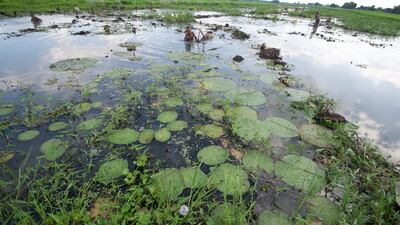
  • The seeds form in pods under the big circular leaves of the lily plant, hidden under the water
    The seeds form in pods under the big circular leaves of the lily plant, hidden under the water
  • Labourer Dilip Kumar says the work is tedious and the thorns prick his hands but he earns more than if he was working in a paddy or maize field
    Labourer Dilip Kumar says the work is tedious and the thorns prick his hands but he earns more than if he was working in a paddy or maize field
  • Seeds are bought from farms and roasted at makeshift stations across Purnea
    Seeds are bought from farms and roasted at makeshift stations across Purnea
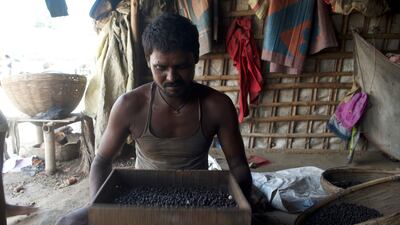
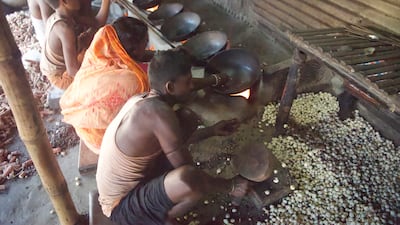
  • The seeds are dried and then sifted to get rid of dirt and stones before they are roasted in iron woks on clay ovens
    The seeds are dried and then sifted to get rid of dirt and stones before they are roasted in iron woks on clay ovens
  • Santosh Shani sieves the seeds to get rid of any stones
    Santosh Shani sieves the seeds to get rid of any stones
  • Whole families, including children, are involved in roasting the seeds
    Whole families, including children, are involved in roasting the seeds
  • The seeds are roasted and the outer shell broken with a mallet for the puffy part to pop
    The seeds are roasted and the outer shell broken with a mallet for the puffy part to pop
  • A labourer using his stick to collect the seeds
    A labourer using his stick to collect the seeds
  • A labourer transferring seeds from his basket. Each plant yields between 75 and 125 seeds
    A labourer transferring seeds from his basket. Each plant yields between 75 and 125 seeds

Fox nut farming, however, has given them hope. The seeds are grown in nine districts across the state, including Purnea, with local farmers and labourers saying they earn more than from maize or rice.

“We earn 500 rupees ($6) more a day,” Mr Mahaldar said. “Bihar is a poor state. We are forced to go to different states for work but we work here for two or three months and earn more money. We get sick from staying in the water but take medicines and return to work the next day. There are also insects and thorns. They prick the hands. An inexperienced person cannot work.”

'Extremely laborious'

Foxnuts were initially only found in the wild, but farmers now cultivate them in lowland waters during summer by sowing seeds. The seeds are ready by spring and harvested in September, said Guddu Kumar, who farms 20 acres of fox nuts in the Purnea village of Singhia.

Mr Kumar, 34, originally a paddy farmer, started fox nut farming six years ago. He said the transition was prompted by the produce's bumper profits.

“Our foxnuts are exported worldwide. We have noticed that sales have grown in recent years, and this is why there is more farming. We also grow maize, but we are benefiting more as the fox nuts give high returns,” he said.

But harvesting the seeds is tedious, Mr Kumar added. They grow in the pods of big circular leaves on the lily plant, hidden in murky, shallow water. The pods are surrounded by thick thorns that prick the labourers as they harvest them by hand.

Each plant yields between 75 and 125 seeds. The lilies need abundant rain to thrive, so when there is low rainfall farmers use pumps to maintain water levels in the ponds. The fruits rot and release the seeds into the water.

“I have 50 labourers who work four hours a day,” Mr Kumar said. “It is extremely laborious, starting from sowing the seeds, spraying fertiliser, clearing out weeds and then taking out seeds from the water.”

From pods to snacks

Once out of the water, the seeds are left to dry in a pit for a few days under the sun, before being roasted in iron woks on clay ovens. Labourers buy the seeds from farms and carry out the roasting. Entire families, including children, are involved in the process.

The seeds are first sieved to eliminate stones. Then they are roasted and left to rest overnight, for up to 15 hours. They are again roasted and once they start to crackle, their outer black shell is popped open using a wooden mallet called a puppy. The resulting white pearly puffs are the foxnuts.

Of every 100 grams of seeds in the wok, only about 80 per cent pop. These are then sold in the market. The lengthy process makes foxnuts a premium product.

“There is hard work although there is also more money,” said Rohit Sahni, 27, another labourer at a makeshift station in Purnea. “We work sitting next to the oven – there is smoke and heat … But we work six months popping fox nuts and make enough money for the year.”


Grand Slam Los Angeles results

Men:
56kg – Jorge Nakamura
62kg – Joao Gabriel de Sousa
69kg – Gianni Grippo
77kg – Caio Soares
85kg – Manuel Ribamar
94kg – Gustavo Batista
110kg – Erberth Santos

Women:
49kg – Mayssa Bastos
55kg – Nathalie Ribeiro
62kg – Gabrielle McComb
70kg – Thamara Silva
90kg – Gabrieli Pessanha

Lexus LX700h specs

Engine: 3.4-litre twin-turbo V6 plus supplementary electric motor

Power: 464hp at 5,200rpm

Torque: 790Nm from 2,000-3,600rpm

Transmission: 10-speed auto

Fuel consumption: 11.7L/100km

On sale: Now

Price: From Dh590,000

THE CLOWN OF GAZA

Director: Abdulrahman Sabbah 

Starring: Alaa Meqdad

Rating: 4/5

The%C2%A0specs%20
%3Cp%3E%3Cstrong%3EEngine%3A%20%3C%2Fstrong%3E3.5-litre%2C%20twin-turbo%20V6%0D%3Cbr%3E%3Cstrong%3ETransmission%3A%20%3C%2Fstrong%3E10-speed%20auto%0D%3Cbr%3E%3Cstrong%3EPower%3A%20%3C%2Fstrong%3E410hp%0D%3Cbr%3E%3Cstrong%3ETorque%3A%20%3C%2Fstrong%3E495Nm%0D%3Cbr%3E%3Cstrong%3EPrice%3A%20%3C%2Fstrong%3Estarts%20from%20Dh495%2C000%20(Dh610%2C000%20for%20the%20F-Sport%20launch%20edition%20tested)%0D%3Cbr%3E%3Cstrong%3EOn%20sale%3A%20%3C%2Fstrong%3Enow%3C%2Fp%3E%0A
In-demand jobs and monthly salaries
  • Technology expert in robotics and automation: Dh20,000 to Dh40,000 
  • Energy engineer: Dh25,000 to Dh30,000 
  • Production engineer: Dh30,000 to Dh40,000 
  • Data-driven supply chain management professional: Dh30,000 to Dh50,000 
  • HR leader: Dh40,000 to Dh60,000 
  • Engineering leader: Dh30,000 to Dh55,000 
  • Project manager: Dh55,000 to Dh65,000 
  • Senior reservoir engineer: Dh40,000 to Dh55,000 
  • Senior drilling engineer: Dh38,000 to Dh46,000 
  • Senior process engineer: Dh28,000 to Dh38,000 
  • Senior maintenance engineer: Dh22,000 to Dh34,000 
  • Field engineer: Dh6,500 to Dh7,500
  • Field supervisor: Dh9,000 to Dh12,000
  • Field operator: Dh5,000 to Dh7,000
While you're here
MATCH INFO

Uefa Champions League, last-16. first leg

Atletico Madrid v Juventus, midnight (Thursday), BeIN Sports

Manikarnika: The Queen of Jhansi

Director: Kangana Ranaut, Krish Jagarlamudi

Producer: Zee Studios, Kamal Jain

Cast: Kangana Ranaut, Ankita Lokhande, Danny Denzongpa, Atul Kulkarni

Rating: 2.5/5

THE SIXTH SENSE

Starring: Bruce Willis, Toni Collette, Hayley Joel Osment

Director: M. Night Shyamalan

Rating: 5/5

Founders: Abdulmajeed Alsukhan, Turki Bin Zarah and Abdulmohsen Albabtain.

Based: Riyadh

Offices: UAE, Vietnam and Germany

Founded: September, 2020

Number of employees: 70

Sector: FinTech, online payment solutions

Funding to date: $116m in two funding rounds  

Investors: Checkout.com, Impact46, Vision Ventures, Wealth Well, Seedra, Khwarizmi, Hala Ventures, Nama Ventures and family offices

If you go...

Fly from Dubai or Abu Dhabi to Chiang Mai in Thailand, via Bangkok, before taking a five-hour bus ride across the Laos border to Huay Xai. The land border crossing at Huay Xai is a well-trodden route, meaning entry is swift, though travellers should be aware of visa requirements for both countries.

Flights from Dubai start at Dh4,000 return with Emirates, while Etihad flights from Abu Dhabi start at Dh2,000. Local buses can be booked in Chiang Mai from around Dh50

Results

5pm: Al Maha Stables – Maiden (PA) Dh80,000 (Turf) 1,600m; Winner: Reem Baynounah, Fernando Jara (jockey), Mohamed Daggash (trainer)

5.30pm: Wathba Stallions Cup – Maiden (PA) Dh70,000 (T) 1,600m; Winner: AF Afham, Tadhg O’Shea, Ernst Oertel

6pm: Emirates Fillies Classic – Prestige (PA) Dh100,000 (T) 1,600m; Winner: Ghallieah, Sebastien Martino, Jean-Claude Pecout

6.30pm: Emirates Colts Classic – Prestige (PA) Dh100,000 (T) 1,600m; Winner: Yas Xmnsor, Saif Al Balushi, Khalifa Al Neyadi

7pm: The President’s Cup – Group 1 (PA) Dh2,500,000 (T) 2,200m; Winner: Somoud, Adrie de Vries, Jean de Roualle

7.30pm: The President’s Cup – Listed (TB) Dh380,000 (T) 1,400m; Winner: Haqeeqy, Dane O’Neill, John Hyde.

Company%20profile
%3Cp%3E%3Cstrong%3EName%3A%3C%2Fstrong%3E%20Yabi%20by%20Souqalmal%C2%A0%3C%2Fp%3E%0A%3Cp%3E%3Cstrong%3EStarted%3A%20%3C%2Fstrong%3EMay%202022%2C%20launched%20June%202023%3C%2Fp%3E%0A%3Cp%3E%3Cstrong%3EFounder%3A%20%3C%2Fstrong%3EAmbareen%20Musa%3C%2Fp%3E%0A%3Cp%3E%3Cstrong%3EBased%3A%20%3C%2Fstrong%3EDubai%C2%A0%3C%2Fp%3E%0A%3Cp%3E%3Cstrong%3ESector%3A%20%3C%2Fstrong%3EFinTech%C2%A0%3C%2Fp%3E%0A%3Cp%3E%3Cstrong%3EInitial%20investment%3A%20u%3C%2Fstrong%3Endisclosed%20but%20soon%20to%20be%20announced%C2%A0%3C%2Fp%3E%0A%3Cp%3E%3Cstrong%3ENumber%20of%20staff%3A%20%3C%2Fstrong%3E12%C2%A0%3C%2Fp%3E%0A%3Cp%3E%3Cstrong%3EInvestment%20stage%3A%20%3C%2Fstrong%3Eseed%C2%A0%C2%A0%3C%2Fp%3E%0A%3Cp%3E%3Cstrong%3EInvestors%3A%20%3C%2Fstrong%3EShuaa%20Capital%3C%2Fp%3E%0A
The Sand Castle

Director: Matty Brown

Stars: Nadine Labaki, Ziad Bakri, Zain Al Rafeea, Riman Al Rafeea

Rating: 2.5/5

Results

2.30pm: Handicap (PA) Dh40,000 1,700m; Winner: AF Mezmar, Adam McLean (jockey), Ernst Oertel (trainer).

3pm: Maiden (PA) Dh40,000 2,000m; Winner: AF Ajwad, Tadhg O’Shea, Ernst Oertel.

3.30pm: Handicap (PA) Dh40,000 1,200m; Winner: Gold Silver, Sam Hitchcott, Ibrahim Aseel.

4pm: Maiden (PA) Dh40,000 1,000m; Winner: Atrash, Richard Mullen, Ana Mendez.

4.30pm: Gulf Cup Prestige (PA) Dh150,000 1,700m; Winner: AF Momtaz, Saif Al Balushi, Musabah Al Muhairi.

5pm: Handicap (TB) Dh40,000 1,200m; Winner: Al Mushtashar, Richard Mullen, Satish Seemar.

Updated: September 27, 2024, 7:21 PM