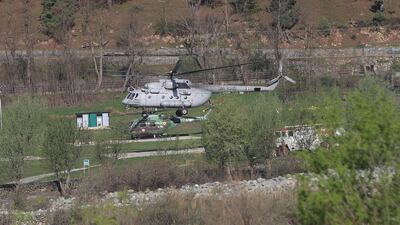
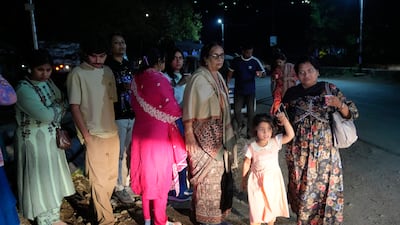
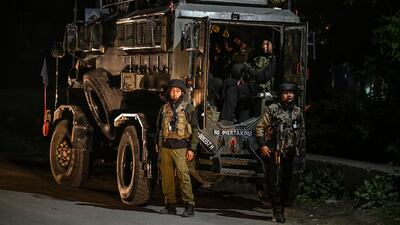
• Indian paramilitary soldiers patrol Dal Lake in Srinagar. EPA
    Indian paramilitary soldiers patrol Dal Lake in Srinagar. EPA
  • An Indian paramilitary soldier stands guard on the banks of Dal Lake. EPA
    An Indian paramilitary soldier stands guard on the banks of Dal Lake. EPA
  • People in Kolkata, India, walk with candles and banners during a protest march against the killings in Kashmir. AP
    People in Kolkata, India, walk with candles and banners during a protest march against the killings in Kashmir. AP
  • A woman in Kolkata places a candle during a protest against the killings. AP
    A woman in Kolkata places a candle during a protest against the killings. AP
  • Demonstrators in Pahalgam, Mumbai, during a protest condemning the terror attack. AFP
    Demonstrators in Pahalgam, Mumbai, during a protest condemning the terror attack. AFP
  • Members of the Anti-Terror Action Forum hold a protest near the Pakistan High Commission in New Delhi, India. EPA
    Members of the Anti-Terror Action Forum hold a protest near the Pakistan High Commission in New Delhi, India. EPA
  • Pakistan Markazi Muslim League activists shout slogans at an anti-India protest in Karachi. AFP
    Pakistan Markazi Muslim League activists shout slogans at an anti-India protest in Karachi. AFP
  • Indian Hindu activists carry burning torches in Bangalore. EPA
    Indian Hindu activists carry burning torches in Bangalore. EPA
  • Indian security personnel patrol a street in Srinagar, in Indian-controlled Kashmir. Reuters
    Indian security personnel patrol a street in Srinagar, in Indian-controlled Kashmir. Reuters
  • Pakistani security personnel stand guard outside the Indian High Commission in Islamabad. AFP
    Pakistani security personnel stand guard outside the Indian High Commission in Islamabad. AFP
  • A supporter of the Pakistan Murkazi Muslim League party chants at a demonstration against the suspension of a water-sharing treaty between India with Pakistan, in Peshawar. AP
    A supporter of the Pakistan Murkazi Muslim League party chants at a demonstration against the suspension of a water-sharing treaty between India with Pakistan, in Peshawar. AP
  • Protesters clash with security staff in New Delhi. AFP
    Protesters clash with security staff in New Delhi. AFP

Tension rises after Kashmir attack as India and Pakistan diplomacy breaks down


Amr Mostafa
  • English
  • Arabic

India has revoked visas for Pakistani citizens and given them until Sunday to leave the country as tension rises between the neighbours following this week's deadly terrorist attack on tourists in Kashmir.

Islamabad responded with a string of tit-for-tat diplomatic measures against New Delhi, including the cancellation of visas for Indians, closing its airspace to all Indian-owned or operated airlines and suspending all trade between the countries. Pakistan also warned that it would consider any diversion of water an “act of war”.

India accused Pakistan of supporting terrorism and Prime Minister Narendra Modi vowed to pursue the culprits “to the ends of the Earth”.

Hundreds of Pakistanis joined protests on Thursday against India's threats. In Kashmir, about 300 people brandishing anti-India placards marched through the main city of Muzaffarabad.

The attack in a tourist resort in Indian-administered Kashmir on Tuesday killed 26 people. India responded with a diplomatic offensive, closing a key border crossing, suspending a water treaty and expelling Pakistani diplomats. It went further on Thursday by suspending visa services to Pakistani nationals.

“All existing valid visas issued by India to Pakistani nationals stand revoked” with effect from April 27, India's Foreign Ministry said. It added that medical visas issued to Pakistani nationals will be valid only until April 29.

The ministry also advised Indian citizens in Pakistan to return as soon as possible. Motorists were heading towards India via the Wagah-Attari border crossing, which will be closed from May 1.

Indian citizens returned from Pakistan via the Wagah-Attari border post on Thursday as tensions escalate. AFP

Pakistani response

Pakistan said its “firm reciprocal measures” were about protecting its sovereignty. It described India's moves as “unjust, politically motivated, extremely irresponsible and devoid of legal merit”.

Indian defence, naval and air advisers were declared unwelcome in Islamabad and “directed to leave Pakistan immediately”, Pakistani Prime Minister Shehbaz Sharif’s office said after a national security committee meeting.

Visas issued to Indian citizens were cancelled, with the exception of Sikh pilgrims.

Pakistan also “vehemently” rejected India’s unprecedented move to suspend the water-sharing pact. “Any attempt to stop or divert the flow of water” belonging to Pakistan “will be “considered as an act of war and responded with full force”, the government said.

Rare attack

Tuesday's rare attack on civilians, mostly tourists who were visiting a popular scenic meadow, shocked and outraged India. Among the 26 people killed was Dubai resident Niraj Udhwani.

Pakistan denied any connection to the attack, which was claimed by a previously unknown militant group that called itself the Kashmir Resistance.

Gunmen target tourists in Kashmir attack – in pictures

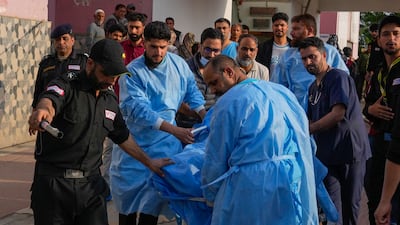
  • Paramedics at a hospital in Anantnag after gunmen attacked Indian tourists visiting Pahalgam, Kashmir, on April 22. AP
    Paramedics at a hospital in Anantnag after gunmen attacked Indian tourists visiting Pahalgam, Kashmir, on April 22. AP
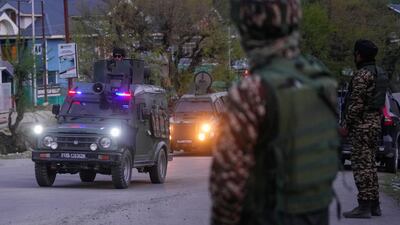
  • Indian security officers patrol the streets of Pahalgam following the attack. AP
    Indian security officers patrol the streets of Pahalgam following the attack. AP
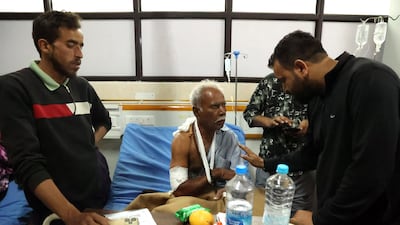
  • At least five tourists were killed and several others injured. Getty images
    At least five tourists were killed and several others injured. Getty images
  • Authorities have condemned the attack as the most severe targeting civilians in the region in recent years. Reuters
    Authorities have condemned the attack as the most severe targeting civilians in the region in recent years. Reuters
  • Prime Minister Narendra Modi has cut short his trip to Saudi Arabia and returned to India. EPA
    Prime Minister Narendra Modi has cut short his trip to Saudi Arabia and returned to India. EPA
  • Indian tourists were stuck on the road heading to Pahalgam after the attack. AP
    Indian tourists were stuck on the road heading to Pahalgam after the attack. AP
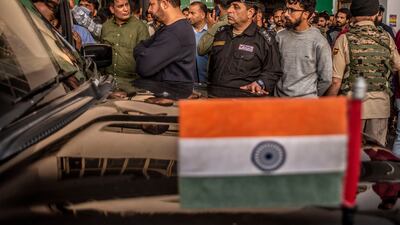
  • Indian army personnel stand guard near Pahalgam, south of Srinagar. AFP
    Indian army personnel stand guard near Pahalgam, south of Srinagar. AFP

India has vowed to punish those responsible. “I say to the whole world: India will identify, track and punish every terrorist and their backer,” Mr Modi said. “We will pursue them to the ends of the Earth”.

India and Pakistan each administer a part of Kashmir, but both claim the territory in its entirety. New Delhi describes all militancy in Kashmir as being backed by Pakistan. Islamabad denies this and many Muslim Kashmiris consider the militants to be part of a home-grown freedom struggle.

Indian border guard troops guard a road leading to the Attari-Wagah border, which is being closed in response to the Kashmir attack. AP

India’s Foreign Secretary, Vikram Misri, announced on Wednesday night that a number of Pakistani diplomats were asked to leave New Delhi and that diplomats were recalled from Pakistan.

Diplomatic missions in both countries will reduce their staff from 55 to 30 as of May 1, and the only functional land border crossing between the countries would be closed.

India also suspended a landmark water-sharing treaty that has survived two wars between the countries, in 1965 and 1971, and a major border skirmish in 1999.

The Indus Water Treaty, brokered by the World Bank in 1960, allows for sharing the waters of a river system that is a lifeline for both countries, particularly for Pakistan’s agriculture.


The specs: 2017 Dodge Ram 1500 Laramie Longhorn

Price, base / as tested: Dhxxx
Engine: 5.7L V8
Transmission: Eight-speed automatic
Power: 395hp @ 5,600rpm
Torque: 556Nm @ 3,950rpm
Fuel economy, combined: 12.7L / 100km

The specs: 2018 Alfa Romeo Stelvio

Price, base: Dh198,300
Engine: 2.0L in-line four-cylinder
Transmission: Eight-speed automatic
Power: 280hp @ 5,250rpm
Torque: 400Nm @ 2,250rpm
Fuel economy, combined: 7L / 100km

WOMAN AND CHILD

Director: Saeed Roustaee

Starring: Parinaz Izadyar, Payman Maadi

Rating: 4/5

How does ToTok work?

The calling app is available to download on Google Play and Apple App Store

To successfully install ToTok, users are asked to enter their phone number and then create a nickname.

The app then gives users the option add their existing phone contacts, allowing them to immediately contact people also using the application by video or voice call or via message.

Users can also invite other contacts to download ToTok to allow them to make contact through the app.


MATCH INFO

Manchester United v Manchester City, Wednesday, 11pm (UAE)

Match is on BeIN Sports

Ten tax points to be aware of in 2026

1. Domestic VAT refund amendments: request your refund within five years

If a business does not apply for the refund on time, they lose their credit.

2. E-invoicing in the UAE

Businesses should continue preparing for the implementation of e-invoicing in the UAE, with 2026 a preparation and transition period ahead of phased mandatory adoption. 

3. More tax audits

Tax authorities are increasingly using data already available across multiple filings to identify audit risks. 

4. More beneficial VAT and excise tax penalty regime

Tax disputes are expected to become more frequent and more structured, with clearer administrative objection and appeal processes. The UAE has adopted a new penalty regime for VAT and excise disputes, which now mirrors the penalty regime for corporate tax.

5. Greater emphasis on statutory audit

There is a greater need for the accuracy of financial statements. The International Financial Reporting Standards standards need to be strictly adhered to and, as a result, the quality of the audits will need to increase.

6. Further transfer pricing enforcement

Transfer pricing enforcement, which refers to the practice of establishing prices for internal transactions between related entities, is expected to broaden in scope. The UAE will shortly open the possibility to negotiate advance pricing agreements, or essentially rulings for transfer pricing purposes. 

7. Limited time periods for audits

Recent amendments also introduce a default five-year limitation period for tax audits and assessments, subject to specific statutory exceptions. While the standard audit and assessment period is five years, this may be extended to up to 15 years in cases involving fraud or tax evasion. 

8. Pillar 2 implementation 

Many multinational groups will begin to feel the practical effect of the Domestic Minimum Top-Up Tax (DMTT), the UAE's implementation of the OECD’s global minimum tax under Pillar 2. While the rules apply for financial years starting on or after January 1, 2025, it is 2026 that marks the transition to an operational phase.

9. Reduced compliance obligations for imported goods and services

Businesses that apply the reverse-charge mechanism for VAT purposes in the UAE may benefit from reduced compliance obligations. 

10. Substance and CbC reporting focus

Tax authorities are expected to continue strengthening the enforcement of economic substance and Country-by-Country (CbC) reporting frameworks. In the UAE, these regimes are increasingly being used as risk-assessment tools, providing tax authorities with a comprehensive view of multinational groups’ global footprints and enabling them to assess whether profits are aligned with real economic activity. 

Contributed by Thomas Vanhee and Hend Rashwan, Aurifer

Updated: April 25, 2025, 4:32 AM