![The UAE has collected 'close to 800,000 [sequences] in terms of numbers' under the Emirati Genome Programme. Khushnum Bhandari/The National](https://www.thenationalnews.com/resizer/v2/MKQMFEPM7CFV4RT63OHLMG656I.jpg?smart=true&auth=9c712c706fec9604c98d5e751ea82b861dafac6fa98121c8bfd6a5a5c5730063&width=812&height=456)


The UAE is to expand its knowledge in genomics and increase its contribution to global diversity in the field of studying DNA by teaming up with Uzbekistan.
Under a new partnership between M42 – the Abu Dhabi health technology company – and Uzbekistan’s Ministry of Health, an infrastructure similar to the Emirati Genome Programme (EGP) will explore a build, operate and transfer model for genomics to shift the country’s healthcare sector to a more preventive approach.
This will involve designing, developing and manufacturing relevant screening and diagnostic tools; supporting the implementation of genetically inherited disease prevention programmes; and expanding the approach to other diseases such as cancer.
Uzbekistan’s Deputy Minister of Health
Launched in Abu Dhabi in 2019, the UAE programme was created to provide preventive health care for the Emirati population. It collected and analysed genetic material from almost half the Emirati population, to understand why some disease is more prevalent than among other nationalities and how drugs respond in different ways. The project placed power in the hands of scientists, researchers and doctors to offer more specific, precision-based therapy.
“Now, we are looking at partnerships outside our borders,” Dr Fahed Al Marzooqi, chief executive of integrated health solutions platform M42, told The National during the 2025 Arab Health conference in Dubai, which was attended by Sheikh Mohammed bin Rashid, Vice President and Ruler of Dubai.
Dr Al Marzooqi said the EGP has “touched close to 800,000 [sequences] in terms of numbers” and that the “value and data that's generated can be deployed in multiple areas”.
“In the genome programme we really go by the motto of 'sequence once, use for a lifetime',” he added. “Your DNA is not going to change – it's [been] exactly the same since you were born, that data can be used for your whole life and for innovations in the future.”
Partnership with Uzbekistan
The partnership on the Uzbek Genome Programme will enable a new level of understanding of the population's genetic diversity that will help in early identification and prevention of disease.
Expanding on the scope of the partnership, Dr Al Marzooqi said Uzbekistan would stand to gain a lot from the comprehensive genetic database for the Emirati population. “We've deployed it in the UAE, so we know how to use it and we've learnt from our mistakes,” he added.
While there are many similarities, the programme will be created to meet Uzbekistan's “unique challenges”. Dr Al Marzooqi added: “A lot of what we will do will be similar but there will be aspects unique to their population.”
Proactive approach
“We're seeing global gaps in the healthcare scape, one of which is the lack of diversity when it comes to genomics research – this is a very important factor in terms of growing that diversity,” said Dr Al Marzooqi. “If you look at the genetic data available today, it's very western Caucasian-skewed, and when it comes to this part of the world and the Asian population, the amount of data we have is very low. This will add to the diversity of the data … to benefit all of humanity.”
M42 has built its Omics Centre of Excellence into the world’s largest such establishment outside the US, with a capacity to sample and sequence up to 400,000 genomes annually.

The UAE last year announced a compulsory premarital screening programme for Emirati couples, to check if their children may be at risk of genetic disease. In support of a national drive to “safeguard the health of future generations”, it is aimed at creating an integrated database to proactively identify genetic diseases among Emiratis and allow for early medical intervention. Under premarital screening, about 570 genes linked to more than 840 conditions will be analysed.
Blood disorders
“Genomic research offers unique opportunities to understand the genetic characteristics of the Uzbek population,” said Farhkodjon Tashpulatov, Uzbekistan’s deputy minister of health. “This will enable the creation of targeted programmes for early detection and prevention.”
Natural Uzbeks are genetically a mix of East Asian and West Eurasian groups, and have a relatively high carrier rate of thalassaemia, an inherited blood disorder that leads to depleted haemoglobin levels. This is more commonly seen in regions with close-knit communities where consanguineous marriage is more prevalent. When both parents are carriers, their children have a higher likelihood of inheriting the condition.
Testing capacity is not yet fully known, although Uzbekistan has a population of about 36 million, considerably larger than the UAE’s, which exceeds 9.5 million. “Not only are we advancing the potential of our national healthcare system, but also contributing to global efforts to explore genetic diversity,” Mr Tashpulatov said. “Special attention will be given to training our specialists and integrating advanced technologies, positioning Uzbekistan as a leader in genomics in Central Asia.”
50 years of Arab Health
Sheikh Mohammed attended day three of the Arab Health and marked its 50th edition with a special post on his official handle on social media platform X.
“We thank everyone who has built their trust in Dubai and the Emirates … and we support every initiative that develops human health and improves the services provided to them,” he wrote.
The 50th edition saw the participation of delegations from 180 countries and 3,800 specialised companies, Sheikh Mohammed added.
Arab Health 2025: in pictures
-

Visitors on the first day of the Arab Health Conference held at Dubai World Trade Centre. Pawan Singh / The National -

Visitors on the first day of the Arab Health Conference, which is celebrating its 50th year. Pawan Singh / The National -
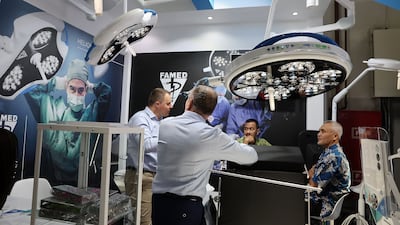
The latest medical devices and diagnostic scanners were on display at the exhibition. Pawan Singh / The National -
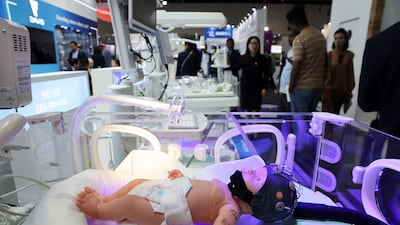
An infant incubator on display at the event. Pawan Singh / The National -
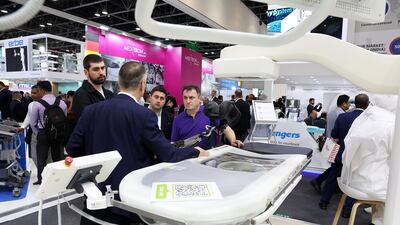
The Arab Health Conference runs until Thursday. Pawan Singh / The National -
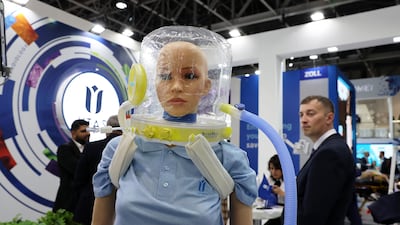
Significant focus has been placed on technology during the conference. Automation will be integral across all future medical operations. Pawan Singh / The National -
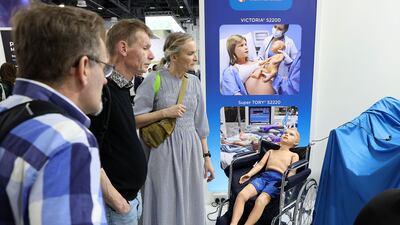
Visitors on the first day of the Arab Health Conference. Pawan Singh / The National -
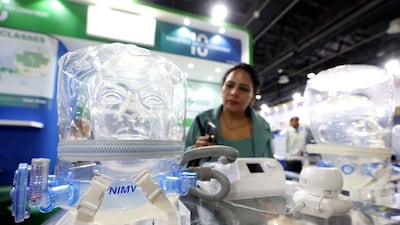
A helmet mask for breathing in an ICU is displayed on the second day of Arab Health 2025 at the conference. Chris Whiteoak / The National -
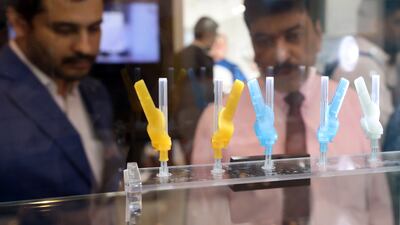
Safety needles on display at the Dubai conference. Chris Whiteoak / The National -
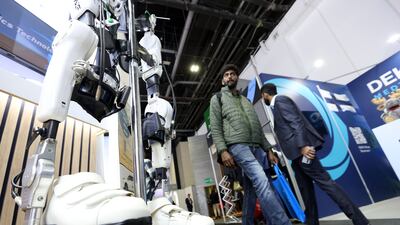
Cyberdyne's active exoskeleton with bioelectrical signals at the Arab Health Conference. Chris Whiteoak / The National



