
“It feels like you're at the wrong end of an air conditioner,” said Franco Malcampo, from Davao City in the Philippines, which is in the grip of a punishing heatwave.
His daughter, who is asthmatic, takes a desk fan to study in a sweltering classroom at school, but it merely blows hot air in her face.
Franco's family have air conditioning at home, which has to be cranked up full from lunchtime. “Our electric bill has gone up,” he says, which squeezes his sales executive salary.
Manila, the sprawling capital of 15 million, hit a record 38.8ºC on April 27. And it was so hot last week that big cats in the zoo were given “bloodsicles” to suck on to avert heat stroke.
from Colombo, Sri Lanka
From Sri Lanka in the west to Thailand and the Philippines in the east, Asia has been subject to a merciless heatwave that has outdoor workers collapsing and residents flocking to malls for relief.
April and May are the hottest months for much of the continent – but this year many countries are breaking records.
“It is extremely hot. I am sweating profusely but I am helpless,” Mahesh Solanki, who sells tea at a stall in Gujarat – where it was 41ºC on Thursday – told The National.
“I have to work to make ends meet.”
In Bangkok, the world's most visited city, the mercury was in the mid-30s, with 70 per cent humidity and daily thunderstorms this week.
Even for Thais used to equatorial conditions, it was “absurdly hot”, one resident told The National.
“Families have flocked to shopping malls to take advantage of their air conditioning,” he said.
“Most people spend very little time outdoors.”
Solutions big and small
Scientists warn these super hot spring and summer temperatures are here to stay – and all of the evidence points to climate change as the cause.
Ramit Debnath, an assistant professor at the University of Cambridge, who studies the climate in the subcontinent, said there was now a consensus that measures needed to be taken to adapt to a warming climate.
“We’re now at the stage where a lot of things have to be viewed from the lens of climate adaptation, especially at the urban and city level,” Prof Debnath said.
At a local level, shelters to offer shade from the sun, reflective building surfaces and increases in urban tree cover can reduce the impact of extreme temperatures.
And at the top level, governments must do far more to meet targets on emissions.
“The stress is on trying to build shading infrastructure and getting the message out that heatwaves are getting real, so prepare yourself,” he said.
As another example of how people can cope with or adapt to heatwaves, he said that some schoolchildren in India were being reminded to drink water every 30 minutes.
“And usual government guidelines are don’t leave the house unless it’s extremely important,” he said.
Other measures, he said, included adding more trees or water features to urban areas, as these can reduce temperatures.
Bob Ward, policy and communications director at the Grantham Research Institute on Climate Change and the Environment, part of the London School of Economics, said painting buildings white to reflect the heat was recommended.
“Heatwaves are growing in intensity and frequency around the world,” Mr Ward said. “They’re particularly dangerous in those regions already prone to extreme heat. Even healthy people are in danger from the temperatures we see.”
India, except in the Himalayan states in the north, has recently witnessed temperatures between 38ºC and 40ºC. The capital, Delhi, sizzled at 42ºC – the hottest day this season – on Tuesday.
The national weather agency warned of intense heatwaves in the state of Rajasthan, Gujarat and Madhya Pradesh this week.
According to a study in The Lancet, the annual number of heat-related deaths among over-65s in India between 2017 and 2021, an average of 31,000, was 55 per cent higher than it was between 2000 and 2004, when the annual figure was 20,000.
At least eight people were killed in April due to heatwaves in the country, according to media reports.

Millions of voters have been casting their ballots in peak temperatures as India holds a seven-phase election for its lower house of parliament.
Last month, Transport Minister Nitin Gadkari fainted while campaigning in western state of Maharashtra.
The Election Commission of India issued an advisory asking voters not to go out during the hottest part of the day, and has made arrangements for drinking water and fans at polling booths.
Bangladesh, which typically receives around 130mm of rain in April, had almost none this year as the heatwave broke the record of 76 years.
At least 10 deaths were reported across the country last month due to heatstroke.
The temperatures last week were hovering at 43ºC, with authorities advising people to not venture out in the sun.
Grantham Institute, London School of Economics
High temperatures have been baking parts of Sri Lanka, with the mercury on the island nation rising to 39ºC, causing the national meteorological department to issue an “extreme caution” heat advisory.
“There have been a few hospital admissions, mainly due to fainting, headaches and dehydration,” Kasun Nupearachchi, a Colombo-based software engineer, told The National.
“I am trying to keep cool by using air conditioning or a fan, staying hydrated with water and planning ahead by cancelling or rescheduling activities for the coolest part of the day.”
-
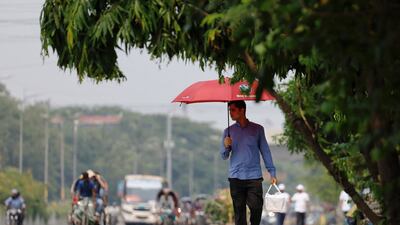
A man uses an umbrella to protect himself from the sun during a heatwave in Dhaka, Bangladesh, on Sunday. Reuters -

A woman uses an electric fan to cool down in Bangkok, Thailand, where temperatures have exceeded 40°C and are expected to keep rising until early May. EPA -
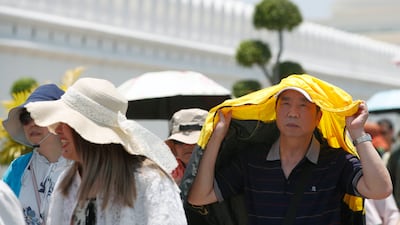
Chinese tourists shield themselves from sunlight during a hot day outside the Grand Palace in Bangkok on Monday. The Thai Meteorological Department has advised the public to avoid prolonged outdoor activities. EPA -
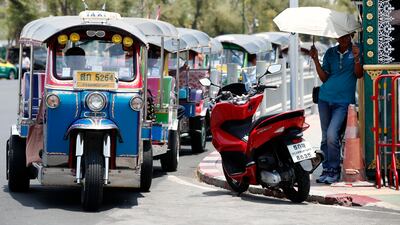
Heat stroke killed 30 people between January and April this year, Thailand's Public Health Ministry said. EPA -
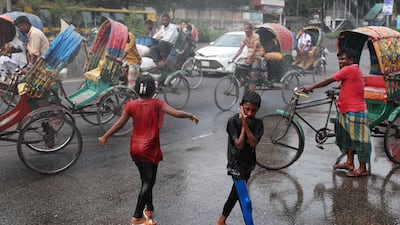
Children cool themselves in water fired from a spray cannon in Dhaka on Sunday. Reuters -
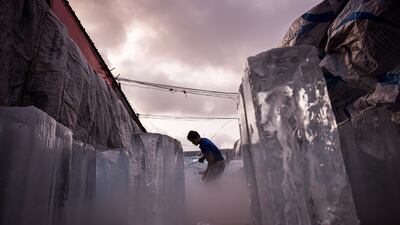
A man unloads blocks of ice from a lorry during a heatwave in Bangkok. Thailand has been bracing for hotter-than-normal days due to the El Nino weather pattern. Bloomberg -

Children jump into a body of water at the Martyred Intellectuals Memorial in Dhaka as they seek respite from the heat. Reuters


El Nino effect looms
Dr Diana Francis, head of the Environmental and Geophysical Sciences Lab at Khalifa University in Abu Dhabi, said the world’s climate is currently being influenced by the El Nino weather system.
During an El Nino phase, warmer surface temperatures in the Pacific Ocean cause the climate to be warmer, while in the opposite La Nina system, they tend to be cooler.
She said that climate change was also partly responsible, as Asia has experienced a trend in which heatwaves are becoming more common and lasting longer.
“Attribution studies have found that this is linked to global warming and, more specifically, to the formation of stagnant heat domes over the continent,” Dr Francis said.
She said many big cities were facing combinations of high temperatures and humidity, exacerbated by the urban heat island effect, making them “uncomfortable to live in without cooling systems”.
Mr Ward warned that there was no respite in sight, with continued increases in temperature inevitable over the coming years.
“Unfortunately it’s locked in for the next two decades, at least. We’re going to see things get worse,” he said.

