


Russia vetoed a UN resolution on Wednesday calling on all nations to prevent a nuclear arms race in outer space.
Sponsored by the US and Japan, the draft received 13 votes in favour, an abstention from China and the Russian veto.
The vote came after Washington accused Moscow of developing space-based capabilities to attack satellites using nuclear weapons.
Russian President Vladimir Putin said the accusations were “unfounded”, and that the US was seeking to “drag [Moscow] into negotiations on their own terms, which are beneficial exclusively” to Washington.
US envoy Linda Thomas-Greenfield told Security Council members that Mr Putin has said publicly that Moscow has no intention of putting nuclear weapons in space.
“And so today's veto begs the question – why?” Ms Thomas-Greenfield asked.
“Why, if you are following the rules, would you not support a resolution that reaffirms them? What could you possibly be hiding? It is baffling and it's a shame.
“This is not the outcome the United States wanted. And given the vote count, it is not the outcome the rest of this council wanted either.”
Russia’s UN envoy Vasily Nebenzya who proposed an amendment to the US-Japan draft stating an arms race in outer space should refer to all kinds of weapons – not just nuclear weapons and other weapons of mass destruction - responded to Ms Thomas Greenfield by asserting that Moscow advocates for a prohibition on the deployment of all types of weapons in outer space, not just weapons of mass destruction.
“But you don't want that. And let me ask you that very same question. Why?” he asked.
The Russian amendment was defeated by a vote of 7 countries in favor, 7 against and one abstention because it failed to get the minimum 9 “yes” votes required for adoption.
This month, Russian deputy foreign minister Sergey Ryabkov said that Moscow and Washington have been in contact over the topic of not positioning nuclear weapons in space.
But a senior US administration official, speaking on condition of anonymity, told reporters on Tuesday that Washington is “in contact in that they [Russia] rejected further discussions of the topic”.
“I don't know if he's referencing something else, but that has been the level of contact that we've had on this topic,” the official said.
The draft resolution called on all countries not to develop or station weapons of mass destruction, such as nuclear arms, in space.
It urged all countries carrying out activities in exploring and using outer space to comply with international law and the UN Charter.
It also affirmed that countries that ratified the 1967 Outer Space Treaty must comply with their obligations not to put in orbit around the Earth “any objects” with weapons of mass destruction, or install them “on celestial bodies, or station such weapons in outer space”.
“To put it simply, there should be no nuclear weapons stationed in space,” warned Britain’s UN representative Barbara Woodward.
“And that is something every council member should agree on.”
She called it “profoundly concerning” that Russia would choose to veto such a resolution.
The 1967 treaty, ratified by 114 countries including the US and Russia, prohibits sending “nuclear weapons or any other kinds of weapons of mass destruction” into orbit or the stationing of “weapons in outer space in any other manner”.
The draft resolution emphasised “the necessity of further measures, including political commitments and legally binding instruments, with appropriate and effective provisions for verification, to prevent an arms race in outer space in all its aspects”.
At the March Security Council meeting when the US-Japan initiative was launched, UN Secretary General Antonio Guterres warned that “geopolitical tensions and mistrust have escalated the risk of nuclear warfare to its highest point in decades”.
He said the movie Oppenheimer, which focused on the man responsible for directing the US atom bomb project during the Second World War, “brought the harsh reality of nuclear doomsday to vivid life for millions around the world”.
“Humanity cannot survive a sequel to Oppenheimer,” Mr Guterres said.
America's new space race with China – in pictures
-
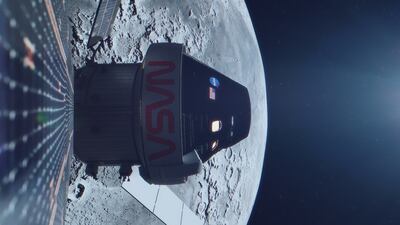
Nasa's Orion spacecraft will carry astronauts to the Moon. It orbited the lunar surface in 2022 as part of an uncrewed test flight. Nasa -
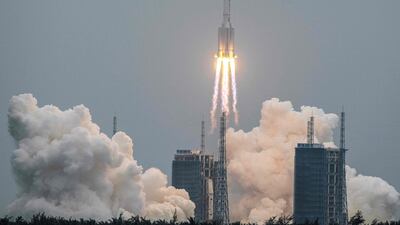
China is developing the Long March 9 rocket, which would be powerful enough for Moon missions. The Long March 5b rocket, pictured, carried China's Tianhe space station module in 2021. AFP -
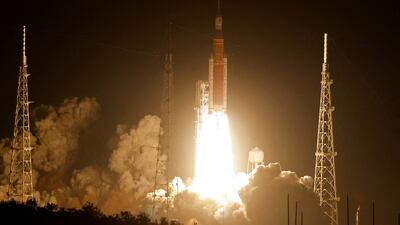
Nasa's Space Launch System, a rocket powerful enough for Moon missions, blasts off on a test flight on November 16, 2022. Reuters -
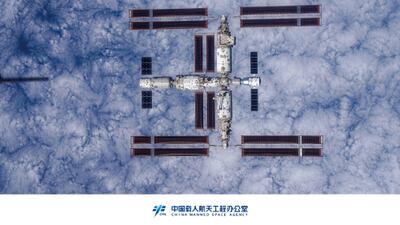
China's Tiangong space station, which is currently hosting astronauts. CMSA -

Chinese astronauts prepare for a flight to the Tiangong space station on May 30, 2023. Getty Images -
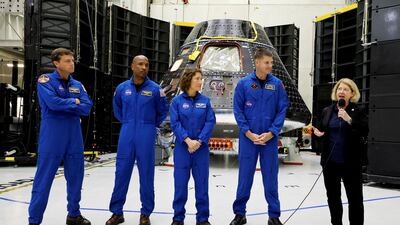
Nasa selected four astronauts to fly around the Moon as part of its Artemis 2 mission, scheduled for 2025. Reuters



