

Iran’s capital is battling a fourth wave of Covid-19 and cases are surging, the country’s Health Ministry said on Monday, as officials sounded the alarm to tighten restrictions during Ramadan later this month.
The announcement comes just two days after the end of Iran's two-week Nowruz holidays and before this year's Ramadan, which is expected to begin around April 12.
The daily seven-day average cases in Iran has crossed 10,000 again with 11,680 new cases on April 4 and 161 deaths.
Despite calls from health officials, many Iranians celebrated the New Year holidays, continued to see family members and travel around the country.
Tehran is “witnessing a 37 per cent surge in the number of hospitalised patients compared to last week,” Nader Tavakkoli, a member of the city’s Covid-19 task force, told semi-official news agency ISNA.
Mr Tavakkoli also raised concerns about employees returning to work and the possibility of a further rise in cases as he says that it may take nearly two weeks before the full impact of the New Year celebrations are seen.
-

A man releases a wish lantern for the traditional Charshanbeh Suri fire festival, in Tehran, Iran, on Tuesday, March 16. EPA -

People gather to mark the traditional Charshanbeh Suri fire festival, in Tehran. It is held on the eve of the last Wednesday before Nowruz, the Iranian New Year, which starts on March 21. EPA -

Women release a wish lantern for the Charshanbeh Suri fire festival, in Iran's capital Tehran. The festival dates from at least 1700 BC, and has been linked to the ancient religion of Zoroastrianism. EPA -
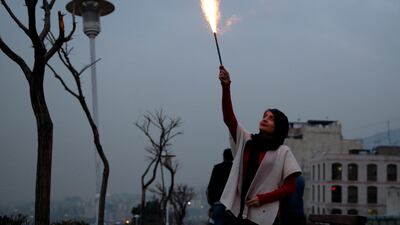
A woman holds a flare aloft during the Charshanbeh Suri fire festival, in Tehran. EPA -
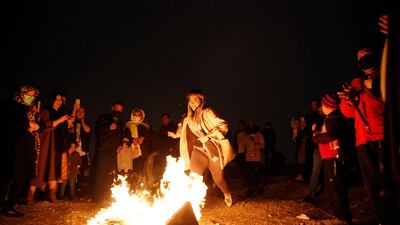
A girl prepares to jump over a fire, as onlookers watch, during Charshanbeh Suri celebrations in Tehran. EPA -

The girl leaps over the flames, during Charshanbeh Suri celebrations in Tehran. Jumping over the fire is considered a purification practice and is accompanied by a song. EPA -
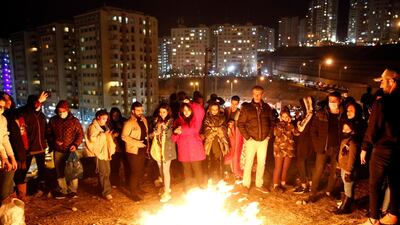
People gather round a bonfire during Charshanbeh Suri fire festival celebrations, in Tehran. EPA -
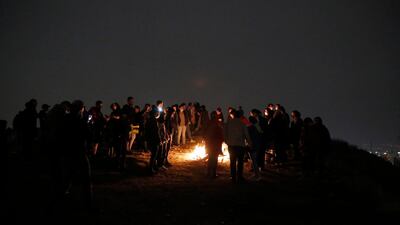
A crowd gathers round a bonfire for Charshanbeh Suri, in Tehran. The festival is also marked by fortune telling and smashing pots for good luck. EPA -

A child holds up a flare, during Charshanbeh Suri celebrations in Tehran, Iran. AFP


“To fully realise the effect of the travels on the spread of the disease, we need to wait 10 more days. What is evident to us, for now, is that the fourth wave of the pandemic has hit Tehran,” he said.
New restrictions will apply in the 10 cities that make up Tehran province.
As of now, those cities have been declared high-risk “red” and “orange” zones.
The new rules will focus on halting the spread of the virus in workplaces and freeing up beds in Tehran’s hard-hit hospitals.
In red zones like the capital, officials said that one third of employees will be required to stay at home in hopes of mitigating further spread.
Tehran hospitals will now be rejecting all elective surgeries and will be converting their facilities into clinics for Covid-19 patients.
Iran’s Health Minister Saeed Namaki took to social media last week to plead with Iranians to listen to health experts.
He wrote that officials have begged, pleaded and called on people not to travel and to use the two weeks of Nowruz to help control the virus and that Iranians should expect tough days ahead.
Deputy Health Minister Iraj Harirchi, who himself had Covid-19 last year, also spoke out.
Mr Harirchi said that the daily death toll would be likely to remain in the triple digits and well above 100 a day, saying that Iran has "1,000 to 1,050 infections in Iran daily, so when there are 123 coronavirus fatalities in one day, that constitutes a 12 per cent mortality rate”.
Iran has been one of the hardest-hit countries during the pandemic.
Initial lockdowns last year were lifted early to alleviate the nation’s economic problems, leading instead to some of the highest infection rates and the highest death toll in the region.
Iran has reported nearly 1.9 million coronavirus cases since February last year and has recorded 63,000 fatalities.
The government has begun its vaccination programme, with 161,000 doses having been administered already and more doses of vaccines expected to arrive in the country through the Covax programme.

