

On first impression, the scene looked like it could have taken place in a refugee camp: a row of white tents, people queuing for food, a clothes distribution point. Volunteers roam around the site offering help, children play in their pyjamas amid the sound of Syrian voices.
But this is not a refugee camp, this is an emergency response site set up by Turkish authorities and visited by The National in Osmaniye, one of the cities badly affected by the strong earthquakes.
Two violent earthquakes hit the country in the early hours of Monday morning, killing more than 5,000 people in southern Turkey and northern Syria.
“Us Syrians, we are going from one destruction to another,” said 38-year-old Tarek from Homs, He is an NGO worker who worked with the organisation to provide emergency response.
The camp is also hosting Turkish people, he said, but a large proportion of the affected families are Syrian.
Turkey is home to a huge Syrian community, hosting the largest number of refugees from the country in the world, 3.6 million according to the UN. Waves of refugees fled the 12-year civil war which saw entire cities destroyed by aerial bombardment, creating one of the worst refugee crises since the Second World War.
-
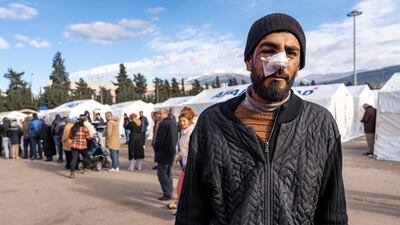
Hamid, from the Syrian town of Homs, was badly injured when his home collapsed during the earthquake. All photos: Matt Kynaston / The National -
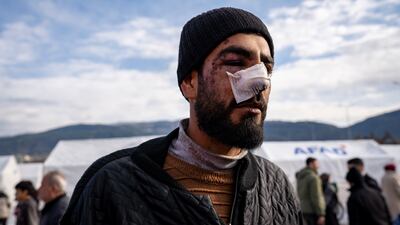
'We were screaming for help until people came to help us and they took us to the hospital,' said Hamid -
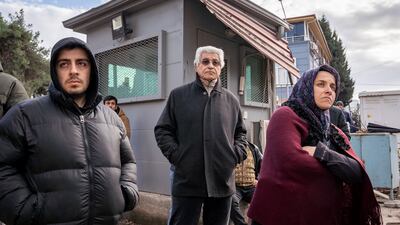
Residents of Turkish city Osmaniyeh watch as rescuers search for survivors -
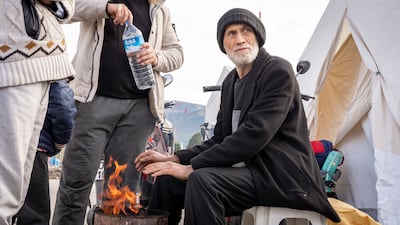
A man warms his hands by a fire at a camp in Osmaniyeh -
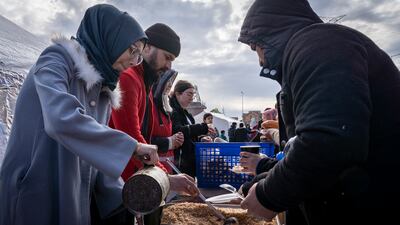
Aid workers serve food to the inhabitants of the camp. The quake killed at least 300 people in Osmaniyeh -
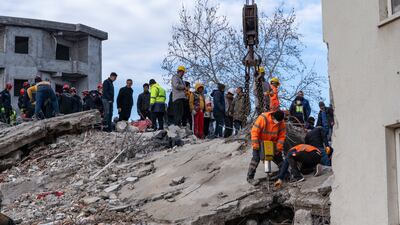
Rescuers search for survivors 36 hours after the quake, in Osmaniyeh -

The camp is in the car park of an adventure park and it is a temporary home to about 2,000 people -
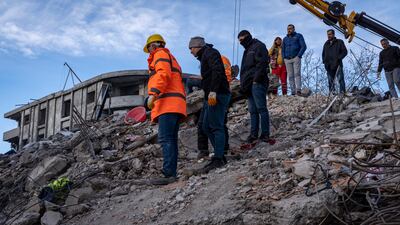
Rescuers search for signs of life at the site of a collapsed building -
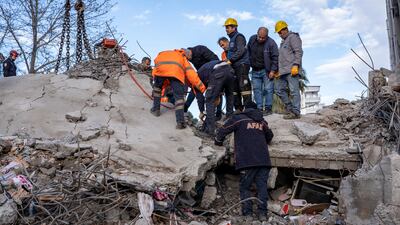
Rescuers carefully work through the rubble in hopes of finding survivors -

Aid workers serve tea to survivors


“We lived the same thing in Syria, but it is even worse than the civil war because we lost everything in just one second”, said Abdel Hamid, 30, originally from Damascus.
He was in his flat with his family when the ground started to shake. The whole building collapsed, but his family survived. Others were not as lucky. “I know several people who lost their lives, it was terrible,” he said.
Osmaniye is about 100km from the epicentre of the 7.8 magnitude earthquake, which was followed by a similarly violent aftershock.
Both quakes destroyed at least 6,000 buildings, many of them collapsing in the middle of the night, or later in the day as rescue workers struggled to save people stranded in the rubble. The death toll is feared to be as high as 20,000, according to the WHO.
“We're going through the same uncertainty, we’ve lived in Syria,” said Anas, 38, originally from Damascus.
He said he was sleeping when the explosion happened, when he and his family “woke up terrorised”.
Their house did not collapse completely, but the cracks in the walls pose a serious hazard, which makes it unsafe for them to go back.
They have been staying in the emergency camp since then. Anas lost several relatives in the earthquake. As a Syrian who left his country in 2013, it is not the first time he has experienced grief and disaster.
“Whether in Syria or here with the earthquake, it is the same pain,” he said in a sad, calm voice, pausing between replies.
“It is the same feeling that there is only a moment that separates us from death.”

Hamid, a refugee from Homs, lost his house in the catastrophe, which collapsed under his feet. He and his family were injured and had to rushed to the hospital, which he said was crowded with others injured from the disaster.
For the young man, who was left with a black eye and a huge bandage on his nose, the event also resonated with the traumatic experiences he lived in Syria.
“We already lived through a war in Homs, and we were bombed”.
“But hamdellah we are ok”, he added, grateful that he and his relatives were spared.
The emergency camp is now home to 2,000 displaced people who have lost their homes following the catastrophe. It was set up in less than a day in the car park of an amusement centre. Some of the displaced children are still hammering pegs into the tarmac.
One of the volunteers of the Red Crescent told The National that the death toll in Osmanie was at least 300 people, and could rise, as recovery teams are still searching for bodies under the rubble of collapsed buildings.
After 36 hours, chances are slim of finding any survivors, and mostly dead bodies are pulled out of the rubble.
The volunteer added that each city has set up its own camps, and it is only one of the many now in Turkey.

