

Residents of more than 40 towns in north-west Syria face an increased risk of cholera and other diseases after an NGO-run water project was shut down.
Water pumps run with assistance from Goal, an international humanitarian response agency, were switched off at the end of October, creating water shortages in 42 towns and villages in Idlib province, as well as 12 refugee camps which used pumps in nearby towns. Pumps aissted by Goal in other areas remain in use.
While some residents can afford to buy water supplies, the majority have been forced to go without, officials say.
Firas Dannoun, director of the Armanaz city council, said Goal had informed them five months in advance that the project might have to be shut down if a donor could not be found.
“We in the local council cannot secure water for the population without the support of charitable organisations,” he said.
Goal, which also provides food assistance as part of its humanitarian aid in northern Syria, “supported four water units in Idlib province to help regularly deliver clean running water to a catchment population of one million-plus people” in more than 100 communities, its website said.

Public services in north-west Syria have been severely affected by the civil war that broke out in 2011. The largely opposition-held area is home to millions of people displaced by the conflict, many of whom live in camps.
Mr Dannoun said the water shortage could force people to risk illness by neglecting hygiene and safety precautions — fears that were echoed by Hussam Qara Muhammed, deputy director of the Idlib Health Directorate.
“The people will be forced to search for alternative water sources, which may be unhealthy and improper, and this causes an increase in the spread of water infections that belong to a group of diseases,” Dr Muhammed told The National.
“Foremost among them is the cholera that is currently afflicting the region.”
He added that personal hygiene could also suffer, increasing skin diseases such as scabies and lice, in addition to the spread of Covid infections.
Cholera, a gastrointestinal illness caused by consuming food or water infected with the bacteria Vibrio cholerae, can lead to death in severe cases if left untreated.
The UN Office for the Co-ordination of Humanitarian Affairs says that more than 17,400 suspected cholera cases have been reported in the Idlib and Aleppo governorates since August. Twelve people have died.
Both the country’s health ministry and the UN believe the source of the outbreak is linked to people drinking unsafe water from the Euphrates River and using contaminated water to irrigate crops.
Khaled Al Othman, who has lived in a camp in western Idlib after fleeing his home in neighbouring Aleppo province, said residents had been living in fear after cholera cases were detected in the area.

“People began to go for tests to ensure that there is no infection, especially the elderly. There are concerns because of the spread of sewage water among the tents and because of the watering of some vegetables with sewage water,” Mr Al Othman The National.
“I have seen one of the displaced people here in the camp after he contracted cholera: he did not leave his tent for about 12 days because of the pain, his inability to breathe and body spasms.
“This prompted us to take more preventive measures, but the health conditions in the camps are not appropriate.”
There are also fears that the lack of water will force displaced people in the camps to move once again.
According to the latest statistics from the Response Co-ordinators team in northern Syria, about 2.1 million of the more than four million people living in opposition-held areas have been displaced.
director of Al Kazia camp in Idlib
Nizar Abu Ammar, the director of Al Kazia camp near Armanaz, said residents were suffering after the NGO-supported water station was shut down.
“After the support for this station was cut off, people have difficulty in procuring water, and most of the camp residents do not have the financial ability to buy water through tankers,” Mr Abu Ammar said.
Most of the displaced families have no income, scraping by on savings. Those that are able to get jobs earn daily wages of between 30 and 50 Turkish lira — the currency adopted in the opposition-held area since 2020. A 5,000-litre tanker, which costs 120 lira ($6.40), is unaffordable for many.
“There are 75 families living in Al Kazia camp, and these families, after the interruption of the water-pumping support, now have to travel 2km to meet their water needs, if they can afford it,” Mr Abu Ammar said.
“Some of the camp's residents used to depend on transporting water via motorcycle, but after petrol was cut off in the Idlib region, they could only transport water by walking long distances. Note that each family needs at least 500 litres of water per day.”
Syrian farming at risk from low water levels in the Euphrates River — in pictures
-
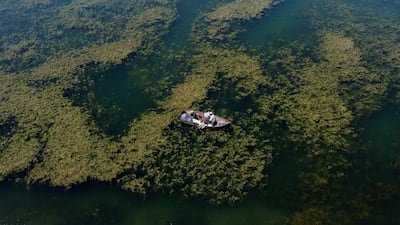
Fishermen in the Euphrates river, in western Raqqa, Syria. All photos: AFP -
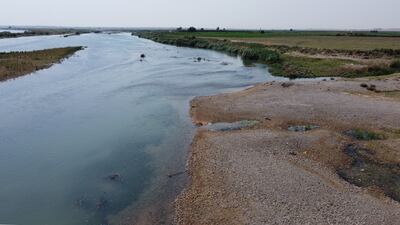
The Euphrates is the longest river in Syria and one of the most important in the Middle East. -
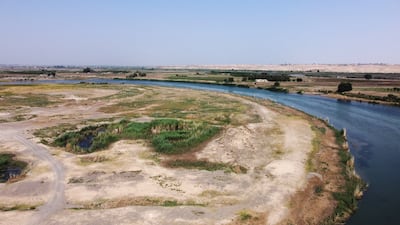
It flows from Turkey through Syria and Iraq, joining the Tigris river in Shatt Al Arab. -

In 1987, Turkey and Syria signed an agreement that the former would send 500 cubic metres of water per second down the Euphrates river. -

The volume is now down to 200 cubic metres per second. -
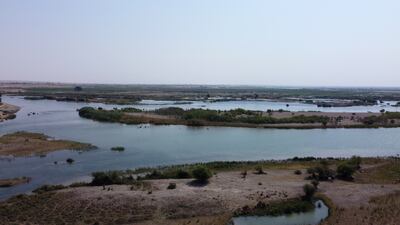
Low water levels in the river are largely being caused by rising temperatures, low rainfall and drought. -
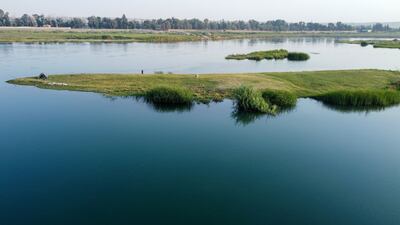
The decrease in the volume of water affects the supply for drinking water, agriculture and electricity being produced by hydroelectric dams. -

More than five million people in the country depend on the Euphrates river. -
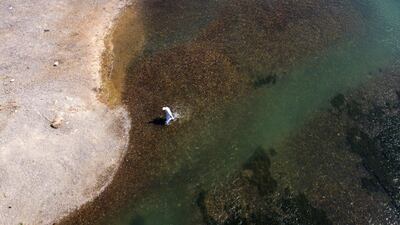
A man walks on the banks of the Euphrates.



