The 'Free Woman' square in the Kurdish-majority city of Kobane, northern Syria. AFP

Turkey could use ground forces in Syria 'in days'


  • English
  • Arabic

Turkish troops could mount a ground invasion of Kurdish-administered parts of northern Syria within days, officials said on Monday.

President Recep Tayyip Erdogan has warned on several occasions this year that a new offensive could be forthcoming, but despite a massive aerial attack beginning on November 20, a ground invasion has yet to happen.

Reuters spoke to a number of Turkish government officials, who said a decision could be imminent on whether to move forces deeper into Syria. Some districts are already controlled by Turkish troops and allied Islamist militias.

“The Turkish Armed Forces need just a few days to become almost fully ready,” one Turkish official said. “It depends only on the President giving the word.”

Turkish warplanes and drones again bombed Kurdish positions overnight in northern Syria, striking a Kurdish militia group in Aleppo governorate and killing Kurdish separatists as well as an unconfirmed number of Syrian soldiers.

Reports varied, but according to the Syrian Observatory for Human Rights, a war monitor, five Syrian soldiers were killed overnight. Other reports suggested at least one Syrian soldier had been killed

Turkish state media said on Monday that 13 members of the Kurdistan Worker's Party, or PKK — one of the main groups targeted in the offensive — have been killed since Sunday morning.

The Syrian government has yet to comment, although the state-linked Sana news agency characterised the attacks as “Turkish aggression”.

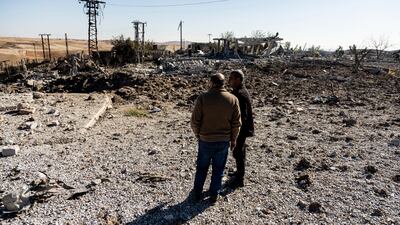
  • People inspect the damage after Turkish air strikes hit a power station in Taql Baql, Syria. AP
    People inspect the damage after Turkish air strikes hit a power station in Taql Baql, Syria. AP
  • A fire rages at an oil installation hit by a Turkish air strike in Tal Awdah, in north-eastern Syria's Hasakah province. AFP
    A fire rages at an oil installation hit by a Turkish air strike in Tal Awdah, in north-eastern Syria's Hasakah province. AFP
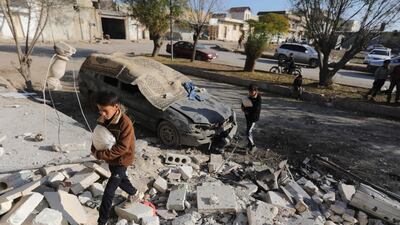
  • Residents walk over the rubble of a building destroyed by a rocket in the town of Azaz, Aleppo province. AFP
    Residents walk over the rubble of a building destroyed by a rocket in the town of Azaz, Aleppo province. AFP
  • People look at a site damaged by Turkish air strikes in Taql Baql, Hasakah province. AP
    People look at a site damaged by Turkish air strikes in Taql Baql, Hasakah province. AP
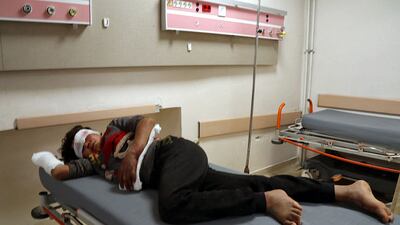
  • A person wounded in a rocket attack in the town of Azaz receives medical care at a clinic. AFP
    A person wounded in a rocket attack in the town of Azaz receives medical care at a clinic. AFP
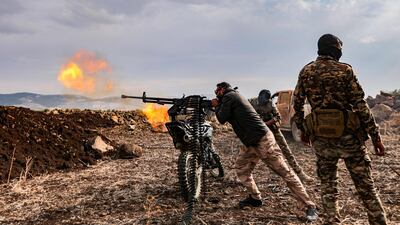
  • A Syrian fighter fires a machinegun mounted on the back of motorcycle during military drills by the Turkish-backed Suleiman Shah Division in the opposition-held Afrin region of northern Syria. AFP
    A Syrian fighter fires a machinegun mounted on the back of motorcycle during military drills by the Turkish-backed Suleiman Shah Division in the opposition-held Afrin region of northern Syria. AFP
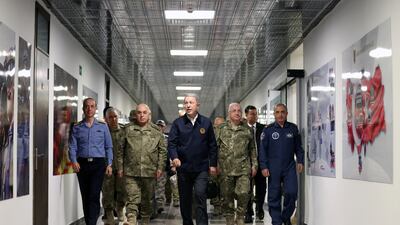
  • Turkey's Defence Minister Hulusi Akar visits the Land Forces Operation Centre, in Ankara. Reuters
    Turkey's Defence Minister Hulusi Akar visits the Land Forces Operation Centre, in Ankara. Reuters
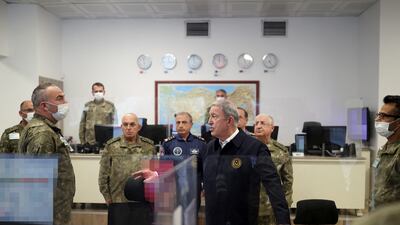
  • Mr Akar is briefed on the operations. Reuters
    Mr Akar is briefed on the operations. Reuters
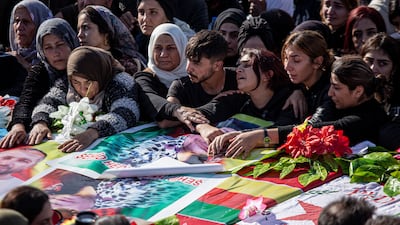
  • Kurds attend a funeral of people killed in Turkish air strikes in the village of Al Malikiyah, northern Syria. AP
    Kurds attend a funeral of people killed in Turkish air strikes in the village of Al Malikiyah, northern Syria. AP
  • Women mourn during the funeral service. AP
    Women mourn during the funeral service. AP
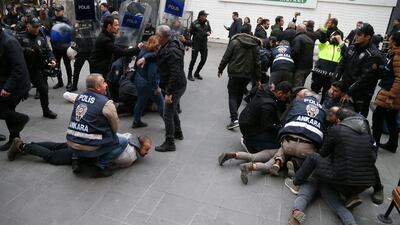
  • Police arrest members of the Peoples' Democratic Party (HDP) during a protest against the Turkish Armed Forces' (TSK) air campaign in the northern regions of Iraq and Syria, in Ankara. AFP
    Police arrest members of the Peoples' Democratic Party (HDP) during a protest against the Turkish Armed Forces' (TSK) air campaign in the northern regions of Iraq and Syria, in Ankara. AFP

Since Turkish attacks began on November 20, nearly 70 people have died in northern Syria, SOHR said.

Mr Erdogan promised that ground forces would be deployed after a November 13 bombing in Istanbul killed six, including two children.

Mr Erdogan blamed the attack on Kurdish militias in Syria, including the US-backed Syrian Democratic Forces, in addition to the separatist PKK, which operates mainly in Turkey and northern Iraq.

Both groups denied carrying out the Istanbul bombing, but Turkey has launched its fourth large-scale military operation to punish Kurdish militias in Syria, who rose to prominence by winning a number of victories against ISIS between 2014 and 2019, gaining territory in the process.

The SDF now control swathes of eastern and north-eastern Syria, but Turkish-backed Islamist militias and ground forces have sought to create a buffer zone along the border, denying Kurdish groups a “border sanctuary” by controlling the districts of Aleppo, Raqqa and Hasakah.

Amid sporadic Turkish offensives, the SDF has sought to co-ordinate more closely with the government of Bashar Al Assad, having warned the US that they would have little choice in the event of a Turkish invasion.

It's unclear whether the Syrian soldiers killed on Sunday night were co-located with the SDF, but the two sides have co-ordinated in the past, working together against Al Qaeda-linked rebel groups in Aleppo in 2016.

In June, SDF commander Mazloum Abdi told Reuters that his forces would be willing to work with the Syrian army to fend off a Turkish offensive, saying that Damascus could “defend Syrian territory using air defence systems against Turkish planes”.

Last week, the Syrian government condemned a Turkish air strike it said had killed an undisclosed number of Syrian troops.

Mr Al Assad firmly opposes any Turkish or US presence on Syrian soil, including around 900 US advisers working with the Kurds in eastern Syria.

But neither Mr Al Assad — whose forces are weakened by over a decade of war — nor the SDF, which has no air force, stand much chance of fending off a major Turkish assault, backed by the third largest air force in Europe, after Russia and France.

Turkey is capable of launching scores of air strikes in a single wave, striking nearly 100 targets in the first weekend of bombing.

Protesters in the Kurdish-administered Syrian city of Qamishli also chanted in favour of the resistance in “Rojava” — the name Kurds in Syria given to the area they administer.

“The message that we want to convey to the world is that we are victims of eradication,” said Salah el-Dine Hamou, 55.

“How long will we continue to die while other countries watch?”

Some protesters on Sunday carried Kurdish flags alongside photos of PKK leader Abdullah Ocalan — jailed in Turkey since 1999 — and shouted slogans against Turkish President Recep Tayyip Erdogan.


Director: Laxman Utekar

Cast: Vicky Kaushal, Akshaye Khanna, Diana Penty, Vineet Kumar Singh, Rashmika Mandanna

Rating: 1/5

How to protect yourself when air quality drops

Install an air filter in your home.

Close your windows and turn on the AC.

Shower or bath after being outside.

Wear a face mask.

Stay indoors when conditions are particularly poor.

If driving, turn your engine off when stationary.

Benefits of first-time home buyers' scheme
  • Priority access to new homes from participating developers
  • Discounts on sales price of off-plan units
  • Flexible payment plans from developers
  • Mortgages with better interest rates, faster approval times and reduced fees
  • DLD registration fee can be paid through banks or credit cards at zero interest rates
The specs

Engine: 2.0-litre 4cyl turbo

Power: 261hp at 5,500rpm

Torque: 405Nm at 1,750-3,500rpm

Transmission: 9-speed auto

Fuel consumption: 6.9L/100km

On sale: Now

Price: From Dh117,059

RACE CARD

6.30pm Maiden (TB) Dh82.500 (Dirt) 1,400m

7.05pm Handicap (TB) Dh87,500 (D) 1,400m

7.40pm Handicap (TB) Dh92,500 (Turf) 2,410m

8.15pm Handicap (TB) Dh105,000 (D) 1,900m

8.50pm UAE 2000 Guineas Trial (TB) Conditions Dh183,650 (D) 1,600m

9.25pm Dubai Trophy (TB) Conditions Dh183,650 (T) 1,200m

10pm Handicap (TB) Dh102,500 (T) 1,400m

'HIJRAH%3A%20IN%20THE%20FOOTSTEPS%20OF%20THE%20PROPHET'
%3Cp%3E%3Cstrong%3EEdited%20by%3A%3C%2Fstrong%3E%20Idries%20Trevathan%3Cbr%3E%3Cstrong%3EPages%3A%3C%2Fstrong%3E%20240%3Cbr%3E%3Cstrong%3EPublisher%3A%3C%2Fstrong%3E%20Hirmer%20Publishers%3Cbr%3E%3Cstrong%3EAvailable%3A%3C%2Fstrong%3E%20Now%3C%2Fp%3E%0A
Mia Man’s tips for fermentation

- Start with a simple recipe such as yogurt or sauerkraut

- Keep your hands and kitchen tools clean. Sanitize knives, cutting boards, tongs and storage jars with boiling water before you start.

- Mold is bad: the colour pink is a sign of mold. If yogurt turns pink as it ferments, you need to discard it and start again. For kraut, if you remove the top leaves and see any sign of mold, you should discard the batch.

- Always use clean, closed, airtight lids and containers such as mason jars when fermenting yogurt and kraut. Keep the lid closed to prevent insects and contaminants from getting in.


It's up to you to go green

Nils El Accad, chief executive and owner of Organic Foods and Café, says going green is about “lifestyle and attitude” rather than a “money change”; people need to plan ahead to fill water bottles in advance and take their own bags to the supermarket, he says.

“People always want someone else to do the work; it doesn’t work like that,” he adds. “The first step: you have to consciously make that decision and change.”

When he gets a takeaway, says Mr El Accad, he takes his own glass jars instead of accepting disposable aluminium containers, paper napkins and plastic tubs, cutlery and bags from restaurants.

He also plants his own crops and herbs at home and at the Sheikh Zayed store, from basil and rosemary to beans, squashes and papayas. “If you’re going to water anything, better it be tomatoes and cucumbers, something edible, than grass,” he says.

“All this throwaway plastic - cups, bottles, forks - has to go first,” says Mr El Accad, who has banned all disposable straws, whether plastic or even paper, from the café chain.

One of the latest changes he has implemented at his stores is to offer refills of liquid laundry detergent, to save plastic. The two brands Organic Foods stocks, Organic Larder and Sonnett, are both “triple-certified - you could eat the product”.  

The Organic Larder detergent will soon be delivered in 200-litre metal oil drums before being decanted into 20-litre containers in-store.

Customers can refill their bottles at least 30 times before they start to degrade, he says. Organic Larder costs Dh35.75 for one litre and Dh62 for 2.75 litres and refills will cost 15 to 20 per cent less, Mr El Accad says.

But while there are savings to be had, going green tends to come with upfront costs and extra work and planning. Are we ready to refill bottles rather than throw them away? “You have to change,” says Mr El Accad. “I can only make it available.”

DEADPOOL & WOLVERINE

Starring: Ryan Reynolds, Hugh Jackman, Emma Corrin

Director: Shawn Levy

Rating: 3/5

Company Fact Box

Company name/date started: Abwaab Technologies / September 2019

Founders: Hamdi Tabbaa, co-founder and CEO. Hussein Alsarabi, co-founder and CTO

Based: Amman, Jordan

Sector: Education Technology

Size (employees/revenue): Total team size: 65. Full-time employees: 25. Revenue undisclosed

Stage: early-stage startup 

Investors: Adam Tech Ventures, Endure Capital, Equitrust, the World Bank-backed Innovative Startups SMEs Fund, a London investment fund, a number of former and current executives from Uber and Netflix, among others.

Mercer, the investment consulting arm of US services company Marsh & McLennan, expects its wealth division to at least double its assets under management (AUM) in the Middle East as wealth in the region continues to grow despite economic headwinds, a company official said.

Mercer Wealth, which globally has $160 billion in AUM, plans to boost its AUM in the region to $2-$3bn in the next 2-3 years from the present $1bn, said Yasir AbuShaban, a Dubai-based principal with Mercer Wealth.

Within the next two to three years, we are looking at reaching $2 to $3 billion as a conservative estimate and we do see an opportunity to do so,” said Mr AbuShaban.

Mercer does not directly make investments, but allocates clients’ money they have discretion to, to professional asset managers. They also provide advice to clients.

“We have buying power. We can negotiate on their (client’s) behalf with asset managers to provide them lower fees than they otherwise would have to get on their own,” he added.

Mercer Wealth’s clients include sovereign wealth funds, family offices, and insurance companies among others.

From its office in Dubai, Mercer also looks after Africa, India and Turkey, where they also see opportunity for growth.

Wealth creation in Middle East and Africa (MEA) grew 8.5 per cent to $8.1 trillion last year from $7.5tn in 2015, higher than last year’s global average of 6 per cent and the second-highest growth in a region after Asia-Pacific which grew 9.9 per cent, according to consultancy Boston Consulting Group (BCG). In the region, where wealth grew just 1.9 per cent in 2015 compared with 2014, a pickup in oil prices has helped in wealth generation.

BCG is forecasting MEA wealth will rise to $12tn by 2021, growing at an annual average of 8 per cent.

Drivers of wealth generation in the region will be split evenly between new wealth creation and growth of performance of existing assets, according to BCG.

Another general trend in the region is clients’ looking for a comprehensive approach to investing, according to Mr AbuShaban.

“Institutional investors or some of the families are seeing a slowdown in the available capital they have to invest and in that sense they are looking at optimizing the way they manage their portfolios and making sure they are not investing haphazardly and different parts of their investment are working together,” said Mr AbuShaban.

Some clients also have a higher appetite for risk, given the low interest-rate environment that does not provide enough yield for some institutional investors. These clients are keen to invest in illiquid assets, such as private equity and infrastructure.

“What we have seen is a desire for higher returns in what has been a low-return environment specifically in various fixed income or bonds,” he said.

“In this environment, we have seen a de facto increase in the risk that clients are taking in things like illiquid investments, private equity investments, infrastructure and private debt, those kind of investments were higher illiquidity results in incrementally higher returns.”

The Abu Dhabi Investment Authority, one of the largest sovereign wealth funds, said in its 2016 report that has gradually increased its exposure in direct private equity and private credit transactions, mainly in Asian markets and especially in China and India. The authority’s private equity department focused on structured equities owing to “their defensive characteristics.”

Updated: November 28, 2022, 1:25 PM