US forces patrol the countryside in the north-eastern Hassakeh province of Syria, near the Turkish border. AFP

US forces in Syria and Iraq on ‘high alert’ for attacks by Iran-backed groups


Mina Aldroubi
  • English
  • Arabic

US troops in Iraq and Syria are on “high alert” for attacks by Iran-backed groups, a senior US commander said on Thursday.

US President Joe Biden authorised military strikes on Tuesday against bases the Defence Department said were being used by Iran-aligned groups to attack the US-led coalition in Syria.

The strikes in oil-rich Deir Ezzor province "targeted infrastructure facilities used by groups affiliated with Iran's Islamic Revolutionary Guard Corps".

The operation was carried out in response to an attack on August 15 on a compound used by coalition and US-backed Syrian opposition fighters.

A Central Command commander, Gen Michael Eric Corella, told Sky News Arabia that US forces in Iraq and Syria were “closely monitoring” the situation.

“We have the full range of capabilities to mitigate threats across the region, and have full confidence in protecting our forces and coalition partners from attacks,” he said.

His comments came after three members of the US military were injured on Wednesday in rocket attacks on two sites in Syria where American troops are housed, Centcom said.

It said rockets landed on its Conoco and Green Village sites in north-east Syria, which led to a US response by attack helicopters.

The American attack destroyed three cars and equipment that were used to launch some of the missiles, Centcom said.

Washington believes that at least three Iran-backed militants were killed.

The National contacted Centcom for comment about the matter.

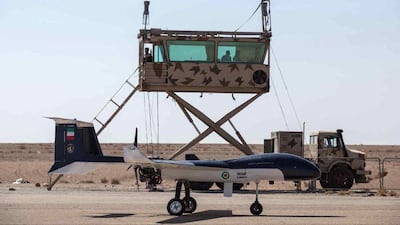
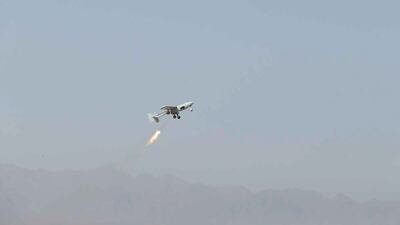
  • A drone during a military exercise in Iran. Reuters
    A drone during a military exercise in Iran. Reuters
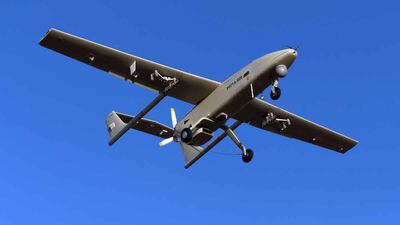
  • A military unmanned aerial vehicle during a two-day drone drill. AFP
    A military unmanned aerial vehicle during a two-day drone drill. AFP
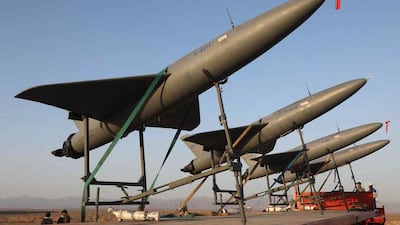
  • Suicide (kamikaze) drones. AFP
    Suicide (kamikaze) drones. AFP
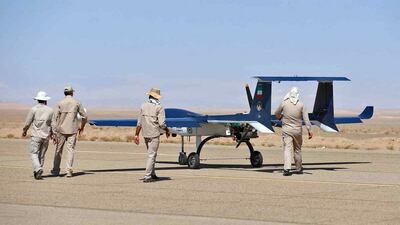
  • Technicians approach a military unmanned aerial vehicle on a runway. AFP
    Technicians approach a military unmanned aerial vehicle on a runway. AFP
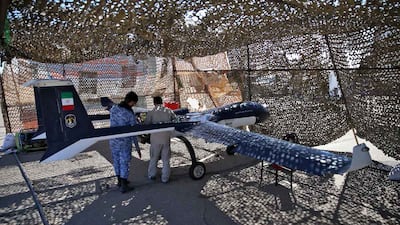
  • Technicians inspect a military vehicle in a camouflage enclosure. AFP
    Technicians inspect a military vehicle in a camouflage enclosure. AFP
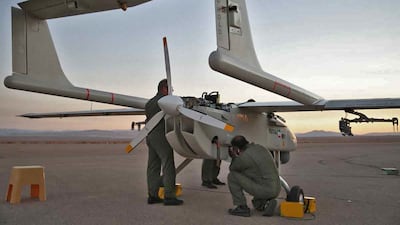
  • Technicians check an aerial vehicle. AFP
    Technicians check an aerial vehicle. AFP
  • Technicians observe an aerial vehicle's performance. AFP
    Technicians observe an aerial vehicle's performance. AFP
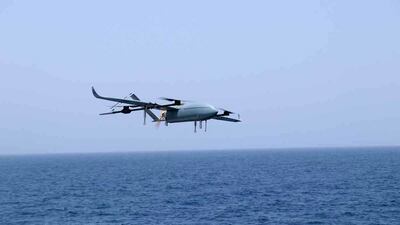
  • A vertical take-off and landing vehicle. AFP
    A vertical take-off and landing vehicle. AFP
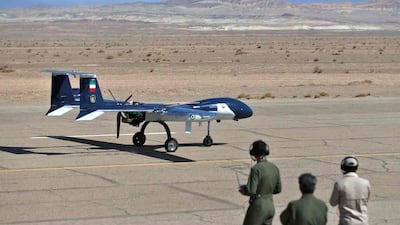
  • A military unmanned aerial vehicle prepares to land. AFP
    A military unmanned aerial vehicle prepares to land. AFP
  • The Iranian Army conducted a two-day military drone drill in various part of Iran. EPA
    The Iranian Army conducted a two-day military drone drill in various part of Iran. EPA
  • A military drone in full flight. EPA
    A military drone in full flight. EPA
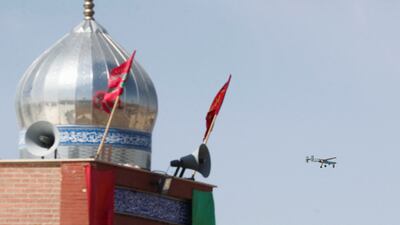
  • A drone flies above Iran's skyline. Reuters
    A drone flies above Iran's skyline. Reuters
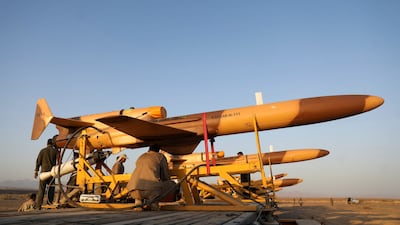
  • Mechanics work on drones ahead of their flight. Reuters
    Mechanics work on drones ahead of their flight. Reuters
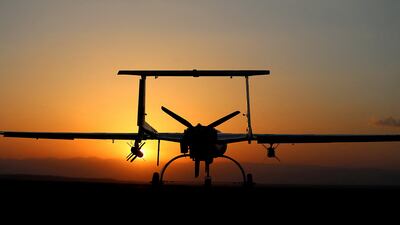
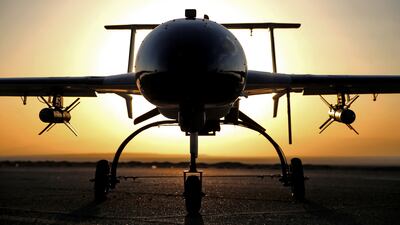
  • A drone at sunset. Reuters
    A drone at sunset. Reuters
  • A drone prepares for takeoff. Reuters
    A drone prepares for takeoff. Reuters

Gen Corella said Washington did not "seek a conflict with Iran, but we will continue to take the necessary measures to protect and defend our people".

The exchange of strikes is latest in the escalation of events in Syria, where 900 American troops are stationed, the majority of them in the east.

US forces were sent to Syria during the administration of president Barack Obama’s campaign against ISIS, teaming up with the Kurdish-led Syrian Democratic Forces.

But Iran-backed militias established a foothold in Syria while fighting in support of President Bashar Al Assad during the civil war that began in 2011.

An IRGC general "on a mission in Syria as a military adviser" was killed on Sunday, Iranian state media reported.

The reports did not say how he was killed and described him as a "defender of the sanctuary", a term used for those who work on behalf of Iran in Syria or Iraq.

Tehran has said it stationed its forces in Syria at the invitation of Damascus and they are only there as advisers.


Ten tax points to be aware of in 2026

1. Domestic VAT refund amendments: request your refund within five years

If a business does not apply for the refund on time, they lose their credit.

2. E-invoicing in the UAE

Businesses should continue preparing for the implementation of e-invoicing in the UAE, with 2026 a preparation and transition period ahead of phased mandatory adoption. 

3. More tax audits

Tax authorities are increasingly using data already available across multiple filings to identify audit risks. 

4. More beneficial VAT and excise tax penalty regime

Tax disputes are expected to become more frequent and more structured, with clearer administrative objection and appeal processes. The UAE has adopted a new penalty regime for VAT and excise disputes, which now mirrors the penalty regime for corporate tax.

5. Greater emphasis on statutory audit

There is a greater need for the accuracy of financial statements. The International Financial Reporting Standards standards need to be strictly adhered to and, as a result, the quality of the audits will need to increase.

6. Further transfer pricing enforcement

Transfer pricing enforcement, which refers to the practice of establishing prices for internal transactions between related entities, is expected to broaden in scope. The UAE will shortly open the possibility to negotiate advance pricing agreements, or essentially rulings for transfer pricing purposes. 

7. Limited time periods for audits

Recent amendments also introduce a default five-year limitation period for tax audits and assessments, subject to specific statutory exceptions. While the standard audit and assessment period is five years, this may be extended to up to 15 years in cases involving fraud or tax evasion. 

8. Pillar 2 implementation 

Many multinational groups will begin to feel the practical effect of the Domestic Minimum Top-Up Tax (DMTT), the UAE's implementation of the OECD’s global minimum tax under Pillar 2. While the rules apply for financial years starting on or after January 1, 2025, it is 2026 that marks the transition to an operational phase.

9. Reduced compliance obligations for imported goods and services

Businesses that apply the reverse-charge mechanism for VAT purposes in the UAE may benefit from reduced compliance obligations. 

10. Substance and CbC reporting focus

Tax authorities are expected to continue strengthening the enforcement of economic substance and Country-by-Country (CbC) reporting frameworks. In the UAE, these regimes are increasingly being used as risk-assessment tools, providing tax authorities with a comprehensive view of multinational groups’ global footprints and enabling them to assess whether profits are aligned with real economic activity. 

Contributed by Thomas Vanhee and Hend Rashwan, Aurifer

THE BIO:

Favourite holiday destination: Thailand. I go every year and I’m obsessed with the fitness camps there.

Favourite book: Born to Run by Christopher McDougall. It’s an amazing story about barefoot running.

Favourite film: A League of their Own. I used to love watching it in my granny’s house when I was seven.

Personal motto: Believe it and you can achieve it.

Results:

2.15pm: Handicap (PA) Dh60,000 1,200m.

Winner: AZ Dhabyan, Adam McLean (jockey), Saleha Al Ghurair (trainer).

2.45pm: Maiden (PA) Dh60,000 1,200m.

Winner: Ashton Tourettes, Sam Hitchcott, Ibrahim Aseel.

3.15pm: Conditions (PA) Dh60,000 2,000m.

Winner: Hareer Al Reef, Gerald Avranche, Abdallah Al Hammadi.

3.45pm: Maiden (PA) Dh60,000 1,700m.

Winner: Kenz Al Reef, Gerald Avranche, Abdallah Al Hammadi.

4.15pm: Sheikh Ahmed bin Rashid Al Maktoum Cup (TB) Dh 200,000 1,700m.

Winner: Mystique Moon, Sam Hitchcott, Doug Watson.

4.45pm: The Crown Prince Of Sharjah Cup Prestige (PA) Dh200,000 1,200m.

Winner: ES Ajeeb, Sam Hitchcott, Ibrahim Aseel.

RESULT

Wolves 1 (Traore 67')

Tottenham 2 (Moura 8', Vertonghen 90 1')

Man of the Match: Adama Traore (Wolves)

WHAT IS GRAPHENE?

It was discovered in 2004, when Russian-born Manchester scientists Andrei Geim and Kostya Novoselov were experimenting with sticky tape and graphite, the material used as lead in pencils.

Placing the tape on the graphite and peeling it, they managed to rip off thin flakes of carbon. In the beginning they got flakes consisting of many layers of graphene. But when they repeated the process many times, the flakes got thinner.

By separating the graphite fragments repeatedly, they managed to create flakes that were just one atom thick. Their experiment led to graphene being isolated for the very first time.

In 2010, Geim and Novoselov were awarded the Nobel Prize for Physics. 

The specs: 2019 Audi A7 Sportback

Price, base: Dh315,000

Engine: 3.0-litre V6

Transmission: Seven-speed automatic

Power: 335hp @ 5,000rpm

Torque: 500Nm @ 1,370rpm

Fuel economy 5.9L / 100km

Mercer, the investment consulting arm of US services company Marsh & McLennan, expects its wealth division to at least double its assets under management (AUM) in the Middle East as wealth in the region continues to grow despite economic headwinds, a company official said.

Mercer Wealth, which globally has $160 billion in AUM, plans to boost its AUM in the region to $2-$3bn in the next 2-3 years from the present $1bn, said Yasir AbuShaban, a Dubai-based principal with Mercer Wealth.

Within the next two to three years, we are looking at reaching $2 to $3 billion as a conservative estimate and we do see an opportunity to do so,” said Mr AbuShaban.

Mercer does not directly make investments, but allocates clients’ money they have discretion to, to professional asset managers. They also provide advice to clients.

“We have buying power. We can negotiate on their (client’s) behalf with asset managers to provide them lower fees than they otherwise would have to get on their own,” he added.

Mercer Wealth’s clients include sovereign wealth funds, family offices, and insurance companies among others.

From its office in Dubai, Mercer also looks after Africa, India and Turkey, where they also see opportunity for growth.

Wealth creation in Middle East and Africa (MEA) grew 8.5 per cent to $8.1 trillion last year from $7.5tn in 2015, higher than last year’s global average of 6 per cent and the second-highest growth in a region after Asia-Pacific which grew 9.9 per cent, according to consultancy Boston Consulting Group (BCG). In the region, where wealth grew just 1.9 per cent in 2015 compared with 2014, a pickup in oil prices has helped in wealth generation.

BCG is forecasting MEA wealth will rise to $12tn by 2021, growing at an annual average of 8 per cent.

Drivers of wealth generation in the region will be split evenly between new wealth creation and growth of performance of existing assets, according to BCG.

Another general trend in the region is clients’ looking for a comprehensive approach to investing, according to Mr AbuShaban.

“Institutional investors or some of the families are seeing a slowdown in the available capital they have to invest and in that sense they are looking at optimizing the way they manage their portfolios and making sure they are not investing haphazardly and different parts of their investment are working together,” said Mr AbuShaban.

Some clients also have a higher appetite for risk, given the low interest-rate environment that does not provide enough yield for some institutional investors. These clients are keen to invest in illiquid assets, such as private equity and infrastructure.

“What we have seen is a desire for higher returns in what has been a low-return environment specifically in various fixed income or bonds,” he said.

“In this environment, we have seen a de facto increase in the risk that clients are taking in things like illiquid investments, private equity investments, infrastructure and private debt, those kind of investments were higher illiquidity results in incrementally higher returns.”

The Abu Dhabi Investment Authority, one of the largest sovereign wealth funds, said in its 2016 report that has gradually increased its exposure in direct private equity and private credit transactions, mainly in Asian markets and especially in China and India. The authority’s private equity department focused on structured equities owing to “their defensive characteristics.”

UAE currency: the story behind the money in your pockets
Our legal consultant

Name: Dr Hassan Mohsen Elhais

Position: legal consultant with Al Rowaad Advocates and Legal Consultants.

Zakat definitions

Zakat: an Arabic word meaning ‘to cleanse’ or ‘purification’.

Nisab: the minimum amount that a Muslim must have before being obliged to pay zakat. Traditionally, the nisab threshold was 87.48 grams of gold, or 612.36 grams of silver. The monetary value of the nisab therefore varies by current prices and currencies.

Zakat Al Mal: the ‘cleansing’ of wealth, as one of the five pillars of Islam; a spiritual duty for all Muslims meeting the ‘nisab’ wealth criteria in a lunar year, to pay 2.5 per cent of their wealth in alms to the deserving and needy.

Zakat Al Fitr: a donation to charity given during Ramadan, before Eid Al Fitr, in the form of food. Every adult Muslim who possesses food in excess of the needs of themselves and their family must pay two qadahs (an old measure just over 2 kilograms) of flour, wheat, barley or rice from each person in a household, as a minimum.

Profile of Foodics

Founders: Ahmad AlZaini and Mosab AlOthmani

Based: Riyadh

Sector: Software

Employees: 150

Amount raised: $8m through seed and Series A - Series B raise ongoing

Funders: Raed Advanced Investment Co, Al-Riyadh Al Walid Investment Co, 500 Falcons, SWM Investment, AlShoaibah SPV, Faith Capital, Technology Investments Co, Savour Holding, Future Resources, Derayah Custody Co.

Men from Barca's class of 99

Crystal Palace - Frank de Boer

Everton - Ronald Koeman

Manchester City - Pep Guardiola

Manchester United - Jose Mourinho

Southampton - Mauricio Pellegrino

Stamp duty timeline

December 2014: Former UK finance minister George Osbourne reforms stamp duty, replacing the slab system with a blended rate scheme, with the top rate increasing to 12 per cent from 10 per cent:
Up to £125,000 - 0%; £125,000 to £250,000 – 2%; £250,000 to £925,000 – 5%; £925,000 to £1.5m: 10%; Over £1.5m – 12%

April 2016: New 3% surcharge applied to any buy-to-let properties or additional homes purchased.

July 2020: Rishi Sunak unveils SDLT holiday, with no tax to pay on the first £500,000, with buyers saving up to £15,000.

March 2021: Mr Sunak decides the fate of SDLT holiday at his March 3 budget, with expectations he will extend the perk unti June.

April 2021: 2% SDLT surcharge added to property transactions made by overseas buyers.

Updated: August 25, 2022, 8:00 AM