

The UN has invited the Syrian government and the opposition for the eighth round of talks, aimed at revising the war-torn nation's constitution.
The talks are slated to be held in Geneva from May 28 to June 3.
Geir Pedersen, the UN special envoy for Syria, told the UN Security Council that agreement on a revised constitution could lead to a political solution to the 11-year conflict, AP reported.
The seventh session of the Syrian Constitutional Committee ended on March 25, with delegations offering “at least some revisions to some of the texts presented,” he said.
A 2012 UN road map to peace in Syria approved by representatives of the UN, the Arab League, the EU, Turkey and all five permanent Security Council members calls for the drafting of a new constitution.
It ends with UN-supervised elections with all Syrians, including members of the diaspora, eligible to participate.
A Security Council resolution adopted in December 2015 unanimously endorsed the road map.
At a Russia-hosted Syrian peace conference in January 2018, an agreement was reached to form a 150-member committee to draft a new constitution.
A smaller, 45-member body would do the actual drafting, including 15 members each from the government, opposition and civil society.
It took until September 2019 for the committee to be formed and little progress has been achieved so far.
Mr Pedersen stressed to the council that air strikes have increased in the northwest, there have been intensified clashes around Afrin and the northeast, and continued exchanges of rocket fire and shelling across all frontlines, as well as improvised explosive devices, car bombs and other security incidents.
He urged the council to focus on Syria.
-
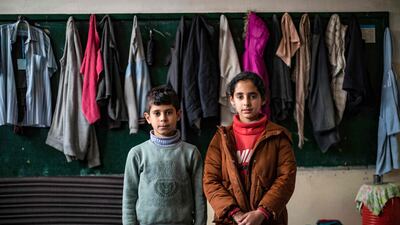
Twins Maha, right, and Mohammad Al Obaid, 11, were born in 2011, the year the Syrian war started. Displaced from Ras Al Ain in north-east Syria three years ago, they are pictured at a school on the outskirts of north-eastern city Hassakeh. All photos: AFP -
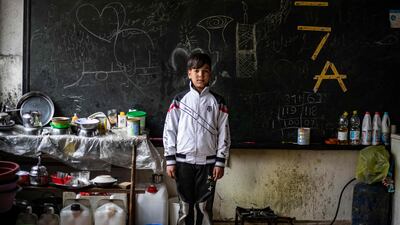
Nimr Alaywi, 11, who was also displaced from Ras Al Ain three years ago, at a school near Hassakeh. -
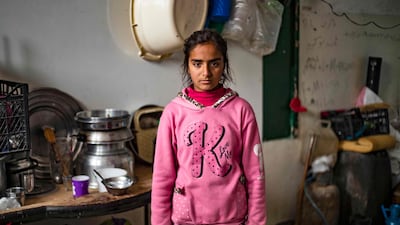
Amani Mahmud, 11, whose family fled Ras Al Ain, pictured at the school near Hassakeh. According to some estimates, 13.3 million Syrians have fled their homes since the civil war began on March 15, 2011. -
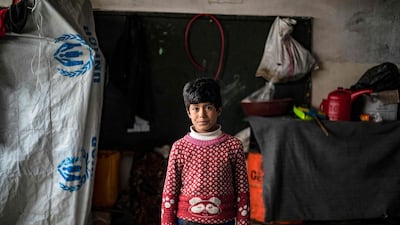
Mohammad Issa, 11, who was also displaced from Ras Al Ain, at the school near Hassakeh. -
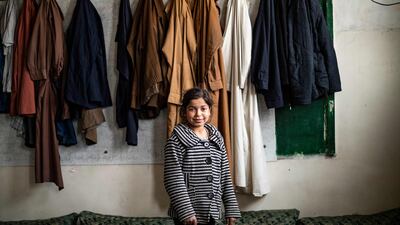
Assil Alaywi, 11, whose family also fled Ras Al Ain for Hassakeh three years ago. Ras Al Ain was the scene of heavy fighting for much of the conflict. -
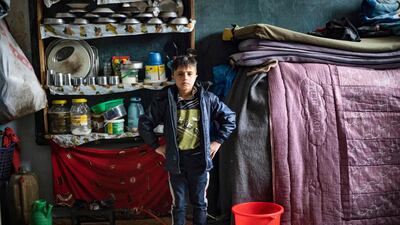
Yazan Khodr, 11, at the school near Hassakeh, after his family fled Ras Al Ain. Various groups, including Syrian government forces, extremists and Kurdish fighters, vied for control of Ras Al Ain. -
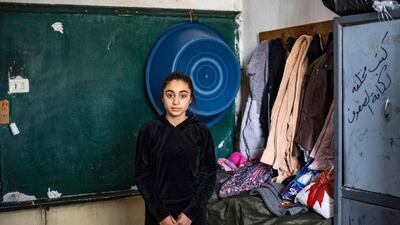
Liana Ali, 11, in the school building on the outskirts of Hassakeh. -

Manaf Mahmud, 11, pictured at the school near Hassakeh. Around four million people, at least half of them displaced, now live in the northern region. -
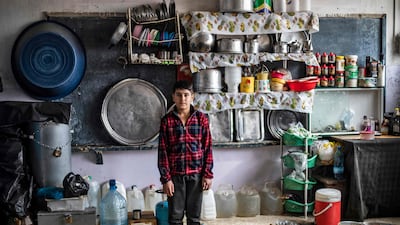
Ahmad Abderrazzak, 11, at the school near Hassakeh. -
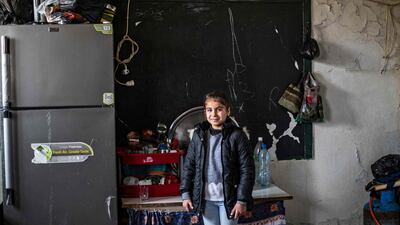
Fatima Barkal, 11, at the school near Hassakeh. -
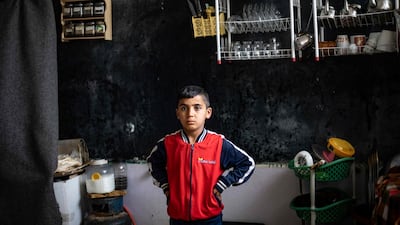
Ammar Al Khodr, 11, at the school near Hassakeh. -
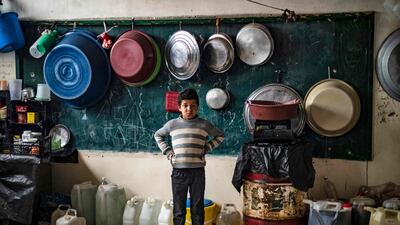
Majd Hassan, 11, at the school near Hassakeh, north-east Syria.



