• Abu Malek Al Shami colouring the 'Suffering Heart' mural. Abd Almajed Alkahr/The National
    Abu Malek Al Shami colouring the 'Suffering Heart' mural. Abd Almajed Alkahr/The National
  • Like Banksy, he has become known for his striking, colourful murals. Abd Almajed Alkahr/The National
    Like Banksy, he has become known for his striking, colourful murals. Abd Almajed Alkahr/The National
  • Al Shami draws a mural called 'Syria Game'. Abd Almajed Alkahr/The National
    Al Shami draws a mural called 'Syria Game'. Abd Almajed Alkahr/The National
  • Al Shami and his friends work on a mural in Kafranbel in 2017, which points to the 1,800 victims in Syria of chemical weapons. Photo supplied by Abu Malek Al-Shami
    Al Shami and his friends work on a mural in Kafranbel in 2017, which points to the 1,800 victims in Syria of chemical weapons. Photo supplied by Abu Malek Al-Shami
  • Al Shami and his friend finish the mural. Photo supplied by Abu Malek Al-Shami
    Al Shami and his friend finish the mural. Photo supplied by Abu Malek Al-Shami
  • An image of Al Shami and Majd Mohadamani in 2014 in Daraya, in front of a mural in a ruined school. Photo supplied by Abu Malek Al-Shami
    An image of Al Shami and Majd Mohadamani in 2014 in Daraya, in front of a mural in a ruined school. Photo supplied by Abu Malek Al-Shami
  • Al Shami looks at his finished picture. Abd Almajed Alkahr/The National
    Al Shami looks at his finished picture. Abd Almajed Alkahr/The National
  • Al Shami drawing in his studio. Abd Almajed Alkahr/The National
    Al Shami drawing in his studio. Abd Almajed Alkahr/The National
  • Abu Malek Al-Shami in his studio in Idlib. Abd Almajed Alkahr/The National
    Abu Malek Al-Shami in his studio in Idlib. Abd Almajed Alkahr/The National
  • Al Shami holding a roller brush looking at the mural 'Syria Game'. The mural appears on a ruined roof. Abd Almajed Alkahr/The National
    Al Shami holding a roller brush looking at the mural 'Syria Game'. The mural appears on a ruined roof. Abd Almajed Alkahr/The National
  • Al Shami puts the finishing touches to his picture based on Vincent Van Gogh’s 'The Starry Night'. Abd Almajed Alkahr/The National
    Al Shami puts the finishing touches to his picture based on Vincent Van Gogh’s 'The Starry Night'. Abd Almajed Alkahr/The National
  • The winter of 2019 in Dair Al-Zugub, in North Idlib, Al Shami draws on a ruined roof as the sun is about to set. Abd Almajed Alkahr/ The National
    The winter of 2019 in Dair Al-Zugub, in North Idlib, Al Shami draws on a ruined roof as the sun is about to set. Abd Almajed Alkahr/ The National
  • Al Shami has been hailed as 'Syria's Banksy', after the internationally-renowned graffiti artist. Abd Almajed Alkahr/ The National
    Al Shami has been hailed as 'Syria's Banksy', after the internationally-renowned graffiti artist. Abd Almajed Alkahr/ The National
  • Al Shami looks at the mural he has drawn on a devastated roof in Dair Al-Zugub in Idlib. Abd Almajed Alkahr/ The National
    Al Shami looks at the mural he has drawn on a devastated roof in Dair Al-Zugub in Idlib. Abd Almajed Alkahr/ The National

'Syria's Banksy' struggles to survive in Idlib


  • English
  • Arabic

Abu Malek Al Shami stands on a mound of rubble, remnants of a bombed-out building in war-shattered Idlib, gazing at his artwork on a collapsed concrete slab.

The silhouette of a young man, his head down and carrying a small bag of possessions tied to a stick, walks through an empty landscape.

Hands stretch up from the ground, as if to pull him back. Are they beckoning him to join them in death? Do they represent a longing to return to a place of displacement?

Every day, many of our friends die. The grim life in the town became routine. So, I began practising my hobby of drawing. I drew on the walls of my room
Abu Malek Al Shami

Al Shami says this poignant image mirrors the condition of a generation of young Syrians who found themselves on the receiving end of a regime determined to destroy any sign of opposition by any means possible, no matter how brutal.

He, too, is a member of this lost generation, but has been hailed as “Syria's Banksy”, after the internationally renowned graffiti artist. Like Banksy, he has become known for his striking, colourful murals – only in Al Shami's case, they are on the walls of ruined Syrian cities at the height of the conflict.

Abu Malek Al Shami stands in front of one of his murals painted on the collapsed roof of a building in Idlib, Syria. Abd Almajed Alkarh for The National.

As state repression became more extreme, he was forced to join nearly four million Syrians in the crowded, war-scarred governorate of Idlib, a place that faces periodic heavy bombing between lulls in violence.

“After I was displaced from Daraya, a suburb of Damascus, in 2016, I paused the art to put all my efforts into finding a new residence, but all of my attempts were in vain. I’m still looking for myself, for a suitable opportunity to learn, for a good job and for the art that is lying inside me,” he tells The National.

The beginnings

Al Shami was born in Damascus in 1994, the ninth brother among 11 siblings. Since childhood, he has had a passion for drawing.

During the first demonstrations at the start of 2011, Al Shami joined crowds of protesters in the Kafar Sousah neighbourhood in Damascus, writing banners and drawing political pictures for anti-regime marches.

It was there that he realised “art’s power to unite people and deliver the revolutionaries’ message to the world,” he says.

Graffiti was not known in Syria before the revolution. However, it developed when children in the southern city of Daraa wrote on walls: “Now it’s your turn, doctor!” – a message to President Bashar Al Assad, who trained as an ophthalmologist, after uprisings across the region in 2011 which toppled leaders in Egypt and Tunisia.

These early expressions soon evolved into political street art.

By the end of 2012, Syria was in the grip of a bloody civil war. Many of Al Shami's brothers were arrested and he feared he would be next. He stopped his studies and left Damascus.

The ruins of revolution

By early 2013, Al Shami found himself in Daraya, a place he visited for “adventure”, he says. The security services were soon breaking into homes and arresting people who were involved in peaceful demonstrations. “I realised it was a matter of time before I got arrested“, he says.

He was astonished by the situation in the town and the scale of the destruction.

“Most of the people there were university students. I thought I would get killed because the conflict was so one-sided,” he says.

The Syrian regime dropped hundreds of barrel bombs on the suburb amid artillery barrages, destroying and damaging thousands of homes.

“Every day, many of our friends die. The grim life in the town became routine. So, I began practising my hobby of drawing. I drew on the walls of my room.”

At that time, Al Shami met Majd Mohadamani, a journalist who was documenting the war in Daraya. When he saw Al Shami’s drawings, he suggested he should paint on the destroyed walls in the streets.

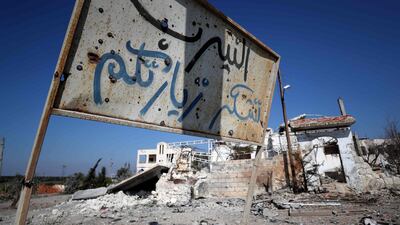
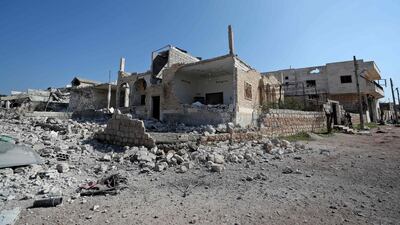
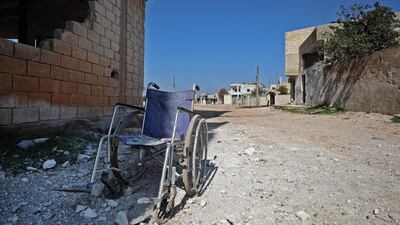
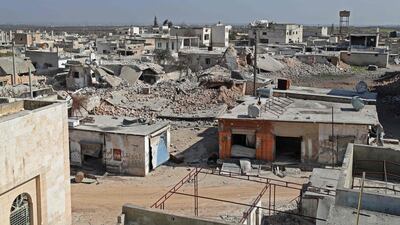
  • Damaged homes in the village of al-Nayrab, about 14 kilometres southeast of the city of Idlib in northwestern Syria, after Turkish-backed rebels seized the village from regime forces. AFP
    Damaged homes in the village of al-Nayrab, about 14 kilometres southeast of the city of Idlib in northwestern Syria, after Turkish-backed rebels seized the village from regime forces. AFP
  • Damaged homes in the village of al-Nayrab. AFP
    Damaged homes in the village of al-Nayrab. AFP
  • Damaged homes in the village of al-Nayrab.
    Damaged homes in the village of al-Nayrab.
  • RPG shells and military equipment in the village of al-Nayrab. AFP
    RPG shells and military equipment in the village of al-Nayrab. AFP
  • Defused anti-tank mines in the village of al-Nayrab. AFP
    Defused anti-tank mines in the village of al-Nayrab. AFP
  • A burnt vehicle in the village of al-Nayrab. AFP
    A burnt vehicle in the village of al-Nayrab. AFP
  • Damaged homes in the village of al-Nayrab. AFP
    Damaged homes in the village of al-Nayrab. AFP
  • Turkish-backed rebels ride their motorcycle in the village of al-Nayrab. AFP
    Turkish-backed rebels ride their motorcycle in the village of al-Nayrab. AFP
  • The damaged roof and minaret of a mosque in the village of al-Nayrab. AFP
    The damaged roof and minaret of a mosque in the village of al-Nayrab. AFP
  • The interior of a mosque in the village of al-Nayrab. AFP
    The interior of a mosque in the village of al-Nayrab. AFP
  • Damaged homes in the village of al-Nayrab. AFP
    Damaged homes in the village of al-Nayrab. AFP

“I was excited about the idea. It was the first time for me to paint graffiti, it was a big challenge for me to achieve."

The two men chose the roofs of ruined buildings for their work.

Mohadamani, originally from Daraya, provided the painting materials and picked the locations, but Al Shami had many fears.

“I was afraid of people's views, those who considered this work to be trivial and a waste of time, or that drawing on their destroyed houses would annoy them.”

The first mural was designed by a Syrian artist known as Omran and painted in July 2014. Called Learn to Love First, it shows a small girl is facing a soldier holding a rifle on his back.

Al Shami says he coloured the artwork so that the soldier could not be identified with any armed group. Instead the work was directed at all the fighters in the country.

“The child is trying to teach him a simple lesson, pointing to the picture of a heart so that he may ask why, and for whom, he is fighting."

In the last period of the siege of Daraya, Mohadamani was killed while covering the fighting and Al Shami's lungs were injured, which forced him to suspend work for a long period.

“One day before Mohadamani died, he recommended I should continue the work despite what would happen. The news of his death was very shocking."

Al Shami fled to Idlib in 2016, leaving behind 30 works of art. “Our murals made an artistic and cultural impression after we left,” he says.

In Idlib, he met an artist who taught him to create oil paintings as a substitute for graffiti.

But he soon faced new problems. “I thought I could practise my activity freely with the availability of equipment. However, the involvement of armed groups in civil issues distracted me from my work, requiring that my artwork would support their interest, or be under their control.”

Since 2017, Idlib has been under the control of Hayat Tahrir Al Sham, an umbrella group of militias, at least one of which is linked to Al Qaeda’s Syrian branch.

The rise of militant groups and the siege-like conditions in Idlib made it difficult for Al Shami to work – in addition to working in secrecy, the rising cost of materials and the absence of a sponsor who could help him continue his art freely.

Despite this, he has co-operated with several organisations, including the Ema’a Foundation NGO for one year, during which he drew three murals.

He also worked with an art collective based in Kafranbel, a town that became known for colourful and innovative protest banners and anti-regime artwork, until it was retaken by Assad’s forces in early 2020, as well as working with Sketch for Syria, a local art campaign which envisages the country post-conflict.

But surviving in Idlib has been the toughest challenge. With limited materials, much of his artwork is completed on fabric or wood.

“I made 13 paintings in 2019 and 17 paintings in 2020 despite the fact that I had to flee during that year. It is true that I suffered from a lack of materials and colours and the lack of required equipment, but I was used to using whatever I can find.”

One of his paintings is based on Vincent van Gogh's iconic The Starry Night, with a Syrian-conflict twist – a helicopter poised to drop a barrel bomb.

“If Vincent van Gogh lived in Syria, he wouldn’t see the beauty of the sky, the moon, the stars and nature because of air strikes that destroyed everything. We in Syria are living a very gloomy story. Everyone is watching but no one is doing anything,” he says.

'Art may lose its moral impact'

Despite Al Shami’s travails, the artist understands that a lack of materials and funding are problems shared by millions of other artists around the world.

Without external support, art will lose its moral impact, he warns, and become purely a commercial venture where artists create simply to survive.

The graphic design nature of what he does could lend itself not to self-expression, but commerce.

“Artists involved in graffiti will decrease in number and their work will become limited to advertisements," he says.

In the early months of 2021, he created 20 paintings, against the odds.

“I cannot stabilise, I am facing difficulty in an environment where we're facing bloody events daily, with no space for art," he laments.

“I am trying to leave Syria. I am afraid to be a number among the dead and injured in a war which has Idlib as its last destination. Maybe I could survive with what’s left of my art and thoughts, and go to a place where I can resume the struggle again."


Countries recognising Palestine

France, UK, Canada, Australia, Portugal, Belgium, Malta, Luxembourg, San Marino and Andorra


If you go...

Fly from Dubai or Abu Dhabi to Chiang Mai in Thailand, via Bangkok, before taking a five-hour bus ride across the Laos border to Huay Xai. The land border crossing at Huay Xai is a well-trodden route, meaning entry is swift, though travellers should be aware of visa requirements for both countries.

Flights from Dubai start at Dh4,000 return with Emirates, while Etihad flights from Abu Dhabi start at Dh2,000. Local buses can be booked in Chiang Mai from around Dh50

Key findings of Jenkins report
  • Founder of the Muslim Brotherhood, Hassan al Banna, "accepted the political utility of violence"
  • Views of key Muslim Brotherhood ideologue, Sayyid Qutb, have “consistently been understood” as permitting “the use of extreme violence in the pursuit of the perfect Islamic society” and “never been institutionally disowned” by the movement.
  • Muslim Brotherhood at all levels has repeatedly defended Hamas attacks against Israel, including the use of suicide bombers and the killing of civilians.
  • Laying out the report in the House of Commons, David Cameron told MPs: "The main findings of the review support the conclusion that membership of, association with, or influence by the Muslim Brotherhood should be considered as a possible indicator of extremism."
Company%C2%A0profile
%3Cp%3E%3Cstrong%3ECompany%20name%3A%20%3C%2Fstrong%3ELeap%0D%3Cbr%3E%3Cstrong%3EStarted%3A%20%3C%2Fstrong%3EMarch%202021%0D%3Cbr%3E%3Cstrong%3EFounders%3A%3C%2Fstrong%3E%20Ziad%20Toqan%20and%20Jamil%20Khammu%0D%3Cbr%3E%3Cstrong%3EBased%3A%3C%2Fstrong%3E%20Dubai%0D%3Cbr%3E%3Cstrong%3ESector%3A%20%3C%2Fstrong%3EFinTech%0D%3Cbr%3E%3Cstrong%3EInvestment%20stage%3A%20%3C%2Fstrong%3EPre-seed%0D%3Cbr%3E%3Cstrong%3EFunds%20raised%3A%3C%2Fstrong%3E%20Undisclosed%0D%3Cbr%3E%3Cstrong%3ECurrent%20number%20of%20staff%3A%20%3C%2Fstrong%3ESeven%3C%2Fp%3E%0A
FIXTURES

Thu Mar 15 – West Indies v Afghanistan, UAE v Scotland
Fri Mar 16 – Ireland v Zimbabwe
Sun Mar 18 – Ireland v Scotland
Mon Mar 19 – West Indies v Zimbabwe
Tue Mar 20 – UAE v Afghanistan
Wed Mar 21 – West Indies v Scotland
Thu Mar 22 – UAE v Zimbabwe
Fri Mar 23 – Ireland v Afghanistan

The top two teams qualify for the World Cup

Classification matches
The top-placed side out of Papua New Guinea, Hong Kong or Nepal will be granted one-day international status. UAE and Scotland have already won ODI status, having qualified for the Super Six.

Thu Mar 15 – Netherlands v Hong Kong, PNG v Nepal
Sat Mar 17 – 7th-8th place playoff, 9th-10th place playoff

Ten tax points to be aware of in 2026

1. Domestic VAT refund amendments: request your refund within five years

If a business does not apply for the refund on time, they lose their credit.

2. E-invoicing in the UAE

Businesses should continue preparing for the implementation of e-invoicing in the UAE, with 2026 a preparation and transition period ahead of phased mandatory adoption. 

3. More tax audits

Tax authorities are increasingly using data already available across multiple filings to identify audit risks. 

4. More beneficial VAT and excise tax penalty regime

Tax disputes are expected to become more frequent and more structured, with clearer administrative objection and appeal processes. The UAE has adopted a new penalty regime for VAT and excise disputes, which now mirrors the penalty regime for corporate tax.

5. Greater emphasis on statutory audit

There is a greater need for the accuracy of financial statements. The International Financial Reporting Standards standards need to be strictly adhered to and, as a result, the quality of the audits will need to increase.

6. Further transfer pricing enforcement

Transfer pricing enforcement, which refers to the practice of establishing prices for internal transactions between related entities, is expected to broaden in scope. The UAE will shortly open the possibility to negotiate advance pricing agreements, or essentially rulings for transfer pricing purposes. 

7. Limited time periods for audits

Recent amendments also introduce a default five-year limitation period for tax audits and assessments, subject to specific statutory exceptions. While the standard audit and assessment period is five years, this may be extended to up to 15 years in cases involving fraud or tax evasion. 

8. Pillar 2 implementation 

Many multinational groups will begin to feel the practical effect of the Domestic Minimum Top-Up Tax (DMTT), the UAE's implementation of the OECD’s global minimum tax under Pillar 2. While the rules apply for financial years starting on or after January 1, 2025, it is 2026 that marks the transition to an operational phase.

9. Reduced compliance obligations for imported goods and services

Businesses that apply the reverse-charge mechanism for VAT purposes in the UAE may benefit from reduced compliance obligations. 

10. Substance and CbC reporting focus

Tax authorities are expected to continue strengthening the enforcement of economic substance and Country-by-Country (CbC) reporting frameworks. In the UAE, these regimes are increasingly being used as risk-assessment tools, providing tax authorities with a comprehensive view of multinational groups’ global footprints and enabling them to assess whether profits are aligned with real economic activity. 

Contributed by Thomas Vanhee and Hend Rashwan, Aurifer

War 2

Director: Ayan Mukerji

Stars: Hrithik Roshan, NTR, Kiara Advani, Ashutosh Rana

Rating: 2/5

Our family matters legal consultant

Name: Hassan Mohsen Elhais

Position: legal consultant with Al Rowaad Advocates and Legal Consultants.

Ferrari 12Cilindri specs

Engine: naturally aspirated 6.5-liter V12

Power: 819hp

Torque: 678Nm at 7,250rpm

Price: From Dh1,700,000

Available: Now

The%20specs%20
%3Cp%3E%3Cstrong%3EEngine%3A%20%3C%2Fstrong%3E2.0-litre%204cyl%20turbo%0D%3Cbr%3E%3Cstrong%3EPower%3A%20%3C%2Fstrong%3E261hp%20at%205%2C500rpm%0D%3Cbr%3E%3Cstrong%3ETorque%3A%20%3C%2Fstrong%3E400Nm%20at%201%2C750-4%2C000rpm%0D%3Cbr%3E%3Cstrong%3ETransmission%3A%20%3C%2Fstrong%3E7-speed%20dual-clutch%20auto%0D%3Cbr%3E%3Cstrong%3EFuel%20consumption%3A%20%3C%2Fstrong%3E10.5L%2F100km%0D%3Cbr%3E%3Cstrong%3EOn%20sale%3A%20%3C%2Fstrong%3ENow%0D%3Cbr%3E%3Cstrong%3EPrice%3A%20%3C%2Fstrong%3EFrom%20Dh129%2C999%20(VX%20Luxury)%3B%20from%20Dh149%2C999%20(VX%20Black%20Gold)%3C%2Fp%3E%0A

Essentials
The flights: You can fly from the UAE to Iceland with one stop in Europe with a variety of airlines. Return flights with Emirates from Dubai to Stockholm, then Icelandair to Reykjavik, cost from Dh4,153 return. The whole trip takes 11 hours. British Airways flies from Abu Dhabi and Dubai to Reykjavik, via London, with return flights taking 12 hours and costing from Dh2,490 return, including taxes. 
The activities: A half-day Silfra snorkelling trip costs 14,990 Icelandic kronur (Dh544) with Dive.is. Inside the Volcano also takes half a day and costs 42,000 kronur (Dh1,524). The Jokulsarlon small-boat cruise lasts about an hour and costs 9,800 kronur (Dh356). Into the Glacier costs 19,500 kronur (Dh708). It lasts three to four hours.
The tours: It’s often better to book a tailor-made trip through a specialist operator. UK-based Discover the World offers seven nights, self-driving, across the island from £892 (Dh4,505) per person. This includes three nights’ accommodation at Hotel Husafell near Into the Glacier, two nights at Hotel Ranga and two nights at the Icelandair Hotel Klaustur. It includes car rental, plus an iPad with itinerary and tourist information pre-loaded onto it, while activities can be booked as optional extras. More information inspiredbyiceland.com

COMPANY%20PROFILE
%3Cp%3E%3Cstrong%3ECompany%20name%3A%3C%2Fstrong%3E%20Clinicy%3Cbr%3E%3Cstrong%3EStarted%3A%3C%2Fstrong%3E%202017%3Cbr%3E%3Cstrong%3EFounders%3A%3C%2Fstrong%3E%20Prince%20Mohammed%20Bin%20Abdulrahman%2C%20Abdullah%20bin%20Sulaiman%20Alobaid%20and%20Saud%20bin%20Sulaiman%20Alobaid%3Cbr%3E%3Cstrong%3EBased%3A%3C%2Fstrong%3E%20Riyadh%3Cbr%3E%3Cstrong%3ENumber%20of%20staff%3A%3C%2Fstrong%3E%2025%3Cbr%3E%3Cstrong%3ESector%3A%3C%2Fstrong%3E%20HealthTech%3Cbr%3E%3Cstrong%3ETotal%20funding%20raised%3A%3C%2Fstrong%3E%20More%20than%20%2410%20million%3Cbr%3E%3Cstrong%3EInvestors%3A%3C%2Fstrong%3E%20Middle%20East%20Venture%20Partners%2C%20Gate%20Capital%2C%20Kafou%20Group%20and%20Fadeed%20Investment%3C%2Fp%3E%0A
Without Remorse

Directed by: Stefano Sollima

Starring: Michael B Jordan

4/5

How to help

Send “thenational” to the following numbers or call the hotline on: 0502955999
2289 – Dh10
2252 – Dh 50
6025 – Dh20
6027 – Dh 100
6026 – Dh 200

Full Party in the Park line-up

2pm – Andreah

3pm – Supernovas

4.30pm – The Boxtones

5.30pm – Lighthouse Family

7pm – Step On DJs

8pm – Richard Ashcroft

9.30pm – Chris Wright

10pm – Fatboy Slim

11pm – Hollaphonic


Updated: October 27, 2021, 11:51 AM