



The Syrian government is violating international agreements on chemical weapons and obstructing inspectors from investigating allegations, the United States, France and Britain said on Monday.
Syria insists that its chemical weapons stockpile was handed over to the UN for disposal following a 2013 agreement.
Russia maintains that its Syrian ally did not use the prohibited weapons or violate the Chemical Weapons Convention, which Syria acceded to in 2013.
-
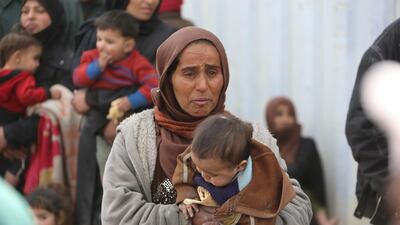
Syrians from the rebel-held Eastern Ghouta cross a government-controlled corridor in Hamouria on March 16, 2018 as government and Russian warplanes continued to bomb the region for a fourth week. AFP -
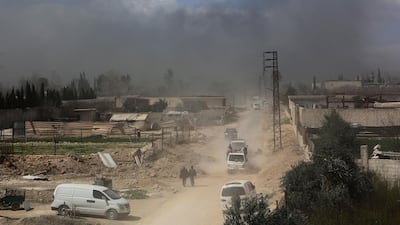
Vehicles carrying Syrians from Eastern Ghouta pass through a regime-controlled corridor in Hamouria on March 16, 2018, a day after the town was recaptured by government forces. AFP -
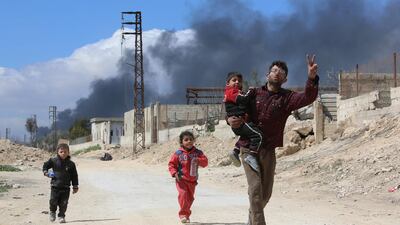
A man and his children walk towards government-held territory in Hamouria on March 16, 2018. AFP -
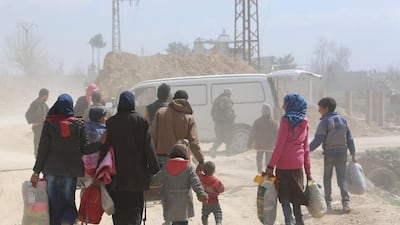
More than 20,000 people have fled Hamouria and nearby areas in the Eastern Ghouta region since government forces captured the town, according to activists. AFP -
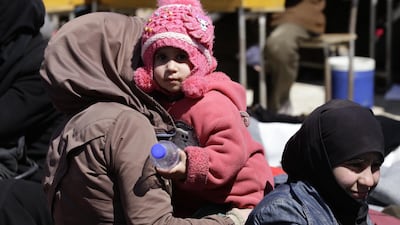
Many of the people fleeing Eastern Ghouta were women and children. Louia Beshara / AFP -
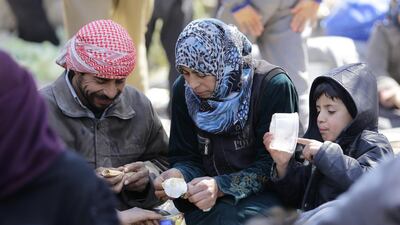
Syrian civilians evacuated from rebel-held areas in Eastern Ghouta gather at a school in the regime-controlled Adra district, on the north-eastern outskirts of the capital Damascus, on March 16, 2018. Louia Beshara / AFP -
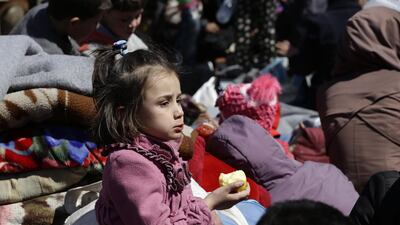
Syrian civilians evacuated from rebel-held areas in the Eastern Ghouta at a school in the regime-controlled Adra district outside Damascus on March 16, 2018. Louia Beshara / AFP -
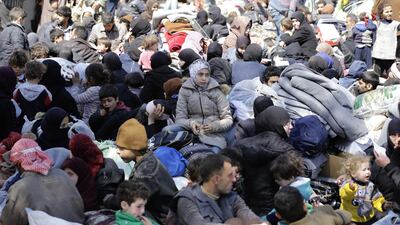
Syrian civilians at a school in Adra district on outskirts of Damascus on March 16, 2018. Louia Beshara / AFP -
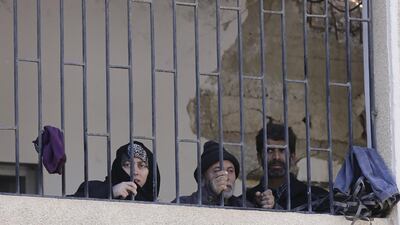
Syrian civilians look out from a window at a school in Adra district near Damascus after fleeing Eastern Ghouta, on March 16, 2018. Louia Beshara / AFP -
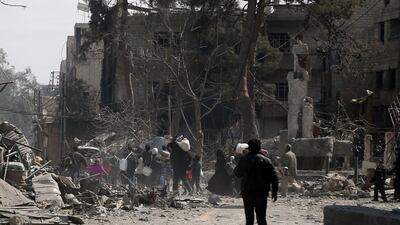
People carry their belongings as they flee their homes in the town of Hamouria on March 15, 2018. Abdulmonam Eassa / AFP -
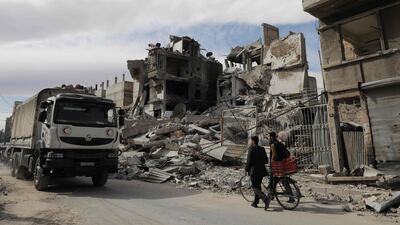
A humanitarian convoy organised by the Syrian Arab Red Crescent in cooperation with the International Committee of the Red Cross and the UN enters Douma, the main town in Eastern Ghouta, on March 15, 2018. Hamza Al Ajweh / AFP -
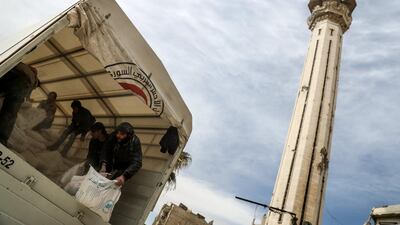
Workers unload aid from one of the 25 trucks in the aid convoy that arrived in Douma on March 15, 2018. Mohammed Badra / EPA -
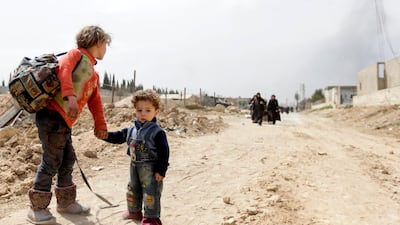
Syrian children wait for other civilians to catch up as they pass through a regime-controlled corridor opened by government forces in Hawsh Al Ashaari, east of Hamouria, on March 15, 2018. Louia Beshara / AFP


At the time, the US had threatened to attack Syria following a chemical weapons attack in Ghouta, a suburb of Damascus which was bombed with lethal Sarin gas after rebel groups took control of the area.
Hundreds of civilians - by some estimates more than 1,700 died in the attack.
Addressing a UN Security Council briefing on the issue, US Ambassador to the UN Richard Mills said that Syria had denied weapons inspectors visas to investigate alleged use of chemical weapons.
“Repeated and continued failures by the Assad regime to comply with its obligations under international law must not be tolerated,” Mr Mills said.
Inspectors from the Organisation for the Prohibition of Chemical Weapons (OPCW) have applied to visit sensitive sites in Syria but are awaiting permission.
Mr Mills, along with representatives from France and Britain, said that this was in breach of the 2013 UN Security Council Resolution 2118.
The resolution warned “that the use of chemical weapons constitutes a serious violation of international law,” and that “those responsible for any use of chemical weapons must be held accountable.”
“The Security Council should impose measures under Chapter VII of the UN Charter in response to Syria’s non-compliance with Resolution 2118. At this point, there can be no doubt, Mr President, that the Syrian government has repeatedly violated its international obligations,” Mr Mills said, referring to the president of the UN Security Council.
In The Hague, the OPCW also held a meeting on the delayed issuance of visas, where Britain's ambassador to the Netherlands Joanna Roper called on Syria to “explain” the fate of two chlorine cylinders identified as evidence in a chemical weapons attack on the town of Douma in 2018.
-
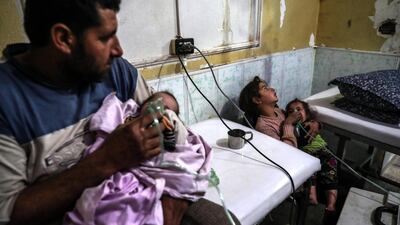
An affected man puts the aerosol mask on his child while his other daughter gives treatment to her other sister after a shelling attack on rebels-held Eastern Ghouta. EPA -
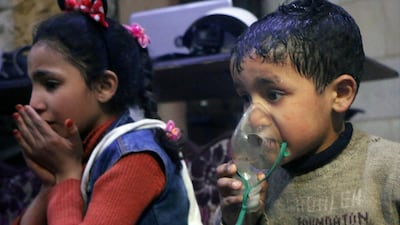
A child receiving oxygen through respirators following an alleged poison gas attack in the rebel-held town of Douma on Sunday, April 8, 2018. Syrian Civil Defense White Helmets via AP -
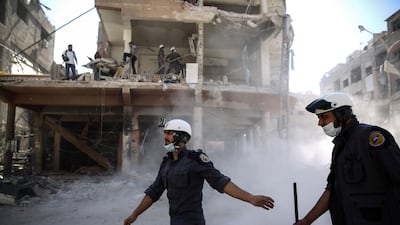
Syrian civil defence volunteers, known as the White Helmets, work around destroyed buildings following reported air strikes on the rebel-held town of Douma. AFP, file -

A Syrian child who was injured in shelling on the town of Misraba receives treatment at a make-shift hospital in the besieged rebel-held town of Douma. AFP -
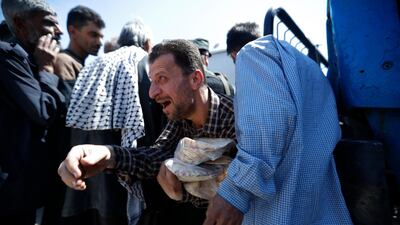
A Syrian man pushes out of a crowd after Syrian authorities distributed bread, vegetables and pasta to hungry Douma residents. AP -
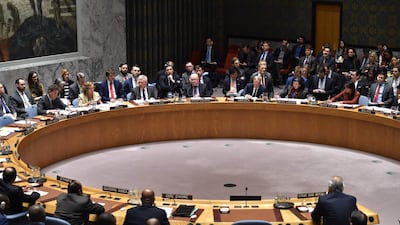
Russia vetoes a UN Security Council resolution that would have set up an investigation into chemical weapons use in Syria on April 10, 2018. AFP -
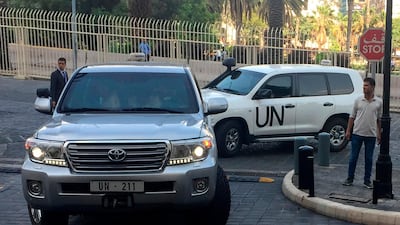
UN vehicles carrying the team of the Organization for the Prohibition of Chemical Weapons (OPCW). AP, File -
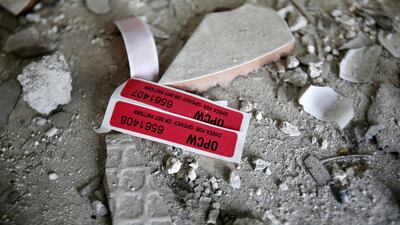
Labels of the Organisation for the Prohibition of Chemical Weapons (OPCW) are seen inside a damaged house in Douma in Damascus, Syria April 23, 2018. Reuters -
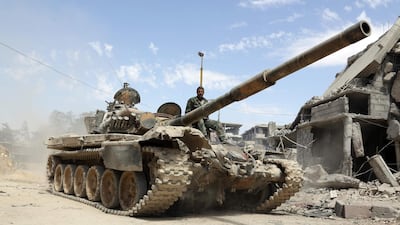
The Syrian government unleashed a ferocious assault on the then-rebel stronghold of Eastern Ghouta on February 18, 2018 aiming to crush militant groups on the doorstep of the capital. Civilans were trapped and many died. AFP -
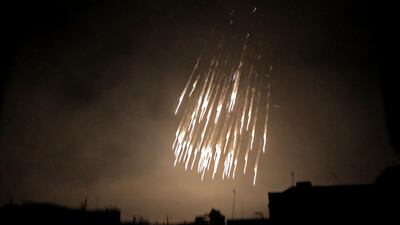
What appears to be white phosphorus incendiaries over Douma during regime bombardment of what was one of the few remaining rebel-held pockets in Eastern Ghouta. AFP, file -

A Syrian man helps evacuate an injured victim following Syrian government air strikes on the Eastern Ghouta rebel-held enclave of Douma, on the outskirts of the capital Damascus on March 20, 2018. AFP -
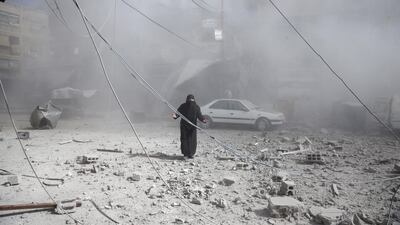
A woman gestures as she walks on rubble of damaged buildings after an airstrike in the besieged in eastern Ghouta. Reuters -
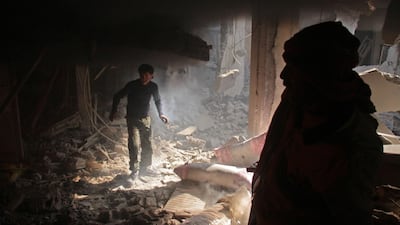
Syrians search for survivors following regime air strikes on the rebel-held besieged town of Douma in the eastern Ghouta region. AFP -
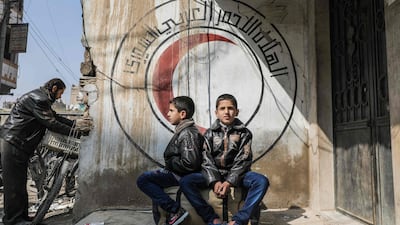
Syrian children sit before a mural on a wall bearing the logo of the Syrian Red Crescent in the Syrian town of Douma in the rebel-held enclave of Eastern Ghouta on the eastern outskirts of the capital Damascus on March 13, 2018. AFP -
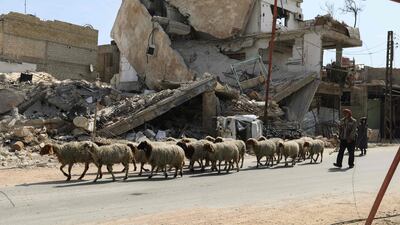
A shepherd leads his flock away from Douma to safer areas in the rebel-held enclave of Eastern Ghouta, on the outskirts of Damascus, on March 7, 2018. AFP -

People ride a horse along a damaged street at the city of Douma in Damascus. Reuters -
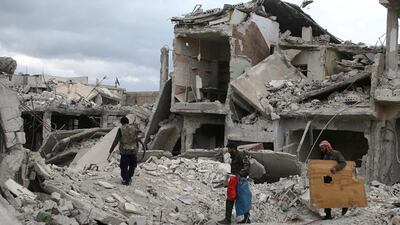
People walk on rubble of damaged buildings in the besieged town of Douma, Eastern Ghouta. Reuters, file


Damascus recently told the OPCW the two cylinders had been destroyed in an unspecified attack on one of its own chemical weapons facilities in June this year.
More than 40 people were killed in the Douma incident, prompting Western nations to unleash a barrage of missiles at three suspected chemical weapons facilities run by President Bashar Al Assad's regime.
OPCW director general Fernando Arias said the watchdog “noted with concern” the delays in discussions with Damascus.
The regulator would not send the inspection team to Syria unless it got visas for all members, he said.
Mr Arias added that Syria's declaration on its remaining chemical weapons “cannot be considered accurate and complete” due to what he called “gaps, inconsistencies and discrepancies that remain unresolved.”

