

Live updates: Follow the latest news on Israel-Gaza
The US on Friday vetoed a UN Security Council resolution calling for an immediate humanitarian ceasefire in the Gaza Strip, after Secretary General Antonio Guterres took the rare step of declaring the conflict a threat to world peace and security.
The Arab drafted resolution tabled by the UAE received 13 votes in favour, an abstention from Britain and the US veto.
Co-sponsored by about 100 nations, the resolution had expressed “grave concern over the catastrophic humanitarian situation in the Gaza Strip and the suffering of the Palestinian civilian population”.
After the vote, Robert Wood, the US deputy ambassador to the UN, said the resolution was “divorced from reality” and he criticised it for “failing to acknowledge that Israel has the right to defend itself against terrorism, consistent with international law”.
He also said it was “unfathomable” that the resolution “declined to include language condemning Hamas's horrific terrorist attack on Israel on October 7.”
The US “engaged in good faith on this text” but “nearly all of our recommendations were ignored”, Mr Wood added.
Britain’s UN ambassador Barbara Woodward said Westminster also could not support a resolution that failed to “condemn the atrocities Hamas committed against innocent Israeli civilians on October 7 “.
Mohamed Abushahab, the UAE's deputy ambassador to the UN, said his country was “deeply disappointed” with the vote.
“Regrettably, and in the face of untold misery, this council is unable to demand a humanitarian ceasefire,” he said.
Mr Abushahab also said the broad support for the resolution, which drew about 100 co-sponsors in 24 hours, was a reflection of global support for efforts to end the war and save Palestinian lives.
Israel Gaza war two months on – in pictures
-
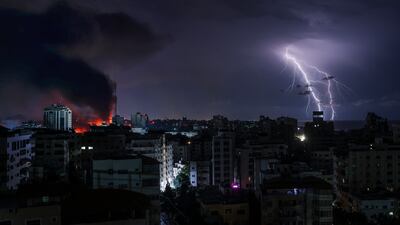
Lightning strikes as smoke billows following an Israeli bombardment of Gaza city. AFP -

A funeral of Palestinians killed in Israeli strikes in Khan Younis in the southern Gaza Strip. Reuters -
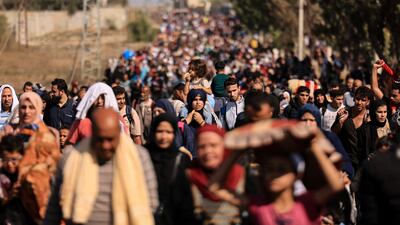
Palestinian families fleeing Gaza city and other parts of northern Gaza head south. AFP -
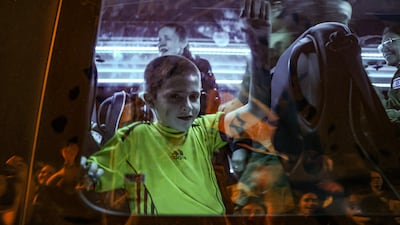
Tal Almog-Goldstein, a hostage released by Hamas, is driven to an army base in Ofakim, southern Israel. AFP -
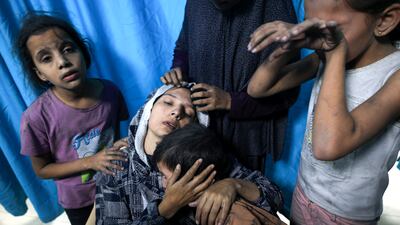
A wounded Palestinian woman is surrounded by her children at Nasser Hospital in Khan Younis after Israeli air strikes hit their home. AFP -
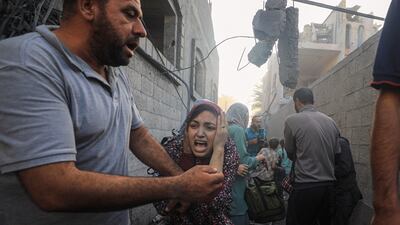
People flee following Israeli air strikes on a neighbourhood in the Al Maghazi refugee camp in the central Gaza Strip. AFP -
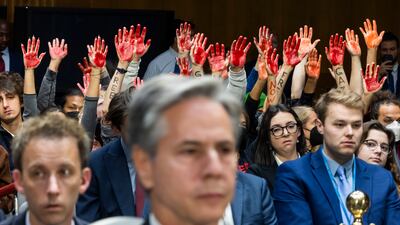
Protesters calling for a ceasefire in Gaza raise their arms as US Secretary of State Antony Blinken testifies at a Senate review of national security requests in Washington. EPA -
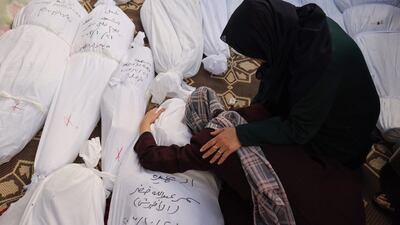
A woman cradles the body of her sister, killed in an Israeli bombardment in Rafah in the southern Gaza Strip. AFP -

A bloody handprint inside a house at Nir Oz kibbutz, one of the Israeli communities near the Gaza Strip attacked on October 7 by Hamas. AFP -
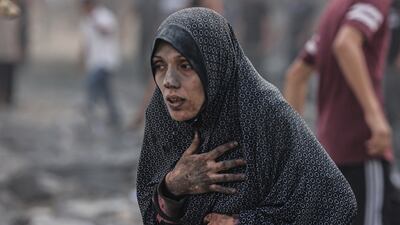
A Palestinian woman in shock after air strikes hit buildings near her home in Rafah. AFP -
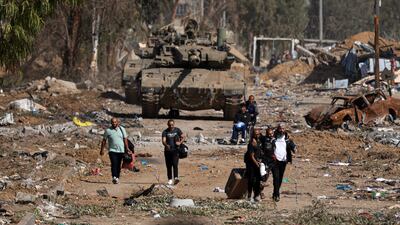
Palestinians fleeing the north trudge along the Salaheddine road in the southern outskirts of Gaza city, with Israeli tanks in the background. AFP -
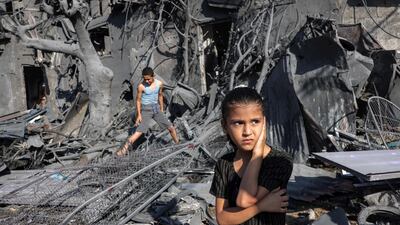
A girl wonders what it is all about after a bombardment in Rafah. AFP -
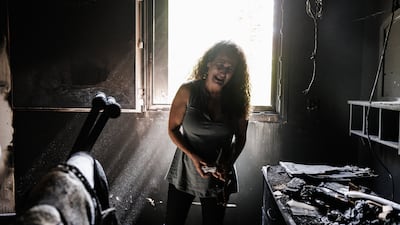
Kibbutz Nir Oz resident Hadas Kalderon, whose children were taken hostage, breaks down. Her mother and niece were killed. Getty Images -

Many displaced Palestinians are now taking shelter in tented camps at UN-run centres. Reuters -
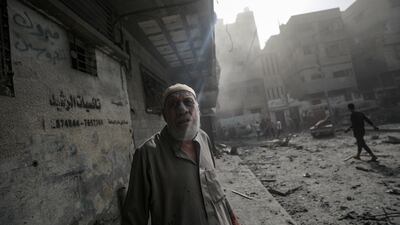
Destruction as far as the eye can see in Gaza city. EPA -
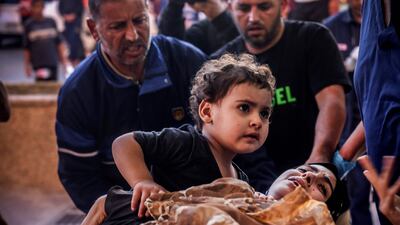
A boy helps wheel his injured mother into Nasser Hospital in Khan Younis. AFP -
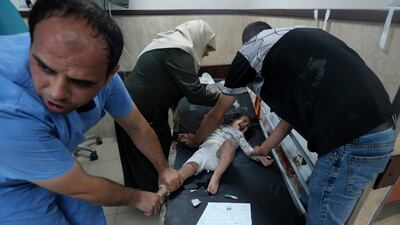
A Palestinian child is treated at Al Aqsa Hospital in Deir al Balah. AP -

A man mourns as bodies are returned to relatives for burial. Reuters -

Members of the Jewish community and supporters of Israel attend a rally in New York calling for the release of hostages held by Hamas. AFP -

Palestinians collect water, of which there is an acute shortage in the Gaza Strip, from a desalination plant. Reuters -
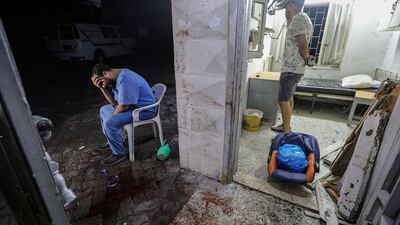
A doctor assesses the situation at Al Ahli Arab Hospital after yet another air strike in Gaza city. EPA


Before the vote, he said: “There is no defensible moral, political nor military justification for this carnage to continue.”
Mr Guterres said the Hamas attacks did not “justify the collective punishment” of people in Gaza.
“Some 130 hostages are still held captive. I call for their immediate and unconditional release, as well as their humane treatment and visits from the International Committee of the Red Cross until they are freed,” Mr Guterres said.
“At the same time, the brutality perpetrated by Hamas can never justify the collective punishment of the Palestinian people.”
Russia’s deputy UN ambassador Dmitry Polyansky called the vote “one of the darkest days in the history of the Middle East” and accused the US of issuing “a death sentence to thousands, if not tens of thousands more civilians in Palestine and Israel, including women and children”.
The Security Council vote came as Israel continued its bombardment and ground invasion of Gaza following last week's collapse of a seven-day truce.
While indiscriminate rocket fire by Hamas into Israel and the use of civilians as human shields contravene the laws of war, Mr Guterres said, such conduct does not absolve Israel of its own breaches of international humanitarian law.
In a letter to the council on Wednesday, Mr Guterres took the extraordinary step of invoking Article 99 of the UN Charter, which states that a Secretary General may bring to the attention of the council “any matter which in his opinion may threaten the maintenance of international peace and security”.
Mr Guterres informed the 15-member Security Council that he had invoked Article 99 because the world body's inability to help civilians in Gaza had reached “a breaking point”.
“Between 3 and 5 December – the two days preceding my letter – the UN could only distribute aid in one of Gaza’s five governorates,” he said.
He spoke of a complete breakdown in the humanitarian support system in Gaza, emphasising that such an outcome would lead to “devastating consequences”, including the destruction of public order and heightened pressure for a large-scale displacement towards Egypt.
In a post on X, Philippe Lazzarini, the head of the UN agency for Palestinian refugees, said he had written a letter to the President of the UN General Assembly to inform him that UNRWA's ability to continue delivering its mandate in Gaza has now become “severely limited”.
He said that in his 35 years of work in complex emergencies, he would never have expected to write such a letter predicting the killing of his staff and the collapse of the mandate that UNRWA is expected to fulfil.
The Health Ministry in the Hamas-run Gaza Strip said on Friday the death toll had risen to at least 17,487.

