


Live updates: Follow the latest news on Israel-Gaza
Jordanian university student Raghida Fares has had to sleep at her friend’s house twice since pro-Gaza demonstrations started this month near the Israeli embassy in her Amman neighbourhood.
On both occasions, a splinter group of mostly young protesters tried to breach security cordons to the embassy, forcing police to disperse them, at one point using tear gas.
“I was out, and when I tried to get back home the police had blocked the roads,” Ms Fares said.
“Other than that, there have been no incidents. Thousands of people assemble daily in front of our house.”
As the Israel-Gaza war enters its fourth week, Jordan, which is socially intertwined with Palestine, has remained relatively calm.
Stability amid upheavals in the Middle East has been a hallmark of the country since its 1970 civil war.
But the war in Gaza has underlined the difficult position Amman often finds itself in whenever violence flares on the western side of the river Jordan.
Unemployment is officially between 22 per cent and 23 per cent, and the economy has been stagnant for the last 12 years.
The country is dependent on US aid and has a military pact with Washington, which over the past decade have helped the kingdom deal with cross-border threats from Syria and elsewhere.
A large proportion of the Jordan's 10 million inhabitants are of Palestinian origin. They fled their homes amid the creation of Israel in 1948, and during the 1967 Arab-Israeli war.
Most of the rest of the country's population are descendants of tribes and clans who inhabited what is now Jordan but often had branches and kin around the Levant and on the Arabian Peninsula.
These tribes played a key role in the formation of Jordan as a British protectorate in 1921, and underpin its security forces.
Security instructions have been widely followed since the war in Gaza broke out on October 7.
The authorities have allowed pro-Gaza rallies near the Israeli embassy in Rabieh district and elsewhere, but not near the US embassy or the border with Israel.
The protests, although angry, have remained mostly verbal.
Ms Fares said that during past anti-Israel rallies near her home, she and other members of her household had given onions to protesters to lessen the impact of tear gas.
But not this time.
“The situation is too grave to play games,” she said.
In Amman, one of the more placid capitals in the Middle East, traffic has lessened considerably at night because the police have blocked some roads near sensitive sites. People have also refrained from going out, in solidarity with Gaza.
Parts of the West Bank, where Gaza-linked violence has been rising, can be seen from Amman’s outskirts.
A Western diplomat who observed one of the Rabieh rallies said that although the rich and poor mingled at the site, a large number of the demonstrators were young and unemployed.
“There is always a risk of things going out of control in these situations,” she said
In 1994, King Hussein, father of current King Abdullah II, signed a peace treaty with Israel, five years after relinquishing Jordanian claims to the West Bank and East Jerusalem.
There remains, however, significant solidarity with Gaza across social strata.
Usually long drive-through lines at McDonald's and Starbucks were nearly empty at the weekend.
-
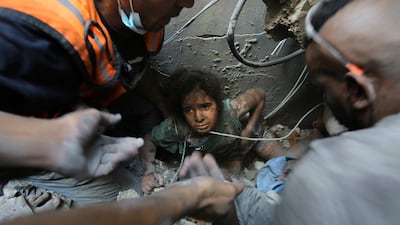
A girl is rescued from the rubble of a building destroyed by Israeli air strikes in Jabalia refugee camp, in the northern Gaza Strip. AP Photo -

An Apache helicopter fires flares, seen from Sderot in southern Israel, close to the border with Gaza. Reuters -

Palestinians plug their phones into portable charging stations on a street in Khan Younis, Gaza. Bloomberg -
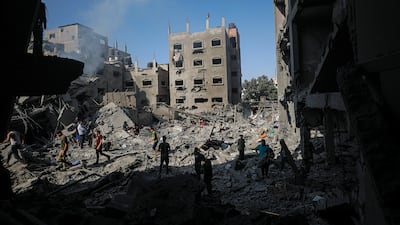
Residents search survivors among the rubble following Israeli strikes on Jabalia, northern Gaza. EPA -
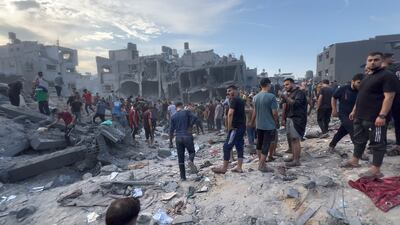
Palestinians search for survivors and bodies following Israeli airstrikes at the Jabalia, the largest refugee camp in Gaza. AP -
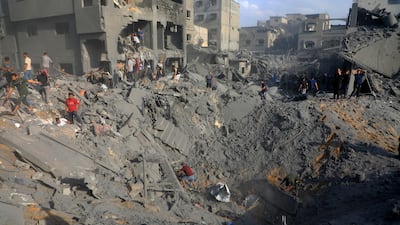
Palestinians look for survivors among the rubble of destroyed buildings following Israeli strikes on Jabalia refugee camp in northern Gaza. AP -
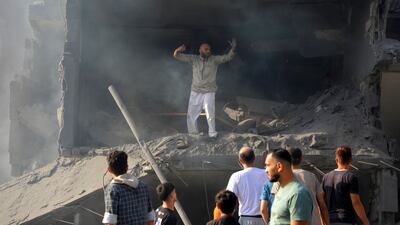
Palestinians look for survivors among the rubble of destroyed buildings following Israeli strikes on Jabalia refugee camp in northern Gaza. AP -

A fire burns in western Gaza after an Israeli air strike. Reuters -

Missiles are fired from Israel towards the Gaza Strip. Getty Images -
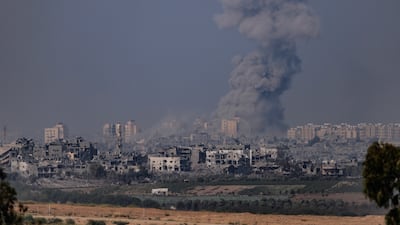
Smoke rises from an explosion in Gaza. Getty Images -
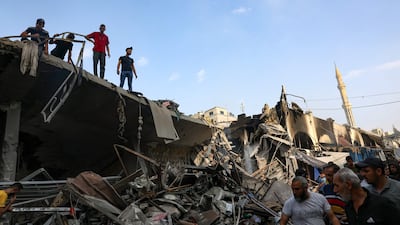
A group of men survey the destruction following air strikes on Al Shatee camp in Gaza city, as Israeli forces entered the northern area of the Gaza Strip. AFP -
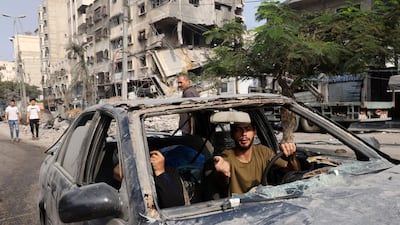
A man drives a damaged car following air strikes on Gaza city. AFP -
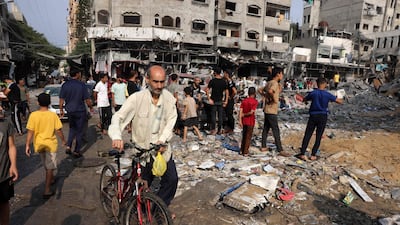
A man pushes a bicycle past the remains of buildings destroyed in Israeli strikes on Al Shatee camp in Gaza city. AFP -

A woman and children walk past a house destroyed in Israeli strikes on Al Shatee camp in Gaza city. AFP -
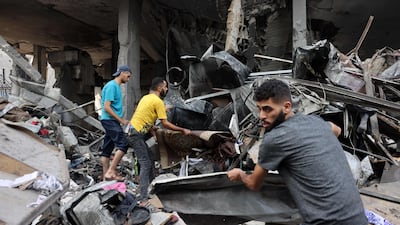
People dig through the rubble of a destroyed building following Israeli strikes on Al Shatee camp in Gaza city. AFP -

A man drives a damaged car past a building destroyed in Israeli strikes on Al Shatee camp in Gaza city. AFP -
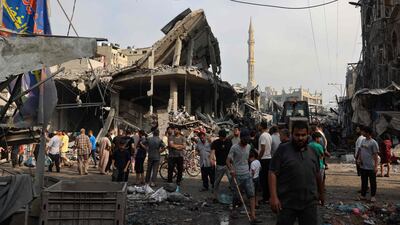
People gather amid the destruction following Israeli strikes on Al Shatee camp in Gaza city. AFP -
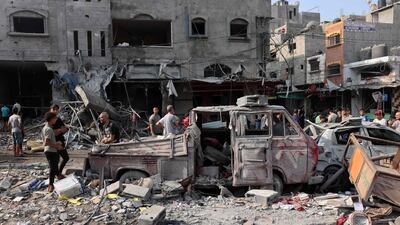
Wrecked vehicles and rubble on the streets following Israeli strikes on Al Shatee camp in Gaza city. AFP -
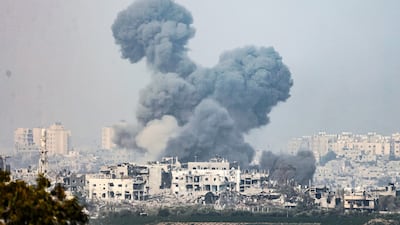
Smoke rises from the northern Gaza Strip as Israeli air and ground forces amplified their military activities against Hamas. EPA -
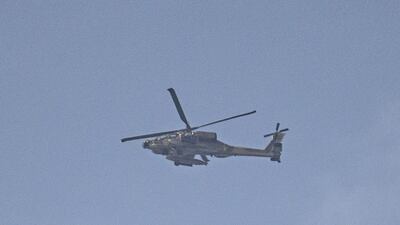
An Israeli Apache attack helicopter flies close to the border with the Gaza Strip, near Israel's southern city of Ashkelon. AFP -
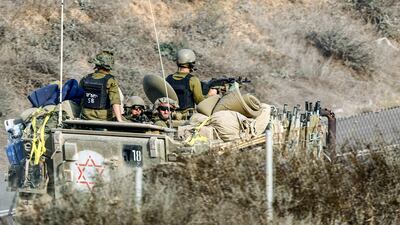
Israeli soldiers in an armoured personnel carrier on patrol near Israel's border with Gaza. EPA -
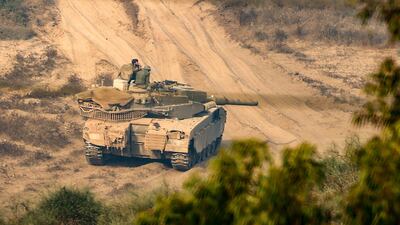
The crew of an Israeli tank prepare for ground operations near the border with Gaza. EPA -
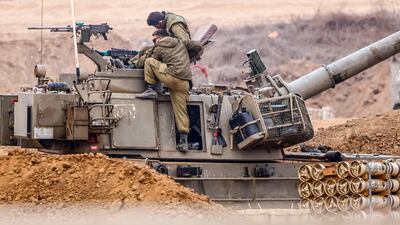
Israeli soldiers prepare for ground manoeuvres at an undisclosed location in Israel near the border with Gaza. EPA -
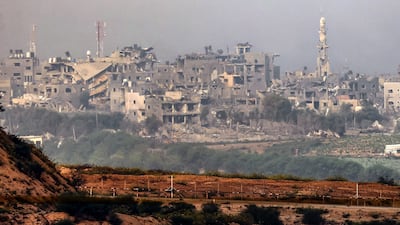
The ruins of northern Gaza seen from Sderot in southern Israel. EPA -
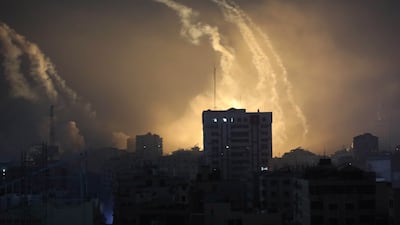
Smoke and explosions caused by Israeli bombardment over northern Gaza. AP Photo -

An explosion on the Israel-Gaza border. Reuters -
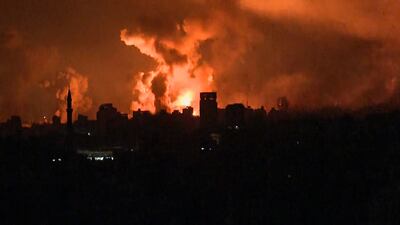
A video grab shows fireballs and smoke rising above Gaza city following an Israeli attack. AFP -

An explosion in Gaza seen from Sderot in southern Israel. Reuters -
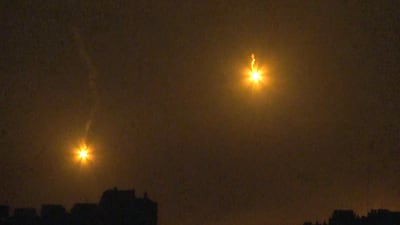
A video grab shows rockets fired from Gaza city. AFP -
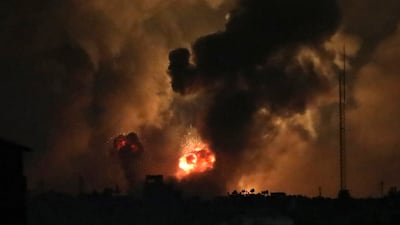
Israeli air strikes in the northern Gaza Strip. AP Photo -
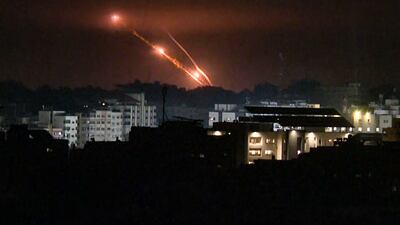
A video grab shows a salvo of rockets fired from Gaza city. AFP -
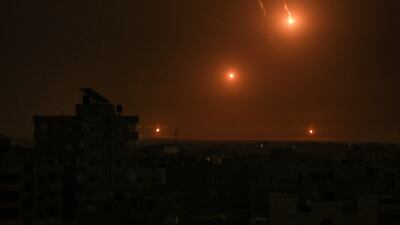
A flare trail fired by the Israeli army east of Khan Younis on the southern Gaza Strip. AFP -
Smoke from the bombing of the Gaza Strip over the Israeli border city of Ashkelon. AFP -

Flares over Gaza as seen from Sderot in southern Israel. Reuters


The two US franchises are being shunned in Jordan because of Washington’s support for the Israeli operation in Gaza, which has claimed more than 8,000 lives in three weeks.
“I saw the empty lines at McDonald's and I was tempted to stop and buy the kids cheeseburgers,” said Lina, an administrative manager at a law firm in Amman.
She added that she had “resisted”.
Lina was out on Friday, however, for a high-school reunion at an upper middle-class restaurant on the airport road.
“I attended because the event was planned for a long time,” she said. “The restaurant was empty and the waiters showered us with attention.”
But not everyone has reduced their social activities because of the war.
One expensive, long-established Lebanese restaurant in the central Zahran area was three quarters full for dinner on the weekend. A nearby Italian restaurant, one of the priciest in Amman, was completely full.

