


Live updates: Follow the latest news on Israel-Gaza
Israel’s demand for about 1.1 million Palestinian civilians to leave northern Gaza and head for the south is “impossible” within a 24-hour period, aid groups and experts told The National on Friday.
Announced before an expected Israeli ground invasion against Gaza's ruling Hamas militant group, it is an unprecedented order affecting almost half the population of the sealed-off territory.
The UN, which was informed by Israel of the plans, has said such a large number of people fleeing en masse would be catastrophic, especially as an aerial bombardment continues in Gaza.
Gazans, many of whom have been seen fleeing on foot, have to travel about 15km if they live in the northernmost part of the Strip to reach the area south of the Wadi Gaza, which is where the Israelis say they have to flee to.
Most people in Gaza city itself, the most densely populated area and its southern environs, have a 5km to 10km journey.
But the potential for heavy fighting and the continuing bombardments in some areas, as well as roads blocked by rubble, craters and, potentially, other refugees will make the journey far more arduous, especially with dwindling access to water.
Hamas, which staged a brutal surprise attack on Israel this week, dismissed the Israeli announcement as a ploy and called on people to stay in their homes, adding to widespread confusion and panic.

Chris Doyle, director of the Council for Arab-British Understanding, told The National it was not possible for so many civilians to safely move out of the region within 24 hours.
“The Gaza strip is still being bombed, there is no power, no roads, so it’s impossible,” he said.
“What we see is essentially an example of state terror. It is to actually inform a civilian population this is what is going to happen and they know they cannot leave, so they are aware of what will occur.”
Israel said early on Friday that it needed to strike Hamas's military infrastructure, much of which is buried deep underground across Gaza.
The Israeli military will use “significant force” while making “extensive efforts to avoid harming civilians”, army spokesman Lt Col Jonathan Conricus said.
The announcement has triggered panic among civilians and aid workers already sheltering from Israeli air strikes and contending with a total siege and territory-wide power cuts.
“Forget about food, forget about electricity, forget about fuel. The only concern now is just if you’ll make it, if you’re going to live,” Nebal Farsakh, a spokeswoman for the Palestinian Red Crescent in Gaza city, told news agencies while breaking into heaving sobs.
More than 1,500 Palestinians have been killed and 6,600 wounded in Gaza since Israel launched retaliatory air strikes, Palestinian health officials said.
More than 1,300 Israelis have been killed and 3,200 wounded, according to the Israeli army, after Hamas launched an attack against Israel from the Gaza Strip on 07 October.
Will people actually move?
Hamas said Israel's Gaza evacuation order had been rejected by “our Palestinian people”.
Videos and pictures shared on social media showed people, with children in their arms, carrying suitcases and plastic bags stuffed with belongings on Friday.
The UN said that more than 423,000 people have already fled their homes in the territory.
The World Health Organisation said it was impossible to transfer severely wounded and sick patients to southern Gaza.
“There are severely ill people whose injuries mean their only chances of survival is being on life support, such as mechanical ventilators,” said WHO spokesman Tarik Jasarevic.
“So, moving those people is a death sentence. Asking health workers to do so is beyond cruel,” he said.
-
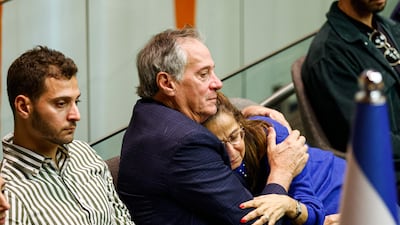
At UN headquarters in New York City, Rachel Zeitchik, right, and Jay Zeitchik attend an event for families of Israelis kidnapped by Hamas. AFP -
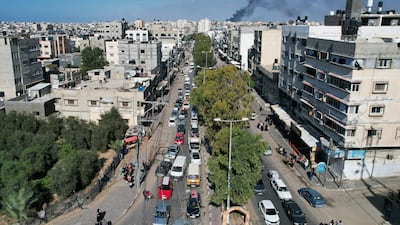
Palestinians flee from northern Gaza towards the south after the Israeli army demanded the population of more than a million people leave before a ground invasion. AP -

Demonstrators at a rally in support of Palestine face a counter-demonstration in support of Israel near Times Square in New York. EPA -
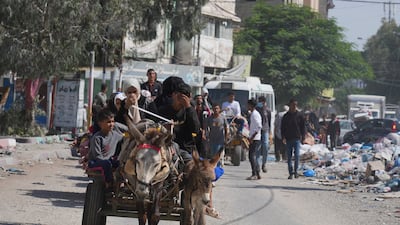
Palestinians flee from northern Gaza to the south after the Israeli army issued an evacuation warning. AP -
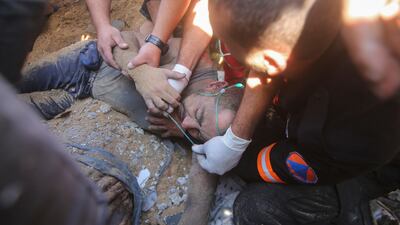
An injured man is rescued from the rubble of a building following an Israeli airstrike in Rafah, Gaza Strip. AP -
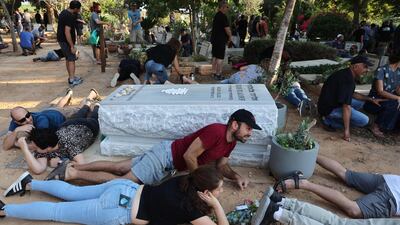
Mourners take cover as sirens sound during the funeral of Tom Godo, killed during the attack by Hamas militants on the Kibbutz Kisuffim last week, in Kibbutz Naan near Tel Aviv. AFP -
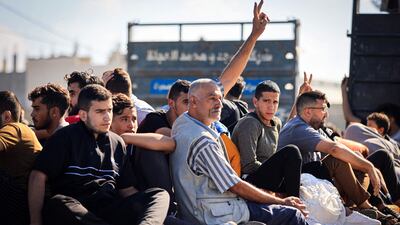
A Palestinian man flashes the victory sign as he and others leave northern Gaza before an expected Israeli ground offensive. AFP -
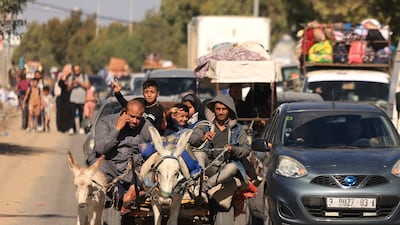
Palestinians head south with their belongings after being ordered by Israel to leave northern Gaza on Friday. AFP -

Israel ordered more than a million Palestinians to head south within 24 hours. Reuters -

The UN criticised the directive, saying forcing such a large number of people to flee en masse would be catastrophic. Reuters -

Gazans have to travel about 15km if they live in the northernmost part of the strip to reach the area south of the Wadi Gaza. Reuters -

The UN said that more than 423,000 people have already fled their homes in the territory, with a sizeable number making the more than 10km journey on foot. Reuters -
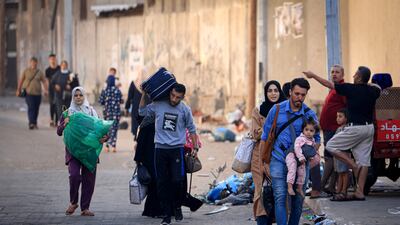
Palestinians with their belongings flee to safer areas in Gaza City. AFP -

An Armoured Personnel Carrier drives near Israel's border with the Gaza Strip. Reuters -

Supporters of Iraqi Shi'ite cleric Moqtada al-Sadr gather for mass Friday prayer during a protest in solidarity with Palestinians in Gaza, in Baghdad, Iraq. Reuters -
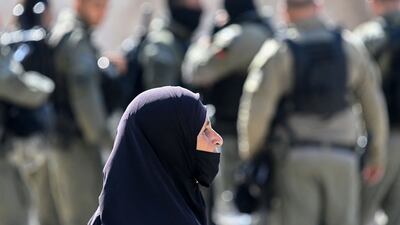
A Palestinian woman waits to cross into Jerusalem's Old City through Damascus Gate next to Israeli soldiers. AFP -
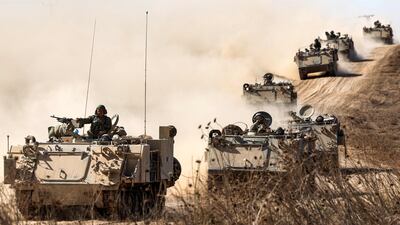
Israeli army infantry fighting vehicles deploy along the border with the Gaza Strip in southern Israel. AFP -
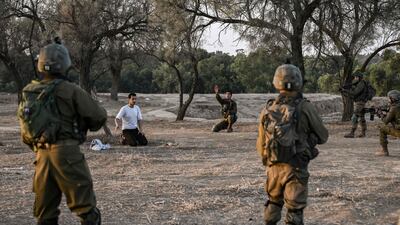
Israeli soldiers detain a man while on patrol near Kibbutz Beeri, near the Gaza Strip. AFP -

Students hold in a rally in support of Palestine at Columbia University in New York. Getty Images -

Family and friends mourn Valentin Ghnassia, 23, who was killed in a battle with Palestinian militants at Kibbutz Beeri near the Israeli border with the Gaza Strip. Getty Images -
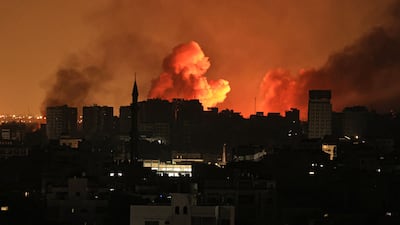
A ball of fire erupts in Gaza city after an Israeli air strike. AFP -
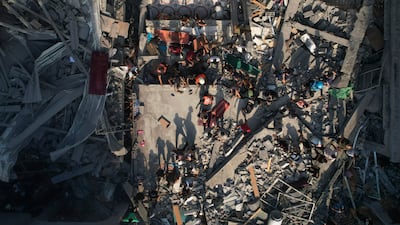
Palestinians inspect the rubble of buildings hit by an Israeli air strike at Al Shati refugee camp. AP -
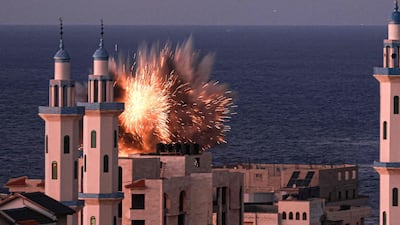
A fireball erupts from an Israeli air strike in Gaza city. AFP -

People waiting for news of victims outside the morgue at Al-Shifa hospital in Gaza City. AFP -
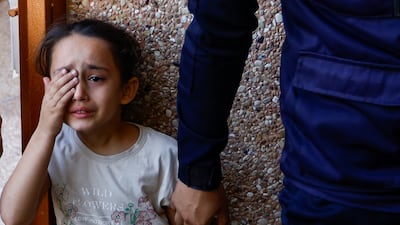
A girl mourns the death of members of the Samour family, who were killed in Israeli strikes on their house in Khan Younis in the southern Gaza Strip. Reuters -

Israelis arrive to sign up at a weapons distribution point for people allowed to carry arms, at the Ayyelet HaShahar Kibbutz in northern Israel, near the Lebanese border. AFP -
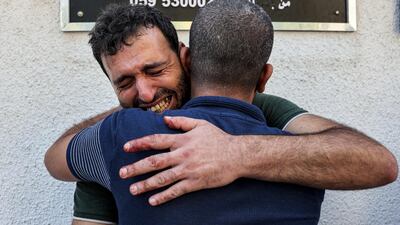
Mourners outside the morgue at Al-Shifa hospital in Gaza City as battles between Israel and the Hamas movement continue for a sixth consecutive day. AFP -
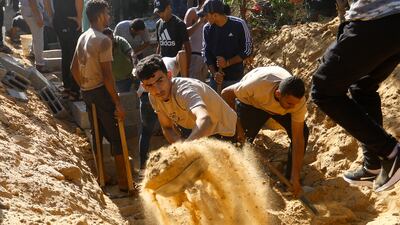
Men dig graves to bury members of the Samour family, who were killed in Israeli strikes on their house in Khan Younis. Reuters -

Palestinian children who fled their homes during Israeli strikes, play at a United Nations-run school in Gaza City. Reuters -
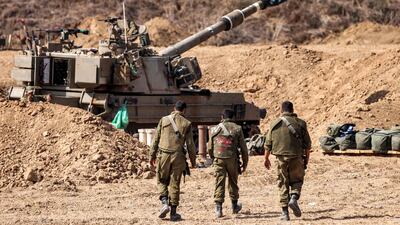
Israeli soldiers near a self-propelled howitzer near the border with Gaza in southern Israel. AFP -

Israel's Foreign Minister Eli Cohen, left, welcomes US Secretary of State Antony Blinken upon arrival at Israel's Ben Gurion Airport. AFP -

Palestinian children in a makeshift shelter at Al-Shifa hospital in Gaza City. Reuters -
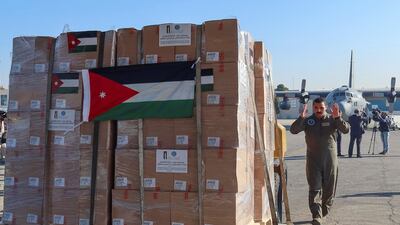
Boxes of humanitarian aid and supplies from Jordan Hashemite Charity Organisation destined for Gaza, in Amman, Jordan. Reuters -
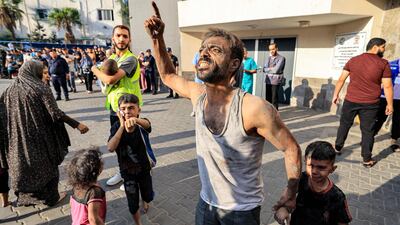
Palestinians outside Al-Shifa hospital in Gaza City on the sixth day of fighting between Israel and Hamas. AFP -
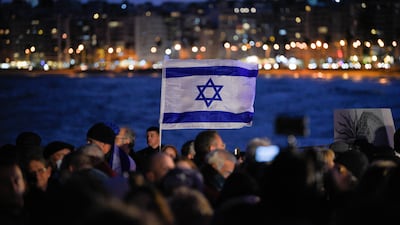
A pro-Israel vigil in Montevideo, Uruguay. EPA


The Norwegian Refugee Council said its humanitarian workers inside Gaza reported “countless people in the northern parts who have no means to safely relocate under the constant barrage of fire”.
“The loss of civilian lives caused by deliberate or indiscriminate use of force is a war crime for which the perpetrators will have to answer,” the group said.
“We fear that Israel may claim that Palestinians who could not flee northern Gaza can be erroneously held as directly participating in hostilities, and targeted.”
Where can they go?
A total siege has been imposed on Gaza since Saturday. Israel has cut off water, electricity and gas supplies as a response to the attack by Hamas.
It also shut its own border crossing into the city and has bombed Egypt's Rafah crossing, temporarily rendering it unusable.
For several days, humanitarian groups have been calling for the safe passage for the two million civilians in Gaza as Israel pounds the enclave with thousands of air strikes.
Leaving would be difficult in the narrow and densely populated Gaza.
Bente Scheller, head of the Mena division at the Heinrich Boll Foundation in Berlin, said there was “no where to go” as Egypt was not ready to open its border for refugees.
“Given the level of humanitarian suffering that is already happening – the scarcity of water, food or fuel, it will be very difficult to provide for people in an even more difficult logistical situation,” Ms Scheller told The National.

