


Lebanese politicians failed for a third time to elect the country's next president on Thursday with no candidate receiving enough votes, only 11 days before the term of incumbent Michel Aoun ends.
Parliamentary speaker Nabih Berri said the next election session in the 128-seat chamber would take place on Monday. In the first polling round, which took place in late September, a two-thirds majority was required to win. But an absolute majority is needed in subsequent votes.
Of the 119 votes cast, 55 were blank and 17 for “New Lebanon”. MP Michel Moawad, who received the most votes in the first round with 36, increased his share to 42 — but that was nowhere near the threshold needed to be elected Lebanon's next president.
“It is clear that one camp comes to elect a president while another attends the sessions just to hide its desire to block them,” said Mr Moawad, a staunch critic of the Iran-backed armed group and political party Hezbollah.
Mr Moawad, whose father Rene served as president for 18 days in 1989 before being assassinated, described himself as the only “serious candidate”.
He has received the support of parliament's largest party, the Lebanese Forces, the Kataeb Party, the Druze Progressive Socialist Party and a handful of independent MPs.
Among the big names not to back a candidate yet are Hezbollah, Mr Berri's Amal Movement, and the Free Patriotic Movement, which was founded by Mr Aoun.
The election rules require a two-thirds quorum, which means no one bloc can impose its candidate. The second parliamentary session last week was abandoned because of a lack of quorum.
The failure to find a successor to Mr Aoun, an 89-year-old former army commander, is not unexpected and has precedent — it took 46 sessions and 29 months for parliament to elect him in 2016.
In the country's confessional system, the presidency is always reserved for a Maronite Christian.
If parliament fails to decide on Mr Aoun's successor before his term ends, the government will assume presidential powers.
-

Schoolteacher Claude Koteich, her teenager daughter and 10-year-old son, should all have been back in class weeks ago – but a crisis in Lebanon's education sector has left them lounging at home on a Monday afternoon. All photos: Reuters -
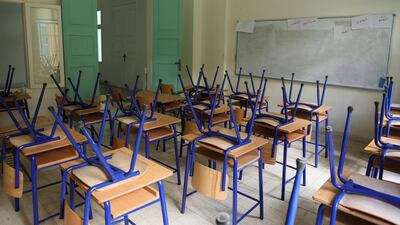
Lebanon's three-year financial meltdown has kept public schools closed so far this academic year, with teachers waging an open-ended strike over severely devalued salaries and administrators worried they will not be able to secure fuel to keep the lights and heating on during the winter. -
![Ms Koteich, 44, has taught French literature at Lebanese public schools for exactly half her lifetime. 'We used to get a salary high enough that I could afford to put them [her children] in private school,' she said.](https://www.thenationalnews.com/resizer/v2/2RL75LZYYFEQDNYSW3SVO2NWSA.JPG?smart=true&auth=c0e79547ec06d247688185041aae4b7b59a165697e6295d330a1b709d4918c9d&width=400&height=225)
Ms Koteich, 44, has taught French literature at Lebanese public schools for exactly half her lifetime. 'We used to get a salary high enough that I could afford to put them [her children] in private school,' she said. -
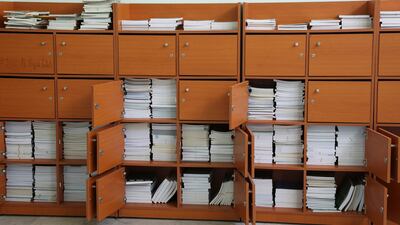
From a monthly salary that was once about $3,000, Ms Koteich now earns the equivalent of $100 – forcing her to make a tough choice last summer over whether to put her children back in costly private schools or transfer them to a public education system paralysed by the pay dispute. 'I was stuck between yes and no – waiting for our salaries to change, or if the education minister wanted to fulfil our demands,' she said. -
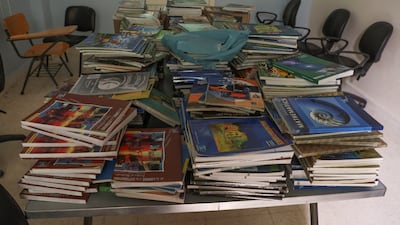
While there is little progress on securing higher salaries given Lebanon's depleted state coffers, at the same time, her children's private school was asking for tuition to be paid mostly in cash dollars to guarantee they could afford to pay for expensive fuel and other imported needs. That would amount to an annual fee of $500 per pupil, plus 15 million Lebanese pounds, or about $400. 'The number was very high and out of this world for me,' Ms Koteich said. -

So as their former classmates don their private school uniforms, Ms Koteich's two children still have no idea when they will return to class. -

The education system in Lebanon has long been heavily reliant on private schools, which taught almost 60 per cent of the country's 1.25 million pupils, according to the Ministry of Higher Education. But the strain on households from the financial collapse has forced a shift and about 55,000 pupils moved from private to public schools in the 2020-2021 school year alone, the World Bank said. -

Public education is historically underfunded, with the government earmarking less than 2 per cent of GDP to education in 2020, according to the World Bank – one of the lowest rates in the Middle East and North Africa. -
!['I noticed that their [my pupils] worries are beyond educational – they started to think about how they can make a living [when] at this age they should be thinking of their homework,' Ms Koteich said.](https://www.thenationalnews.com/resizer/v2/I7KHFQBRPZAOLPLB4MALAEVUSU.JPG?smart=true&auth=160c464189f0b0e9368517576e92e34b32dd63b9020449353439073c26e4ef72&width=400&height=225)
'I noticed that their [my pupils] worries are beyond educational – they started to think about how they can make a living [when] at this age they should be thinking of their homework,' Ms Koteich said. -
![Edouard Beigbeder, the head of Unicef in Lebanon, told Reuters that about one third of children in Lebanon – including Syrian children – are not attending school. 'We have worrying numbers ... more employed in the labour [sector in Lebanon], and some girls getting into early child marriage,' he said.](https://www.thenationalnews.com/resizer/v2/STEUWXNVWDW4UB6IGRZQNWYCLM.jpg?smart=true&auth=175a3a8b78ede85e4a6fc9cb8710c8bf31bdefb0226142e3ff759a1fde83322d&width=400&height=225)
Edouard Beigbeder, the head of Unicef in Lebanon, told Reuters that about one third of children in Lebanon – including Syrian children – are not attending school. 'We have worrying numbers ... more employed in the labour [sector in Lebanon], and some girls getting into early child marriage,' he said. -

A Unicef study this year found that 38 per cent of households had reduced their education expenses compared with just 26 per cent in April 2021. Some hope schools will re-open in October, although there has been no such indication from the government.


![Ms Koteich, 44, has taught French literature at Lebanese public schools for exactly half her lifetime. 'We used to get a salary high enough that I could afford to put them [her children] in private school,' she said.](https://www.thenationalnews.com/resizer/v2/2RL75LZYYFEQDNYSW3SVO2NWSA.JPG?smart=true&auth=c0e79547ec06d247688185041aae4b7b59a165697e6295d330a1b709d4918c9d&width=800&height=450)


!['I noticed that their [my pupils] worries are beyond educational – they started to think about how they can make a living [when] at this age they should be thinking of their homework,' Ms Koteich said.](https://www.thenationalnews.com/resizer/v2/I7KHFQBRPZAOLPLB4MALAEVUSU.JPG?smart=true&auth=160c464189f0b0e9368517576e92e34b32dd63b9020449353439073c26e4ef72&width=800&height=450)
![Edouard Beigbeder, the head of Unicef in Lebanon, told Reuters that about one third of children in Lebanon – including Syrian children – are not attending school. 'We have worrying numbers ... more employed in the labour [sector in Lebanon], and some girls getting into early child marriage,' he said.](https://www.thenationalnews.com/resizer/v2/STEUWXNVWDW4UB6IGRZQNWYCLM.jpg?smart=true&auth=175a3a8b78ede85e4a6fc9cb8710c8bf31bdefb0226142e3ff759a1fde83322d&width=800&height=450)

However, the government itself is in a caretaker capacity, adding to the political paralysis. Najib Mikati was named prime minister-designate in June, a month after parliamentary elections, but political factions have yet to agree on the distribution of portfolios in his Cabinet.
There are fears that any further paralysis will further delay the implementation of reforms that Lebanon needs to help get it out of a crippling financial crisis which has been described by the World Bank as one of the worst in modern history.
The local currency has fallen in value by more than 95 per cent over the past three years and there are severe shortages of basic commodities such as bread, water, electricity and medicines.

