• An electoral worker sits next to ballot boxes, at the Justice Palace, in Jdeideh. Reuters
    An electoral worker sits next to ballot boxes, at the Justice Palace, in Jdeideh. Reuters
  • A soldier stands guard as ballots are counted at the Justice Palace. Reuters
    A soldier stands guard as ballots are counted at the Justice Palace. Reuters
  • Jad Ghosn, an opposition candidate, gestures as people wait for the announcement of official election results, in Jdeideh. Reuters
    Jad Ghosn, an opposition candidate, gestures as people wait for the announcement of official election results, in Jdeideh. Reuters
  • Lebanese Interior Minister Bassam Mawlawi announces the final results for some districts. EPA
    Lebanese Interior Minister Bassam Mawlawi announces the final results for some districts. EPA
  • Opposition candidate Yassin Yassin gestures as he is greeted by supporters in Jeb Jennin, West Bekaa. Reuters
    Opposition candidate Yassin Yassin gestures as he is greeted by supporters in Jeb Jennin, West Bekaa. Reuters
  • Supporters of the Lebanese Forces take to the streets during parliamentary elections in the Ashrafieh district of Beirut. Bloomberg
    Supporters of the Lebanese Forces take to the streets during parliamentary elections in the Ashrafieh district of Beirut. Bloomberg
  • Lebanon headed to the polls with its economy in the grip of hyperinflation. Bloomberg
    Lebanon headed to the polls with its economy in the grip of hyperinflation. Bloomberg
  • Lebanese youths supporting Hezbollah and Amal movement wave their party flags after parliamentary elections in a suburb of Beirut. EPA
    Lebanese youths supporting Hezbollah and Amal movement wave their party flags after parliamentary elections in a suburb of Beirut. EPA
  • Supporters of Lebanon's Shiite groups Hezbollah and Amal lift their flags during a motorbike rally after voting. AFP
    Supporters of Lebanon's Shiite groups Hezbollah and Amal lift their flags during a motorbike rally after voting. AFP
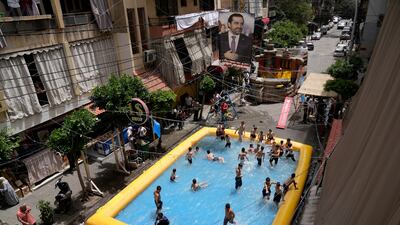
  • Children swim in an inflatable pool that supporters of former prime minister Saad Hariri installed to illustrate their intention to boycott parliamentary elections in Beirut, Lebanon. AP Photo
    Children swim in an inflatable pool that supporters of former prime minister Saad Hariri installed to illustrate their intention to boycott parliamentary elections in Beirut, Lebanon. AP Photo
  • Voters queue to place their vote in parliamentary elections in Beirut, Lebanon. EPA
    Voters queue to place their vote in parliamentary elections in Beirut, Lebanon. EPA
  • Nabih Berri, Speaker of the Lebanese Parliament, stands in a polling booth to vote in Tebnin. Reuters
    Nabih Berri, Speaker of the Lebanese Parliament, stands in a polling booth to vote in Tebnin. Reuters
  • Voters register at a polling station in Beirut. Bloomberg
    Voters register at a polling station in Beirut. Bloomberg
  • Lebanese President Michel Aoun follows the parliamentary elections on screens from the Presidential Palace in Beirut. AP
    Lebanese President Michel Aoun follows the parliamentary elections on screens from the Presidential Palace in Beirut. AP
  • A Lebanese woman shows her inked finger after she cast her vote at a polling station in Beirut. AP
    A Lebanese woman shows her inked finger after she cast her vote at a polling station in Beirut. AP
  • Voters look at a list of candidates at a polling station in Beirut. Bloomberg
    Voters look at a list of candidates at a polling station in Beirut. Bloomberg
  • Lebanese policemen help a voter into a polling station in Beirut. AP
    Lebanese policemen help a voter into a polling station in Beirut. AP
  • A Lebanese voter casts her ballot paper in Beirut. EPA
    A Lebanese voter casts her ballot paper in Beirut. EPA
  • Gyorgy Holvenyi (R), chief observer of the European Union election observation mission, visits a polling station in Beirut. EPA
    Gyorgy Holvenyi (R), chief observer of the European Union election observation mission, visits a polling station in Beirut. EPA
  • Lebanese people wait to vote during parliamentary elections in the capital city. EPA
    Lebanese people wait to vote during parliamentary elections in the capital city. EPA
  • Sheikh Abdul Latif Derian, Grand Mufti of Lebanon, casts his ballot paper during parliamentary elections in Beirut. EPA
    Sheikh Abdul Latif Derian, Grand Mufti of Lebanon, casts his ballot paper during parliamentary elections in Beirut. EPA
  • People queue to cast their votes in the Lebanese capital. AP
    People queue to cast their votes in the Lebanese capital. AP
  • Posters in Al Tariq Al Jadida, Beirut, depict Lebanon’s former prime minister Saad Hariri. Reuters
    Posters in Al Tariq Al Jadida, Beirut, depict Lebanon’s former prime minister Saad Hariri. Reuters
  • A woman prepares her ballot at a polling station in a southern suburb of Beirut. AFP
    A woman prepares her ballot at a polling station in a southern suburb of Beirut. AFP
  • Former prime minister Hassan Diab, who succeeded Saad Hariri, casts his ballot in Beirut. AFP
    Former prime minister Hassan Diab, who succeeded Saad Hariri, casts his ballot in Beirut. AFP
  • A voter checks lists for the parliamentary election at a polling station in the Lebanese capital Beirut. AFP
    A voter checks lists for the parliamentary election at a polling station in the Lebanese capital Beirut. AFP
  • A woman waits to vote in Beirut. EPA
    A woman waits to vote in Beirut. EPA
  • Security forces stand guard at Nur Square on the southern entrance of the northern Lebanese port city Tripoli. AFP
    Security forces stand guard at Nur Square on the southern entrance of the northern Lebanese port city Tripoli. AFP
  • Former Lebanese prime minister Fouad Siniora casts his vote at a polling station during the parliamentary election, in Sidon, southern Lebanon. Reuters
    Former Lebanese prime minister Fouad Siniora casts his vote at a polling station during the parliamentary election, in Sidon, southern Lebanon. Reuters
  • A man check voters' lists in the capital Beirut. AP
    A man check voters' lists in the capital Beirut. AP
  • A woman votes in Lebanon's parliamentary elections in Beirut. AP
    A woman votes in Lebanon's parliamentary elections in Beirut. AP
  • Police check the ID of voters outside a polling station near the Lebanese coastal city of Byblos (Jbeil), north of Beirut. AFP
    Police check the ID of voters outside a polling station near the Lebanese coastal city of Byblos (Jbeil), north of Beirut. AFP
  • A voter dips her finger in ink after casting her ballot in the parliamentary election at a polling station near Byblos. AFP
    A voter dips her finger in ink after casting her ballot in the parliamentary election at a polling station near Byblos. AFP
  • A Lebanese woman shows her ink-marked thumb after voting in Shmustar, Bekaa valley. EPA
    A Lebanese woman shows her ink-marked thumb after voting in Shmustar, Bekaa valley. EPA
  • People queueing to vote at Ras El Nabeh Public School for Girls. Fatima Al Mahmoud/ The National
    People queueing to vote at Ras El Nabeh Public School for Girls. Fatima Al Mahmoud/ The National

Lebanon elections 2022: anger, apathy and cynicism in Tripoli


Jamie Prentis
  • English
  • Arabic

Voters in Lebanon’s second city of Tripoli offered a mix of reasons for their decision of whether or not to take part in Sunday's parliamentary election, ranging from hope to apathy and cynical opportunism.

Many in the Sunni-dominated city — the poorest in a country beset by economic crisis — said a failure to vote would strengthen the hand of Hezbollah, the powerful, Iran-backed Shiite movement, and its parliamentary allies.

Others said they would stay away from the polls because none of the candidates on offer — including those from opposition lists linked to the October 2019 protests against Lebanon’s ruling classes — represented their interests.

But all agreed that Tripoli — with its high levels of poverty and unemployment — was in dire need of change, as they expressed frustration at politicians who they say have done nothing for them.

“There have been bad changes that happened in the last four years; we can feel them,” said Fadi Arabi, a football coach, who did not vote in the 2018 general election.

“This made us more interested in voting, to change this situation we are living in. We are thinking about our children, we want a better future for our children.”

Mr Arabi said he was voting also to prevent Gebran Bassil, leader of the Christian-led Free Patriotic Movement and a Hezbollah ally, from strengthening his position in parliament.

The decision by Saad Hariri to withdraw his Future Movement — often seen as a bastion of the Sunni community — from the election and leave politics, led to fears that many Sunnis would abstain from voting.

The three-time prime minister cited the futility of running when Iran was so influential within his country. Some Future Movement members disagreed and are contesting the election on other lists.

One of the lists is sponsored by Prime Minister Najib Mikati, a billionaire businessman from Tripoli, although he is not contesting the election as a candidate.

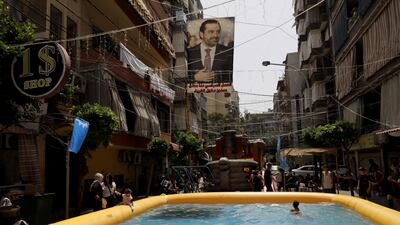
  • Beirut children play in an inflatable swimming pool set up by supporters of former Lebanese prime minister Saad Hariri, who have boycotted the country's elections. AFP
    Beirut children play in an inflatable swimming pool set up by supporters of former Lebanese prime minister Saad Hariri, who have boycotted the country's elections. AFP
  • Mr Hariri, seen in poster, suspended his participation in Lebanese politics last year and called on his supporters to boycott Sunday’s vote. AP
    Mr Hariri, seen in poster, suspended his participation in Lebanese politics last year and called on his supporters to boycott Sunday’s vote. AP
  • Supporters of former prime minister Saad Hariri set up an inflatable swimming pool in the Tarik El Jdideh neighborhood of Beirut, as they boycott Lebanon's elections. Getty
    Supporters of former prime minister Saad Hariri set up an inflatable swimming pool in the Tarik El Jdideh neighborhood of Beirut, as they boycott Lebanon's elections. Getty
  • Beirut children swim in an inflatable pool that supporters of former prime minister Saad Hariri set up to illustrate their intention to boycott parliamentary elections. AP
    Beirut children swim in an inflatable pool that supporters of former prime minister Saad Hariri set up to illustrate their intention to boycott parliamentary elections. AP

For Mr Arabi’s brother, Samer, this is the first time he is voting, as until last year he was a member of the Internal Security Forces and was ineligible to take part. He said he had planned not to vote because of Mr Hariri's withdrawal, but later changed his mind.

“We are looking for change. We want to change how politicians are playing with people and their religion,” he said.

Lebanon’s economic collapse since 2019 sent the local currency crashing by more than 90 per cent and has plunged most of the population into poverty. But Tripoli was poor even before then, particularly the Sunni-dominated Bab Al Tabbaneh neighbourhood.

From 2011 to 2014, the city was rocked by sectarian violence as Syria's civil war between Sunni-dominated rebels and an Alawite-led regime was reflected in Bab Al Tabbaneh and the Alawite Jebel Mohsen neighbourhood, which are separated by a single street called Syria Street.

The neighbourhoods of Bab Al Tabbaneh and Jebel Mohsen in the northern Lebanese city of Tripoli. AFP

But the sectarian tensions had been brewing long before 2011, and continue today.

Ahmed Ibrahim, a 51-year-old driver, blames the politicians.

He said: “A long time ago, Syria Street was called the road of gold. It was full of work and, from everywhere around Tripoli, they came. A lot of money and work, the economy was great.

“A long time ago, the Alawites used to live with us. Later on, they moved to Jebel Mohsen, and the politicians made a war between us. With their hands, not our hands. Before we used to live together, we didn’t know what the difference was between Sunni or Alawite; we were like brothers, living safely. The politicians made that war.”

Now, with the economic situation so dire, Mr Ibrahim is clear about which politicians will get the votes of himself and 24 family members and friends — the highest bidder.

He said he had already spoken to some representatives of electoral lists, and was “waiting for the right moment”.

According to another resident of Bab Al Tabbaneh, who asked not to be named, a group of 100 people could get 500 million Lebanese pounds ― 5 million each ― to vote collectively.

We are suffering now with many problems. No electricity, no water, poverty, unemployment. I think there could be change if the people were against Iran and Hezbollah. If they select the same people, nothing will change
Hassan Arour,
Tripoli resident

Hassan Arour, another local, said he was not surprised by the reports of a low voter turnout by the afternoon.

“A few are waiting for financial support because they need the money. Another part is not voting because of Saad Hariri. Another part are sad because of the boat tragedy,” he said, referring to the sinking of a vessel carrying many Tripoli residents seeking to reach Europe.

“We are suffering now with many problems. No electricity, no water, poverty, unemployment. I think there could be change if the people were against Iran and Hezbollah. If they select the same people, nothing will change.”

One Tripoli resident, who asked not to be named, said he would not vote on any account.

“I think the candidates are about 80 per cent the same. The rest, they are new, true, but they don’t mirror the needs and changes of the normal people like us. They don’t represent us with their ideas and thoughts," he said.

“We want somebody to feel with us, to hurt with us.”

But for Abdel Qadir Sawaf, there was no other choice.

“If you see Lebanon now — no electricity, no economy — we must go and change the political parties, we must do this," he said while sipping a coffee on Azmi Street before heading to a polling station.

‘We tried people before, but we have nothing. I voted before, and I vote again to change the people I voted for before, because they didn’t do anything to help me.”


Updated: May 19, 2022, 8:44 PM