


Pope Francis will visit Lebanon in June, the president’s office said on Tuesday, in an apparent show of support for the country experiencing an unprecedented economic meltdown.
Francis has held special prayers for Lebanon and has repeatedly said since the economic downturn began in October 2019 that he plans to visit the country.
Francis earlier said he was still working on arranging a meeting with the head of the Russian Orthodox Church, despite that leader’s apparent justification for Russia’s invasion of Ukraine.
The leader of the Roman Catholic Church said he would not rule out travelling to Ukraine if it would help.
While returning home from Malta on Sunday, Francis said he and Patriarch Kirill of Moscow were considering a location in the Middle East.
It was not immediately clear if their meeting will be held in Lebanon. The two leaders spoke by video on March 16.
The call was all the more remarkable because Francis and Kirill have only met once, at the Havana airport in 2016, in what was then the first encounter between a pope and Russian patriarch in more than 1,000 years.
Francis’s trip will be the first visit by a pope to the Mediterranean nation since 2012, when Pope Benedict XVI paid a three-day visit to Lebanon.
President Michel Aoun’s office said he received the Vatican’s ambassador to Lebanon, who told him Francis would visit in June, with an exact date and schedule to be decided later.
“The Lebanese have been waiting for this visit for a long time to express their gratitude to the pope for his stance toward Lebanon and its people,” Mr Aoun was quoted as saying.
The Vatican spokesman, Matteo Bruni, said a trip to Lebanon was “one of the hypotheses being studied".
More than 70 per cent of Lebanon’s 6 million people, including 1 million Syrian refugees, now live in poverty because of the crisis rooted in decades of corruption and mismanagement by the ruling class.
The Lebanese pound has lost more than 90 per cent of its value and tens of thousands of people have lost their jobs during the crisis, which the World Bank described as one of the worst the world has witnessed since the 1850s.
-
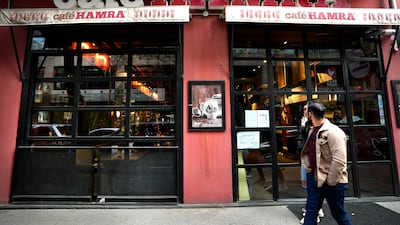
A coffee shop on Hamra Street in Beirut. The street has changed dramatically over the years, reflecting one of the three biggest financial crashes globally since the 1850s. All photos by AP -

Michel Eid, 88, works in his music shop on Hamra street. Mr Eid has witnessed the rise and fall of Lebanon through the changing fortunes of this famed boulevard for more than 60 years. -
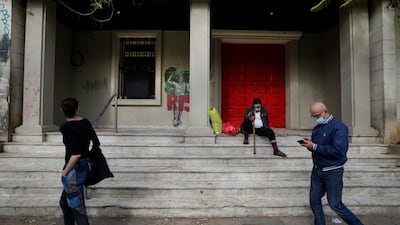
People pass in front of a beggar, centre, on Hamra Street. Fuelled by massive debt and the unsustainable way it was financed, the crisis has slashed Lebanon's gross domestic product by 58.1% since 2019, the World Bank said. -
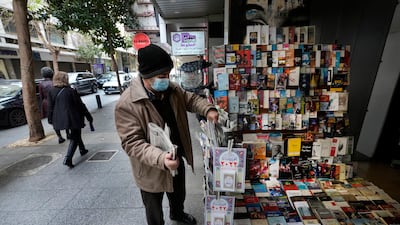
Naim Saleh, who sells newspapers, magazines and books. Mr Saleh said business has dropped dramatically - he used to sell 50 books a day, compared with only about two a month now. -

Shoppers pass a masks street vendor sitting on the ground next to a shop that has closed amid the country's economic crisis. -
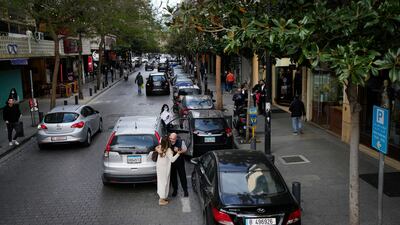
Hamra Street once was home to the region's top movie theatres, shops selling international brands and cafes where intellectuals from around the Arab world gathered. -
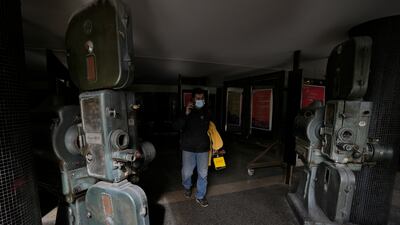
A man passes next to old movie projectors placed outside a theatre in Hamra Street. The projectors were used in the past at the movie theatre once known as Saroula. -
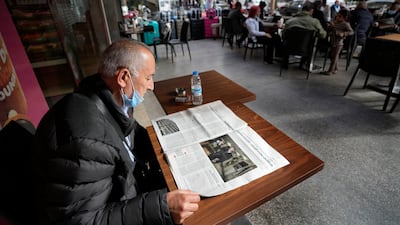
Today, Hamra Street reflects Lebanon's devastating multiple crises, with closed stores, beggars and piles of trash on the corners. -

Beggars sit in front of shops that have been closed since the economic crisis. -

A sign from an old clothes shop set by Hamra Merchants Committee. -
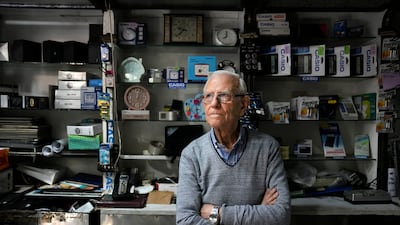
Michel Eid in his music shop. -

Elie Rbeiz, 70, a hairdresser at his shop in Hamra Street. Mr Rbeiz expanded his business 20 years ago to include men clothes. "Hamra is not the Hamra of the past," he said. His business has dropped 60% over the past two years. -

In January, the World Bank blasted Lebanon's ruling class for "orchestrating" one of the world's worst national economic depressions due to their exploitative grip on resources.


Lebanon also continues to struggle against the fall-out from a huge blast at Beirut’s port on August 4, 2020, which killed more than 216 people, injured more than 6,000 and damaged large parts of the capital.
The explosion of thousands of tonnes of improperly stored ammonium nitrate was one of the largest non-nuclear blasts in history. Twenty months later, the stalled judicial investigation has failed to provide answers.
Francis insisted last year that Lebanon must remain a “land of tolerance and pluralism” as he welcomed the country’s Christian patriarchs to the Vatican to pray for an end to the economic and political crisis that has thrown the country into chaos.
Lebanon has the largest percentage of Christians in the Middle East and is the only Arab country with a Christian head of state. Christians make up a third of the population.
The Vatican fears Lebanon’s collapse is particularly dangerous for its Christian community.

