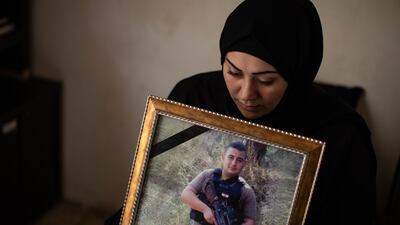
For many Lebanese Bitar is their only hope for truth and accountability in a country that craves both. AP

Beirut blast investigation suspended for fourth time


  • English
  • Arabic

The Lebanese judge leading investigations into last year's Beirut port blast was forced to stop work on Thursday over a lawsuit filed by former ministers he had summoned for interrogation, an official said.

The suspension is the fourth since Tarek Bitar was chosen to lead investigations in February.

It comes two weeks since Mr Bitar was cleared to resume work after a series of court challenges raised by political leaders derailed his efforts.

On Thursday, Mr Bitar was informed of a lawsuit submitted by legislators Ghazi Zeaiter and Ali Hasan Khalil – both members of the Shiite Amal Movement – which forced him to pause the inquiry until a ruling is issued, a court official told AFP.

The total number of lawsuits against Mr Bitar now stands at 18, the official said, most of which were filed by officials he is seeking to question on suspicion of criminal negligence.

Rights groups and relatives of blast victims have repeatedly condemned what they describe as blatant political interference in the investigation.

They say it aims to preserve a culture of political impunity in a country where even assassinations and bombings can go unpunished.

The August 4, 2020 explosion was caused by a huge stockpile of ammonium nitrate fertiliser that was stored haphazardly at Beirut port for years.

Top political and security officials knew of the dangers posed by the shipment but failed to take action.

The powerful Shiite movement Hezbollah is leading demands to remove Mr Bitar.

Its ministers have said they will boycott Cabinet sessions until an official decision is taken to replace him.

As a result, the government, which was formed in September to address an escalating economic crisis, has failed to meet since October, despite mounting woes.

Families of the Beirut Blast victims - in pictures

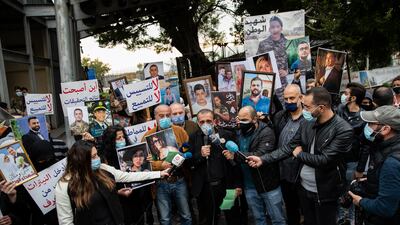
  • Ibrahim Hoteit, surrounded by the families of the victims of the Beirut blast, addresses the media outside the port of Beirut on the sixth-month anniversary of the explosion in February 2021.
    Ibrahim Hoteit, surrounded by the families of the victims of the Beirut blast, addresses the media outside the port of Beirut on the sixth-month anniversary of the explosion in February 2021.
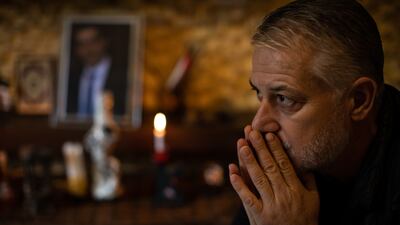
  • Kayan Tleiss sits in front of the shrine dedicated to his brother in his living room in Khalde, in the southern suburbs of Beirut.
    Kayan Tleiss sits in front of the shrine dedicated to his brother in his living room in Khalde, in the southern suburbs of Beirut.
  • A photograph of Mohammad Tleiss is flanked by an image of the Virgin Mary and a copy of the Quran in Kayan Tleiss’s living room in Khalde in Beirut.
    A photograph of Mohammad Tleiss is flanked by an image of the Virgin Mary and a copy of the Quran in Kayan Tleiss’s living room in Khalde in Beirut.
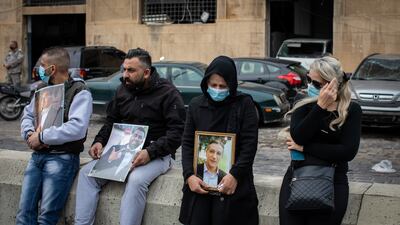
  • Kayan’s mother, holding a photograph of her son, Mohammed, sits outside the port of Beirut on the sixth-month anniversary of the explosion.
    Kayan’s mother, holding a photograph of her son, Mohammed, sits outside the port of Beirut on the sixth-month anniversary of the explosion.
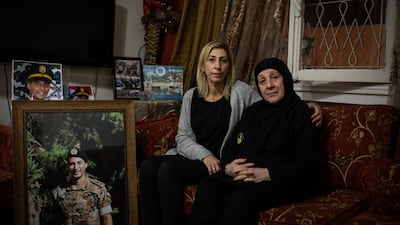
  • Tharwat and Nada Noureddine sit in their living groom in Mar Elias in Beirut surrounded by photographs of Tharwat’s brother and Nada’s son, Ayman.
    Tharwat and Nada Noureddine sit in their living groom in Mar Elias in Beirut surrounded by photographs of Tharwat’s brother and Nada’s son, Ayman.
  • Tharwat Noureddine holds a photograph that Ayman kept on his desk in Beirut. The frame was damaged during the explosion.
    Tharwat Noureddine holds a photograph that Ayman kept on his desk in Beirut. The frame was damaged during the explosion.
  • Photographs of Tharwat’s brother and Nada’s son, Ayman, adorn the family's living room in Mar Elias in Beirut. Ayman had returned from five months of training in the US right before the explosion.
    Photographs of Tharwat’s brother and Nada’s son, Ayman, adorn the family's living room in Mar Elias in Beirut. Ayman had returned from five months of training in the US right before the explosion.
  • Salam Iskandar, her husband, Jaber, and their son, Ali, sit in their living room in Borj El Brajneh in the southern suburbs of Beirut, surrounded by photographs of Salam's brother, Hamza, who died in the Beirut port blast. All photos: Oliver Marsden / The National
    Salam Iskandar, her husband, Jaber, and their son, Ali, sit in their living room in Borj El Brajneh in the southern suburbs of Beirut, surrounded by photographs of Salam's brother, Hamza, who died in the Beirut port blast. All photos: Oliver Marsden / The National
  • Salam Iskandar holds a photograph of her brother, Hamza, on her lap.
    Salam Iskandar holds a photograph of her brother, Hamza, on her lap.
The more serious side of specialty coffee

While the taste of beans and freshness of roast is paramount to the specialty coffee scene, so is sustainability and workers’ rights.

The bulk of genuine specialty coffee companies aim to improve on these elements in every stage of production via direct relationships with farmers. For instance, Mokha 1450 on Al Wasl Road strives to work predominantly with women-owned and -operated coffee organisations, including female farmers in the Sabree mountains of Yemen.

Because, as the boutique’s owner, Garfield Kerr, points out: “women represent over 90 per cent of the coffee value chain, but are woefully underrepresented in less than 10 per cent of ownership and management throughout the global coffee industry.”

One of the UAE’s largest suppliers of green (meaning not-yet-roasted) beans, Raw Coffee, is a founding member of the Partnership of Gender Equity, which aims to empower female coffee farmers and harvesters.

Also, globally, many companies have found the perfect way to recycle old coffee grounds: they create the perfect fertile soil in which to grow mushrooms. 

Real estate tokenisation project

Dubai launched the pilot phase of its real estate tokenisation project last month.

The initiative focuses on converting real estate assets into digital tokens recorded on blockchain technology and helps in streamlining the process of buying, selling and investing, the Dubai Land Department said.

Dubai’s real estate tokenisation market is projected to reach Dh60 billion ($16.33 billion) by 2033, representing 7 per cent of the emirate’s total property transactions, according to the DLD.

How much sugar is in chocolate Easter eggs?
  • The 169g Crunchie egg has 15.9g of sugar per 25g serving, working out at around 107g of sugar per egg
  • The 190g Maltesers Teasers egg contains 58g of sugar per 100g for the egg and 19.6g of sugar in each of the two Teasers bars that come with it
  • The 188g Smarties egg has 113g of sugar per egg and 22.8g in the tube of Smarties it contains
  • The Milky Bar white chocolate Egg Hunt Pack contains eight eggs at 7.7g of sugar per egg
  • The Cadbury Creme Egg contains 26g of sugar per 40g egg
COMPANY%20PROFILE
%3Cp%3E%3Cstrong%3ECompany%20name%3A%3C%2Fstrong%3E%20Revibe%20%0D%3Cbr%3E%3Cstrong%3EStarted%3A%3C%2Fstrong%3E%202022%0D%3Cbr%3E%3Cstrong%3EFounders%3A%3C%2Fstrong%3E%20Hamza%20Iraqui%20and%20Abdessamad%20Ben%20Zakour%20%0D%3Cbr%3E%3Cstrong%3EBased%3A%3C%2Fstrong%3E%20UAE%20%0D%3Cbr%3E%3Cstrong%3EIndustry%3A%3C%2Fstrong%3E%20Refurbished%20electronics%20%0D%3Cbr%3E%3Cstrong%3EFunds%20raised%20so%20far%3A%3C%2Fstrong%3E%20%2410m%20%0D%3Cbr%3E%3Cstrong%3EInvestors%3A%20%3C%2Fstrong%3EFlat6Labs%2C%20Resonance%20and%20various%20others%0D%3C%2Fp%3E%0A

Mercer, the investment consulting arm of US services company Marsh & McLennan, expects its wealth division to at least double its assets under management (AUM) in the Middle East as wealth in the region continues to grow despite economic headwinds, a company official said.

Mercer Wealth, which globally has $160 billion in AUM, plans to boost its AUM in the region to $2-$3bn in the next 2-3 years from the present $1bn, said Yasir AbuShaban, a Dubai-based principal with Mercer Wealth.

Within the next two to three years, we are looking at reaching $2 to $3 billion as a conservative estimate and we do see an opportunity to do so,” said Mr AbuShaban.

Mercer does not directly make investments, but allocates clients’ money they have discretion to, to professional asset managers. They also provide advice to clients.

“We have buying power. We can negotiate on their (client’s) behalf with asset managers to provide them lower fees than they otherwise would have to get on their own,” he added.

Mercer Wealth’s clients include sovereign wealth funds, family offices, and insurance companies among others.

From its office in Dubai, Mercer also looks after Africa, India and Turkey, where they also see opportunity for growth.

Wealth creation in Middle East and Africa (MEA) grew 8.5 per cent to $8.1 trillion last year from $7.5tn in 2015, higher than last year’s global average of 6 per cent and the second-highest growth in a region after Asia-Pacific which grew 9.9 per cent, according to consultancy Boston Consulting Group (BCG). In the region, where wealth grew just 1.9 per cent in 2015 compared with 2014, a pickup in oil prices has helped in wealth generation.

BCG is forecasting MEA wealth will rise to $12tn by 2021, growing at an annual average of 8 per cent.

Drivers of wealth generation in the region will be split evenly between new wealth creation and growth of performance of existing assets, according to BCG.

Another general trend in the region is clients’ looking for a comprehensive approach to investing, according to Mr AbuShaban.

“Institutional investors or some of the families are seeing a slowdown in the available capital they have to invest and in that sense they are looking at optimizing the way they manage their portfolios and making sure they are not investing haphazardly and different parts of their investment are working together,” said Mr AbuShaban.

Some clients also have a higher appetite for risk, given the low interest-rate environment that does not provide enough yield for some institutional investors. These clients are keen to invest in illiquid assets, such as private equity and infrastructure.

“What we have seen is a desire for higher returns in what has been a low-return environment specifically in various fixed income or bonds,” he said.

“In this environment, we have seen a de facto increase in the risk that clients are taking in things like illiquid investments, private equity investments, infrastructure and private debt, those kind of investments were higher illiquidity results in incrementally higher returns.”

The Abu Dhabi Investment Authority, one of the largest sovereign wealth funds, said in its 2016 report that has gradually increased its exposure in direct private equity and private credit transactions, mainly in Asian markets and especially in China and India. The authority’s private equity department focused on structured equities owing to “their defensive characteristics.”

Tell Me Who I Am

Director: Ed Perkins

Stars: Alex and Marcus Lewis

Four stars

Updated: December 23, 2021, 2:42 PM