


Lebanon’s military intelligence agency summoned Lebanese Forces leader Samir Geagea on Monday to give a statement about recent clashes that left seven people dead in one of the country’s worst episodes of violence since 2008.
The summons comes after Iran-backed Hezbollah accused the country's second largest Christian party, Lebanese Forces (LF), of shooting at protesters who took to the streets to demand the removal of the judge leading the investigation into the Beirut port blast.
Mr Geagea denied the accusations, arguing that Hezbollah loyalists sparked the clashes with local residents when they stormed and vandalised property in an area that separated Christian and Muslim neighbourhoods during the country’s 15-year civil war.
Mr Geagea was asked to testify at the army intelligence’s headquarters on Wednesday, according to a notice posted at LF headquarters. Mr Geagea was not present to receive the request, a source close to the LF leader told The National.
The source said the LF's parliamentary bloc and legal team will assess the request and decide on future appropriate measures.
However, the source described the move as part of the continuing tug of war between “those who seek to uphold Lebanon’s sovereignty and state monopoly over weapons on one hand, and Hezbollah on the other.”
-
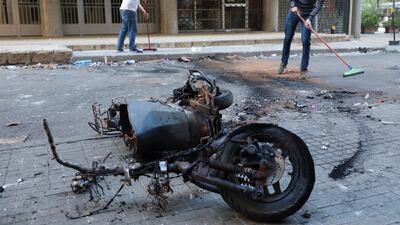
People clean up a street a day after clashes and gunfire erupted in Beirut, Lebanon. Reuters -
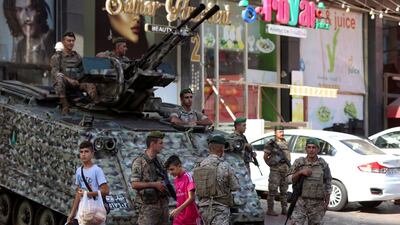
Boys walk past soldiers in Beirut. Six people died during clashes in the Lebanese capital on Thursday. Reuters -

A woman talks on the phone as she stands on her damaged balcony in the district of Ain Al Remaneh, where some of the worst clashes took place. AFP -
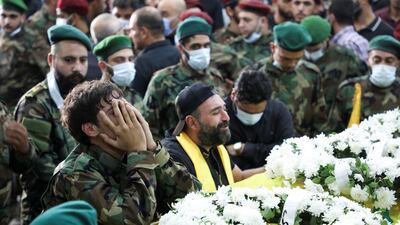
Supporters of Lebanon's Hezbollah attend a funeral in Beirut's southern suburbs. The group accused the Christian Lebanese Forces party of carrying out the Beirut attacks. Reuters -

People stand on the balcony on a bullet-riddled building. Reuters -
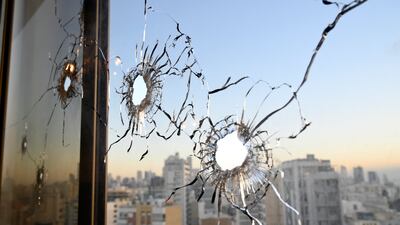
Bullet holes on a window of an apartment building. EPA -

Supporters of Hezbollah chant slogans during a funeral procession in the southern Beirut suburb of Dahiyeh. AP Photo -
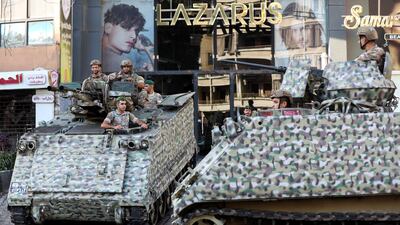
Lebanese soldiers patrol the streets a day after the deadly clashes. Reuters -
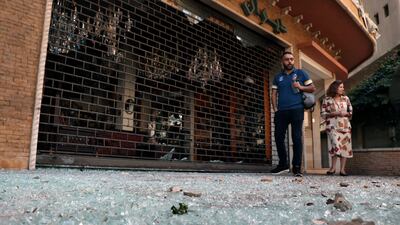
People walk on glass from broken windows littering a street after the violence. AP -

A soldier gestures as he stands in a military vehicle. AP


Mr Geagea had said Hezbollah’s attack on peaceful neighbourhoods was reminiscent of the May 7, 2008 events, when gunmen loyal to the Iran-backed party overran parts of Beirut after the government decided to dismantle its private telecom network.
The LF source said law should apply to all parties including Hezbollah, echoing an earlier statement by Mr Geagea. The latter told a local TV station days earlier he would only give a statement after investigators first listen to Hezbollah leader Hassan Nasrallah.
Mr Geagea, however, said the confrontation with Hezbollah must remain political. Hezbollah leader Hassan Nasrallah has accused Mr Geagea of seeking to instigate civil strife.
Earlier on Monday, the government commissioner at the military court charged 68 people including 18 detainees with murder and inciting sectarian strife in connection with the clashes.
The army said it had concluded investigations into the incident and referred the case to the military prosecutor.
The clashes broke out shortly after protesters gathered for a demonstration organised by Hezbollah and its Shiite ally, Parliament Speaker Nabih Berri’s Amal movement, against Judge Tarek Bitar.
Mr Bitar has issued arrest warrants for two former ministers allied with Hezbollah, including ex-finance minister Ali Hassan Khalil, a close aide of Mr Berri and a member of his parliamentary bloc who was the target of US sanctions last year.
The two indicted officials, along with two other former ministers and former prime minister Hassan Diab, have snubbed Mr Bitar’s summons, arguing he has no authority to prosecute them in line with the constitution. All five argue that they should be tried instead by a special body comprising senior judges and parliamentarians.
Hezbollah has since accused Mr Bitar of politicising the probe into the port explosion that killed over 200 people and destroyed large parts of the capital in August 2020.
Media reports have linked hundreds of tons of explosive fertilisers that were stored at Beirut port for over six years to businessmen with close links to Syrian President Bashar Assad, a key ally of Hezbollah.
It remains unclear who owned the ammonia nitrate, what triggered the explosion or why it was left sitting at the port for so long.
The explosion left Lebanon without a functioning cabinet for a year, compounding the country’s financial meltdown. The crisis has been described by the World Bank as one of the most severe globally since the 1850s.
Lebanon's new cabinet, led by Prime Minister Najib Mikati, has yet to convene since the clashes after ministers affiliated with Hezbollah and its allies threatened to boycott the coming session if Mr Bitar was not replaced.

