


Customers will be banned from Lebanon’s restaurants, beaches and hotels from next week unless they prove they are either immunised or free of the coronavirus, the Tourism Ministry said.
People over 16 years of age must present proof of vaccination, evidence of a recent coronavirus infection or a negative Covid-19 test to be allowed into tourist spots.
“Tourist establishments, hotels, restaurants, cafes, amusement parks, sea resorts and all institutions under the authority of the ministry must work within a safe, coronavirus-free environment,” the statement said.
The circular, issued on Friday, follows a rise in Covid-19 cases at the height of the tourist season, when Lebanese citizens living abroad return home.
Doctors say the rise in cases could signal a new wave of infections, which cash-strapped authorities are ill-equipped to contain.
Dr Firass Abiad, who runs Lebanon’s largest public hospital, said last week on Twitter that “summer vacation in Lebanon is over. Covid is increasing at an exponential rate.”
Lebanon recorded 1,502 new coronavirus cases on Tuesday, the highest number of daily infections since April. One new Covid-19 death was announced.
Head of Lebanon’s Covid-19 vaccination committee, Doctor Abdulrahman Bizri, said that while the new decision was theoretically sound, it may be difficult to implement, as well as discriminatory.
“We cannot demand that everyone show proof of vaccination if there are not enough vaccines,” he said, pointing to the country’s slow inoculation campaign.
The government is using the measures as an alternative to lockdowns as cases rise, he said, but the new rules “do not take into consideration Lebanon’s difficult reality.”
Lebanon has been in economic freefall since late 2019 due to decades of corruption and a lack of foreign currency reserves. More than half of the population has become poor according to UN data as inflation slashes purchasing power.
Coronavirus around the world - in pictures
-
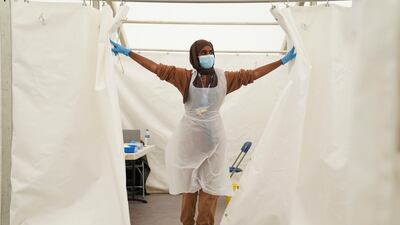
A National Health Service worker prepares for patients at a pop-up vaccination centre during a four-day Covid-19 vaccine festival in Langdon Park, east London. -

Young people line up to receive shots of Sinovac's Covid-19 vaccine at the Phnom Penh Thmey Health Centre, in Phnom Penh, Cambodia. -
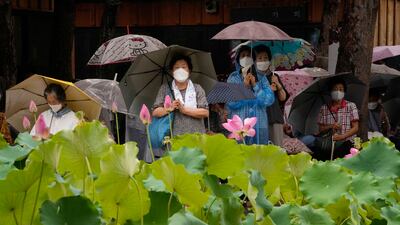
People wearing face masks as a precaution against the coronavirus pray during a service at the Chogyesa temple in Seoul, South Korea. -
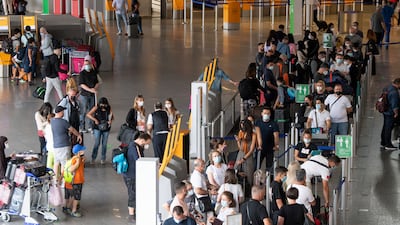
Passengers wearing face masks wait in the outbound queue at Frankfurt airport, in Germany. -
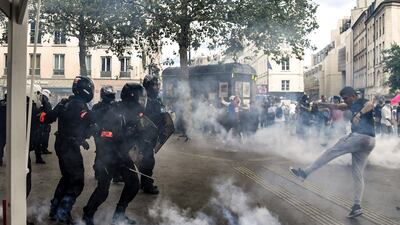
Demonstrators clash with police at the end of a national day of protest against French legislation making a Covid-19 health pass compulsory to visit a cafe, board a plane or travel on an inter-city train, in Paris. -
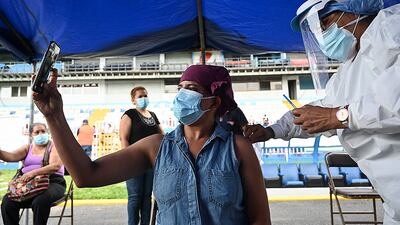
A woman takes a selfie while receiving the first dose of the Moderna vaccine against Covid-19, during the vaccination day called 'Vacunaton', which aims to immunise 50,000 Hondurans aged over 35 in the National Stadium, in Tegucigalpa. -
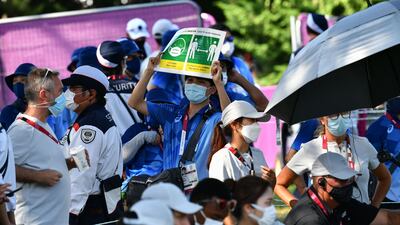
A volunteer holds up a sign to remind people to adhere to Covid-19 protocols during round 4 of the men’s golf individual stroke play during the Tokyo 2020 Olympic Games at the Kasumigaseki Country Club in Kawagoe. -
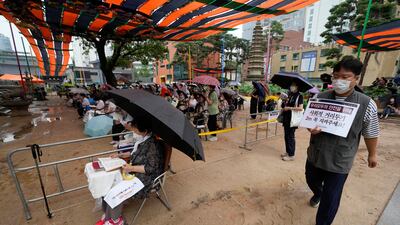
A man with a notice walks around people wearing face masks as a precaution against the coronavirus during a service at the Chogyesa temple in Seoul, South Korea. -
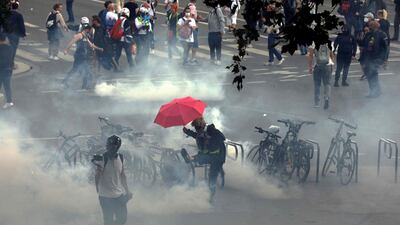
A demonstrator kicks away a smoking teargas shell during a national day of protest against compulsory Covid-19 vaccinations for certain workers and the compulsory use of health passes, in Paris. -
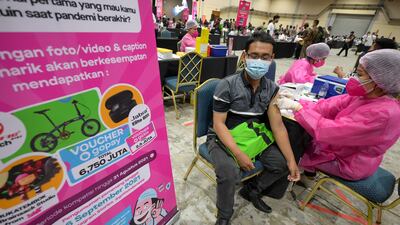
A health worker, right, administers the Sinovac vaccine during a mass vaccination drive against the Covid-19 coronavirus outbreak in Jakarta.


Public health officials attribute the sharp rise in coronavirus cases to the spread of the highly infectious Delta variant. They say it is responsible for up to 80 per cent of new cases.
Lebanon’s relatively low vaccination rate and the lack of border restrictions have fuelled rising infections.
The tourism ministry’s circular covers employees of the tourism sector, who “must receive the vaccine or present a negative PCR test every 72 hours” within two weeks, the circular said.
From Monday, the authorities will crack down on those who fail to abide by the rules.
A spokeswoman for the trade union representing restaurant, cafe and nightclub owners said its members were prepared to enforce the ministry’s decision but had received no specific instructions on how to do so.
“The circular was issued right before the weekend so we didn’t get any additional information. We are waiting to know more on Monday,” she said.

