

Lebanon’s Parliament on Wednesday approved over half a billion dollars in cash assistance to help more than 500,000 families make ends meet.
The ration card bill, which will give up to $126 dollars a month to eligible families, comes as the worst economic crisis to engulf the country in decades deepens.
It is now up to the country's caretaker Cabinet to identify the programme’s beneficiaries and secure funding, Parliament Speaker Nabih Berri said.
“Parliament is bound to discuss and approve the ration card bill … As for the card’s financing and payment mechanisms, it remains the government’s responsibility rather than parliament’s,” Mr Berri told politicians.
The programme aims to replace subsidies that cost Lebanon $6 billion last year, caretaker Finance Minister Ghazi Wazni estimated.
Beneficiaries would be able to spend funds at retail outlets while people living in rural areas may be allowed to withdraw cash, MP Yassin Jaber, a member of Mr Berri’s parliamentary bloc, told The National.
But where the funding will come from for the project is still in question amid dwindling foreign currency reserves.
Mr Jaber said the government was exploring several options to finance the programme, including funds from the International Monetary Fund.
The IMF had informed Mr Wazni that it may consider assigning $900 million to Lebanon in August as part of a proposal to allocate Special Drawing Rights (SDR) to member states to the tune of $650 billion, a statement by the finance ministry said on Tuesday. The IMF’s board of governors will study the proposal in July.
Other options to fund the new package include tapping the Central Bank for a loan that the government could repay once it secures international financial support, Mr Jaber said.
The latter option, however, faces staunch opposition from a number of parliamentary blocs with politicians arguing against the Central Bank dipping into its dwindling foreign currency reserves to fund the programme.
MP Hadi Abu Al Hassan said he feared the programme's implementation would stall.
Mr Jaber said the government has 15 days to set up the programme mechanisms once the law goes into effect.
“These cards should have been issued since the onset of the pandemic to make up for economic hardships,” Mr Jaber added.
The pandemic compounded one of the worst economic crises to grip Lebanon in decades. The crisis has plunged more than half the population into poverty with the national currency losing over 90 per cent of its market value since late 2019.
The newly approved ration cards would complement a social safety net programme to be funded by the World Bank. A $246 million World Bank loan was approved by Parliament in May but has yet to be disbursed pending negotiations with the government over the programme’s roll-out mechanisms.
The delay in the delivery of aid programmes, despite the economic urgency, has fuelled protests and sparked scuffles across the country in recent weeks as people struggled with shortages in fuel, medication and basic commodities.
-
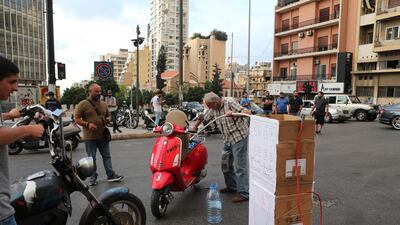
Anti-government protesters set up a mock petrol pump with inscription reading in Arabic 'Dignity Petrol Station' at the Tabaris road in Beirut, Lebanon. EPA -
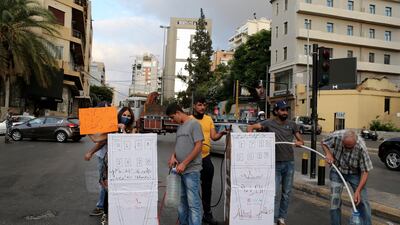
Lebanon is in the midst of an economic crisis. Dwindling foreign currency reserves have led to acute shortages of fuel, as well as other imported commodities. EPA -

Fed-up motorists queue for fuel at a Beirut petrol station. In recent days, some have waited for hours only to find that supplies have run out when they reach the top of the queue. Reuters -
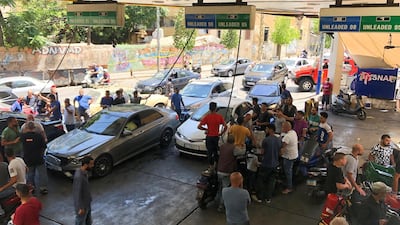
Tensions among motorists waiting for petrol have sometimes led to scuffles, as Lebanon struggles to secure fuel supplies. Reuters -
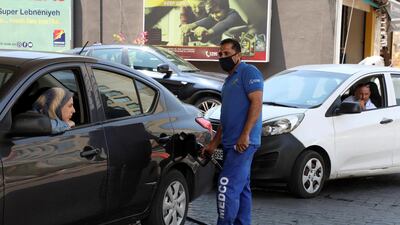
A petrol station worker fills up a customer's car in Beirut. The fuel crisis has also led to disruptions in vital infrastructure services, with more frequent power blackouts, water shortages and internet outages. Reuters -
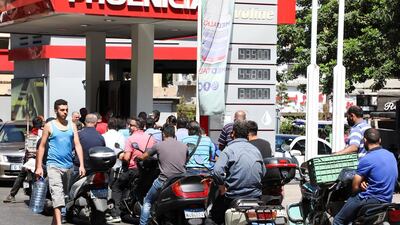
Motorcyclists wait in line for fuel at a Beirut petrol station. Fuel shortages have affected supplies for private generators that make up for state power rationing. Meanwhile, hospitals are also running low on medical supplies. Reuters -
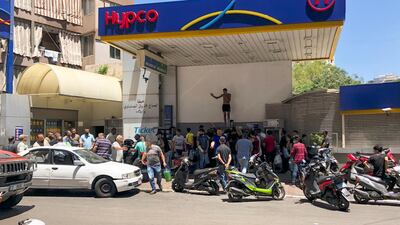
A queue at a Beirut petrol station. Lebanon remains without a fully functioning Cabinet, following a massive explosion at Beirut port that killed more than 200 people last August. Reuters


Shortages have worsened in recent months as the Central Bank continued to ration its subsidies of vital imports amid dwindling foreign currency reserves.
The liquidity crunch prompted the government to recently reduce subsidies on fuel imports, pushing the price of gasoline and diesel up by over a third.
The economic crisis has been further accentuated by the widening political rift between President Michel Aoun and prime minister-designate Saad Hariri over the coming Cabinet's make-up and reform agenda.
The political deadlock has left Lebanon without a fully functioning government since the massive explosion that killed more than 200 people and destroyed thousands of properties across the capital last August.

