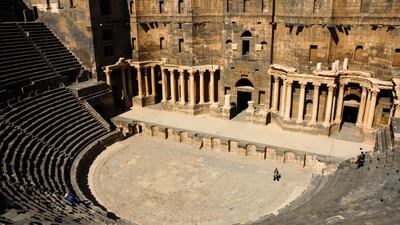
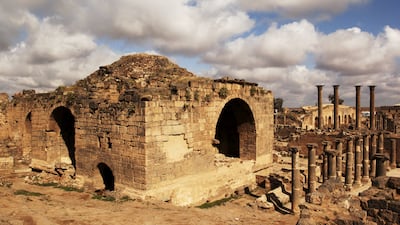
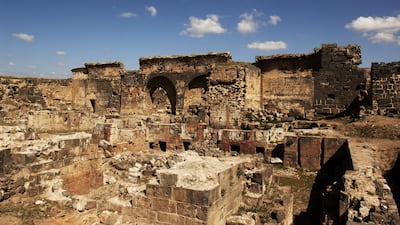
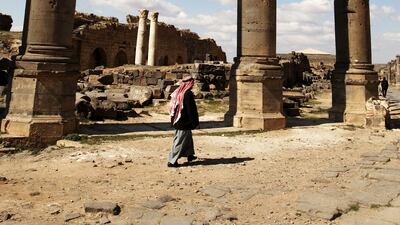
On a wintry afternoon, the basalt theatre in the Greco-Roman city of Gadara in northern Jordan can appear forbiddingly bleak.
Its builders, however, knew how to break the drabness.
“Like this,” says architect Boris Bogdanovic as he picks up two fragments of white marble from the ground and juxtaposes them on the edge of the stage.
The marble cornice that adorned the edges of the 3,000-capacity venue has all broken off or been stolen. It could have come from present day Greece, or Italy, Mr Bogdanovic says.
The theatre resembles a larger one in Bosra, another basalt city 95 kilometres to the east, in present day Syria. The city, which was Nabatean, fell to Roman suzerainty in the second century.
While Bosra, regarded as one the greatest sites of antiquity in the Levant, is practically off limits to most tourists because of the upheaval in Syria, a visit to Gadara could compensate for what they cannot see across the border.
Both cities were situated on trading routes – to the Mediterranean in the case of Gadara and to the Red Sea in regard to Bosra, which was the larger commercial centre.
Bosra even featured in the life of the Prophet Mohammed, who accompanied caravans from inner Arabia to the city when he was young.
Gadara had an estimated population of 30,000 people, less than half that of Bosra.
The two cities received water through advanced aqueducts. They flourished under the emperors Trojan and Hadrian, renowned builders in Imperial Rome.
The ruins of Gadara and Bosra are fairly typical of Roman cities: theatre, baths, colonnaded streets, cisterns and a large public fountain, as well as shops and houses. But they are unusual in that they are largely black or dark grey.
Gadara's infrastructure remains are also impressive: one cistern in the city is 10 metres deep by 11 metres wide. A gravity-based water system that supplied the city stretched 170 kilometres into the Syrian interior. It was largely comprised of tunnels, parts of which survive. They were among the longest built in the ancient world.
From almost anywhere in Gadara there is a view of the Sea of Galilee in present day Israel; the Golan Heights, which Israel has occupied since 1967; and the valley of the Yarmouk, a main tributary of the Jordan river.
Bosra became capital of the Roman province of Arabia Petraea (Stony Arabia), although it is situated on the edge of the Great Syrian Desert.
Gadara was capital of the Decapolis, a league of 10 Greek cities in the Levant, of which Bosra was not a member. The Decapolis allied with Rome and was bound by security and commercial interests. Menippus, a satirist and a disciple of the Cynic philosopher Diogenes, was born in Gadara.
A few kilometres away is the site of the 636 AD Battle of Yarmouk , one of the most significant, and by some accounts, one of the bloodiest, military encounters before the invention of modern weapons. The defeat of the Byzantines by the Rashidyn dynasty marked a significant expansion of Islam and the end of Byzantine rule over Syria.
Mr Bogdanovic says the Gadara theatre bears uncanny resemblance to the one in Bosra, and both could have been built by the architect Apollodorus of Damascus. But he cautions that this is only a hypothesis that needs more research.
He supervises restoration work at the theatre and in a 19th-century village on the edge of Gadara, on behalf of Turquoise Mountain, a charity founded by Prince Charles.
A New Zealander born in the Balkans, Mr Bogdanovic says Gadara's natural location enhanced its defences.
He also describes it as "a very healthy place", citing the ancient Romans' affinity for holidaying in Gadara and enjoying the city's sights, baths, wine, theatre and a diverse plant cover.
"Gadara was a more poetic place," he says.

Ten tax points to be aware of in 2026
1. Domestic VAT refund amendments: request your refund within five years
If a business does not apply for the refund on time, they lose their credit.
2. E-invoicing in the UAE
Businesses should continue preparing for the implementation of e-invoicing in the UAE, with 2026 a preparation and transition period ahead of phased mandatory adoption.
3. More tax audits
Tax authorities are increasingly using data already available across multiple filings to identify audit risks.
4. More beneficial VAT and excise tax penalty regime
Tax disputes are expected to become more frequent and more structured, with clearer administrative objection and appeal processes. The UAE has adopted a new penalty regime for VAT and excise disputes, which now mirrors the penalty regime for corporate tax.
5. Greater emphasis on statutory audit
There is a greater need for the accuracy of financial statements. The International Financial Reporting Standards standards need to be strictly adhered to and, as a result, the quality of the audits will need to increase.
6. Further transfer pricing enforcement
Transfer pricing enforcement, which refers to the practice of establishing prices for internal transactions between related entities, is expected to broaden in scope. The UAE will shortly open the possibility to negotiate advance pricing agreements, or essentially rulings for transfer pricing purposes.
7. Limited time periods for audits
Recent amendments also introduce a default five-year limitation period for tax audits and assessments, subject to specific statutory exceptions. While the standard audit and assessment period is five years, this may be extended to up to 15 years in cases involving fraud or tax evasion.
8. Pillar 2 implementation
Many multinational groups will begin to feel the practical effect of the Domestic Minimum Top-Up Tax (DMTT), the UAE's implementation of the OECD’s global minimum tax under Pillar 2. While the rules apply for financial years starting on or after January 1, 2025, it is 2026 that marks the transition to an operational phase.
9. Reduced compliance obligations for imported goods and services
Businesses that apply the reverse-charge mechanism for VAT purposes in the UAE may benefit from reduced compliance obligations.
10. Substance and CbC reporting focus
Tax authorities are expected to continue strengthening the enforcement of economic substance and Country-by-Country (CbC) reporting frameworks. In the UAE, these regimes are increasingly being used as risk-assessment tools, providing tax authorities with a comprehensive view of multinational groups’ global footprints and enabling them to assess whether profits are aligned with real economic activity.
Contributed by Thomas Vanhee and Hend Rashwan, Aurifer
The%20Emperor%20and%20the%20Elephant
%3Cp%3E%3Cstrong%3EAuthor%3A%20%3C%2Fstrong%3ESam%20Ottewill-Soulsby%3C%2Fp%3E%0A%3Cp%3E%3Cstrong%3EPublisher%3A%20%3C%2Fstrong%3EPrinceton%20University%20Press%3C%2Fp%3E%0A%3Cp%3E%3Cstrong%3EPages%3A%20%3C%2Fstrong%3E392%3C%2Fp%3E%0A%3Cp%3E%3Cstrong%3EAvailable%3A%20%3C%2Fstrong%3EJuly%2011%3C%2Fp%3E%0A
Sting & Shaggy
44/876
(Interscope)
2020 Oscars winners: in numbers
- Parasite – 4
- 1917– 3
- Ford v Ferrari – 2
- Joker – 2
- Once Upon a Time ... in Hollywood – 2
- American Factory – 1
- Bombshell – 1
- Hair Love – 1
- Jojo Rabbit – 1
- Judy – 1
- Little Women – 1
- Learning to Skateboard in a Warzone (If You're a Girl) – 1
- Marriage Story – 1
- Rocketman – 1
- The Neighbors' Window – 1
- Toy Story 4 – 1
The%20specs%3A%20Taycan%20Turbo%20GT
%3Cp%3E%3Cstrong%3EEngine%3A%20%3C%2Fstrong%3EDual%20synchronous%20electric%20motors%0D%3Cbr%3E%3Cstrong%3EPower%3A%20%3C%2Fstrong%3E1%2C108hp%0D%3Cbr%3E%3Cstrong%3ETorque%3A%20%3C%2Fstrong%3E1%2C340Nm%0D%3Cbr%3E%3Cstrong%3ETransmission%3A%20%3C%2Fstrong%3ESingle-speed%20automatic%20(front%20axle)%3B%20two-speed%20transmission%20(rear%20axle)%0D%3Cbr%3E%3Cstrong%3ETouring%20range%3A%20%3C%2Fstrong%3E488-560km%0D%3Cbr%3E%3Cstrong%3EPrice%3A%20%3C%2Fstrong%3EFrom%20Dh928%2C400%0D%3Cbr%3E%3Cstrong%3EOn%20sale%3A%20%3C%2Fstrong%3EOrders%20open%3C%2Fp%3E%0A
German intelligence warnings
- 2002: "Hezbollah supporters feared becoming a target of security services because of the effects of [9/11] ... discussions on Hezbollah policy moved from mosques into smaller circles in private homes." Supporters in Germany: 800
- 2013: "Financial and logistical support from Germany for Hezbollah in Lebanon supports the armed struggle against Israel ... Hezbollah supporters in Germany hold back from actions that would gain publicity." Supporters in Germany: 950
- 2023: "It must be reckoned with that Hezbollah will continue to plan terrorist actions outside the Middle East against Israel or Israeli interests." Supporters in Germany: 1,250
Source: Federal Office for the Protection of the Constitution
Terror attacks in Paris, November 13, 2015
- At 9.16pm, three suicide attackers killed one person outside the Atade de France during a foootball match between France and Germany
- At 9.25pm, three attackers opened fire on restaurants and cafes over 20 minutes, killing 39 people
- Shortly after 9.40pm, three other attackers launched a three-hour raid on the Bataclan, in which 1,500 people had gathered to watch a rock concert. In total, 90 people were killed
- Salah Abdeslam, the only survivor of the terrorists, did not directly participate in the attacks, thought to be due to a technical glitch in his suicide vest
- He fled to Belgium and was involved in attacks on Brussels in March 2016. He is serving a life sentence in France
Winners
Ballon d’Or (Men’s)
Ousmane Dembélé (Paris Saint-Germain / France)
Ballon d’Or Féminin (Women’s)
Aitana Bonmatí (Barcelona / Spain)
Kopa Trophy (Best player under 21 – Men’s)
Lamine Yamal (Barcelona / Spain)
Best Young Women’s Player
Vicky López (Barcelona / Spain)
Yashin Trophy (Best Goalkeeper – Men’s)
Gianluigi Donnarumma (Paris Saint-Germain and Manchester City / Italy)
Best Women’s Goalkeeper
Hannah Hampton (England / Aston Villa and Chelsea)
Men’s Coach of the Year
Luis Enrique (Paris Saint-Germain)
Women’s Coach of the Year
Sarina Wiegman (England)
Who's who in Yemen conflict
Houthis: Iran-backed rebels who occupy Sanaa and run unrecognised government
Yemeni government: Exiled government in Aden led by eight-member Presidential Leadership Council
Southern Transitional Council: Faction in Yemeni government that seeks autonomy for the south
Habrish 'rebels': Tribal-backed forces feuding with STC over control of oil in government territory