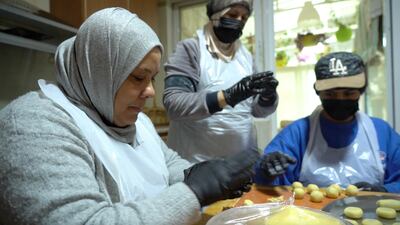
Jordanian pastry chef Suha Abdulkarim is crushing gold-coloured dates to make a filling for her finely decorated Levantine cookies, called maamoul.
Maamoul is one of few foods in Jordan – a country not usually on the culinary radar of the Middle East – that can hold its own against offerings from Syria and Lebanon, the heavyweights of Arab cuisine.
At her home in Amman, Ms Abdulkarim mixes the crushed dates with – among other things – fennel, anise, ghee, mastic, nutmeg and fenugreek, a herb that resembles clover.
The filling is then shaped into hollow circles and engulfed with dough made from semolina. Before the cookies are finished, delicate patterns are etched on their surface.
Unlike much of the maamoul on the market in Jordan and across the region, Ms Abdulkarim does not use premade date paste. Nor does she use moulds for the decorations – these are engraved by hand, a technique called tanqeesh.
Her dates of choice are Khalas, a variety imported from the Emirates. It was a favourite of Sheikh Zayed, the Founding Father.
“Khalas is soft and gives such a nice colour inside the maamoul,” Ms Abdulkarim says.
When she started her business from home a decade ago, Ms Abdulkarim’s maamoul quickly became a local hit.
The market is dominated by mass production but discerning clientele in Amman wanted quality.
But a retreating economy, worsened by the coronavirus pandemic, has hit demand.
Last year, Ms Abdulkarim closed her workshop. It employed a dozen people from impoverished neighbourhoods in east Amman.
She switched to working from home but retained a premises near the Four Seasons Hotel in the western part of the capital.
She sells a kilogram of maamoul for $14, a similar price for some of the mass-produced varieties on sale in Jordan.
"We were affected because so many people since the coronavirus have started cooking businesses from home," she says.
Still, very little of the maamoul sold in Jordan or across the region, receives the attention she gives.
I have been loving cuisine since I was young. I used to skip studying to go into the kitchen and cook
Suha Abdulkarim
She subscribes to an age-old Levantine cooking mantra: the eye also eats.
“It is a labour of love,” she says.
Her three sons and her sister-in-law are her core maamoul assistants. When she has big orders, she hires temporary help.
Haitham, her eldest, is in the 10th Grade and is "really good at tanqeesh", Ms Abdulkarim says.
When she was growing up, her parents pressured her to study hard, but her focus was cooking.
“I have been loving cuisine since I was young. I used to skip studying to go into the kitchen and cook,” she says.
Maamoul is thought to have originated in Pharaonic Egypt, although some say that, similar to many Arabic sweets, it is Ottoman.
But it has been known for generations among the Bedouins of the Levant and in the Gulf, with dates being a staple of desert regions.
City dwellers eat it especially on religious feasts, Muslim and Christian, but for unknown reasons, not at Christmas.
Urban Levantines modernised maamoul by making it into individual cookies and adding more spices, instead of producing one big, flat piece known as the maamoul madd.
Maamoul can also made with pistachio filling and walnuts, instead of dates.
Ms Abdulkarim buys pistachios that are imported from northern Syria because of the intensity of their green colour. The walnuts come from the US.
Many of her customers think she is of Palestinian origin, because her maamoul is made according to a Palestinian recipe she learnt from her mother.
But her father is from the city of Madaba, south of Amman, and her mother is from Saudi Arabia. Ms Abdulkarim is married to an Iraqi dentist, who fled Iraq to Jordan in the 1990s.
“Customers think I am from Nablus,” Ms Abdulkarim says, referring to the Palestinian capital of sweets.
But a good recipe and ingredients alone are not enough to make delicious maamoul, she says.
“The intention also needs to be good.”

Squads
Pakistan: Sarfaraz Ahmed (c), Babar Azam (vc), Abid Ali, Asif Ali, Fakhar Zaman, Haris Sohail, Mohammad Hasnain, Iftikhar Ahmed, Imad Wasim, Mohammad Amir, Mohammad Nawaz, Mohammad Rizwan, Shadab Khan, Usman Shinwari, Wahab Riaz
Sri Lanka: Lahiru Thirimanne (c), Danushka Gunathilaka, Sadeera Samarawickrama, Avishka Fernando, Oshada Fernando, Shehan Jayasuriya, Dasun Shanaka, Minod Bhanuka, Angelo Perera, Wanindu Hasaranga, Lakshan Sandakan, Nuwan Pradeep, Isuru Udana, Kasun Rajitha, Lahiru Kumara
End of free parking
- paid-for parking will be rolled across Abu Dhabi island on August 18
- drivers will have three working weeks leeway before fines are issued
- areas that are currently free to park - around Sheikh Zayed Bridge, Maqta Bridge, Mussaffah Bridge and the Corniche - will now require a ticket
- villa residents will need a permit to park outside their home. One vehicle is Dh800 and a second is Dh1,200.
- The penalty for failing to pay for a ticket after 10 minutes will be Dh200
- Parking on a patch of sand will incur a fine of Dh300
Terminator: Dark Fate
Director: Tim Miller
Starring: Arnold Schwarzenegger, Linda Hamilton, Mackenzie Davis
Rating: 3/5
Ten tax points to be aware of in 2026
1. Domestic VAT refund amendments: request your refund within five years
If a business does not apply for the refund on time, they lose their credit.
2. E-invoicing in the UAE
Businesses should continue preparing for the implementation of e-invoicing in the UAE, with 2026 a preparation and transition period ahead of phased mandatory adoption.
3. More tax audits
Tax authorities are increasingly using data already available across multiple filings to identify audit risks.
4. More beneficial VAT and excise tax penalty regime
Tax disputes are expected to become more frequent and more structured, with clearer administrative objection and appeal processes. The UAE has adopted a new penalty regime for VAT and excise disputes, which now mirrors the penalty regime for corporate tax.
5. Greater emphasis on statutory audit
There is a greater need for the accuracy of financial statements. The International Financial Reporting Standards standards need to be strictly adhered to and, as a result, the quality of the audits will need to increase.
6. Further transfer pricing enforcement
Transfer pricing enforcement, which refers to the practice of establishing prices for internal transactions between related entities, is expected to broaden in scope. The UAE will shortly open the possibility to negotiate advance pricing agreements, or essentially rulings for transfer pricing purposes.
7. Limited time periods for audits
Recent amendments also introduce a default five-year limitation period for tax audits and assessments, subject to specific statutory exceptions. While the standard audit and assessment period is five years, this may be extended to up to 15 years in cases involving fraud or tax evasion.
8. Pillar 2 implementation
Many multinational groups will begin to feel the practical effect of the Domestic Minimum Top-Up Tax (DMTT), the UAE's implementation of the OECD’s global minimum tax under Pillar 2. While the rules apply for financial years starting on or after January 1, 2025, it is 2026 that marks the transition to an operational phase.
9. Reduced compliance obligations for imported goods and services
Businesses that apply the reverse-charge mechanism for VAT purposes in the UAE may benefit from reduced compliance obligations.
10. Substance and CbC reporting focus
Tax authorities are expected to continue strengthening the enforcement of economic substance and Country-by-Country (CbC) reporting frameworks. In the UAE, these regimes are increasingly being used as risk-assessment tools, providing tax authorities with a comprehensive view of multinational groups’ global footprints and enabling them to assess whether profits are aligned with real economic activity.
Contributed by Thomas Vanhee and Hend Rashwan, Aurifer
COMPANY%20PROFILE
%3Cp%3E%3Cstrong%3ECompany%3A%3C%2Fstrong%3E%20Vault%3Cbr%3E%3Cstrong%3EStarted%3A%20%3C%2Fstrong%3EJune%202023%3Cbr%3E%3Cstrong%3ECo-founders%3A%20%3C%2Fstrong%3EBilal%20Abou-Diab%20and%20Sami%20Abdul%20Hadi%3Cbr%3E%3Cstrong%3EBased%3A%20%3C%2Fstrong%3EAbu%20Dhabi%3Cbr%3E%3Cstrong%3ELicensed%20by%3A%3C%2Fstrong%3E%20Abu%20Dhabi%20Global%20Market%3Cbr%3E%3Cstrong%3EIndustry%3A%20%3C%2Fstrong%3EInvestment%20and%20wealth%20advisory%3Cbr%3E%3Cstrong%3EFunding%3A%20%3C%2Fstrong%3E%241%20million%3Cbr%3E%3Cstrong%3EInvestors%3A%20%3C%2Fstrong%3EOutliers%20VC%20and%20angel%20investors%3Cbr%3E%3Cstrong%3ENumber%20of%20employees%3A%20%3C%2Fstrong%3E14%3Cbr%3E%3C%2Fp%3E%0A
Explainer: Tanween Design Programme
Non-profit arts studio Tashkeel launched this annual initiative with the intention of supporting budding designers in the UAE. This year, three talents were chosen from hundreds of applicants to be a part of the sixth creative development programme. These are architect Abdulla Al Mulla, interior designer Lana El Samman and graphic designer Yara Habib.
The trio have been guided by experts from the industry over the course of nine months, as they developed their own products that merge their unique styles with traditional elements of Emirati design. This includes laboratory sessions, experimental and collaborative practice, investigation of new business models and evaluation.
It is led by British contemporary design project specialist Helen Voce and mentor Kevin Badni, and offers participants access to experts from across the world, including the likes of UK designer Gareth Neal and multidisciplinary designer and entrepreneur, Sheikh Salem Al Qassimi.
The final pieces are being revealed in a worldwide limited-edition release on the first day of Downtown Designs at Dubai Design Week 2019. Tashkeel will be at stand E31 at the exhibition.
Lisa Ball-Lechgar, deputy director of Tashkeel, said: “The diversity and calibre of the applicants this year … is reflective of the dynamic change that the UAE art and design industry is witnessing, with young creators resolute in making their bold design ideas a reality.”
Ferrari 12Cilindri specs
Engine: naturally aspirated 6.5-liter V12
Power: 819hp
Torque: 678Nm at 7,250rpm
Price: From Dh1,700,000
Available: Now
Wicked: For Good
Director: Jon M Chu
Starring: Ariana Grande, Cynthia Erivo, Jonathan Bailey, Jeff Goldblum, Michelle Yeoh, Ethan Slater
Rating: 4/5