

Cars speeding along the Dead Sea stop for passengers to take selfies in front of a pinkish-red pool next to the Jordanian side of the shore.
Speculation had raged since the pool appeared last month over why the water is this colour, before the Jordan Valley Authority said it was caused by manganese deposits.
“Test results on the red water showed a high level of manganese said Manar Al Mahasneh, secretary general of the Jordan Valley Authority.
“It does not pose any danger,” she said, without elaborating.
But little attention was paid to what caused the pool, on the southern edge of the small body of water between Jordan and Israel.
It is a sinkhole, one of many appearing ever-more frequently in the area – the lowest point on Earth at 392 metres below sea level.
They wreak havoc on scarce farmland and have swallowed farmers and their machinery.
Despite their sometimes eye-catching colours, the sinkholes are the latest signs of environmental degradation in Jordan – one of the driest countries in the world – and a lingering legacy of the Arab-Israeli conflict.
Unsustainable use of water sources – even the highly saline Dead Sea – continues unabated in Jordan, although scientists warn that aquifers across the country are emptying and the salt lake might disappear this century.
Why do sinkholes form in Jordan?
-

-
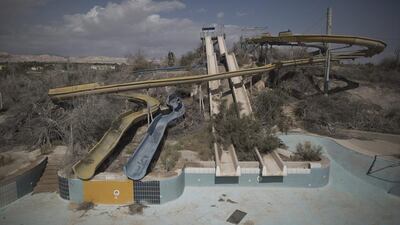
An abandoned water park opposite to the shores of the Dead Sea at the Dead Sea coastal resort near Ein Gedi. -
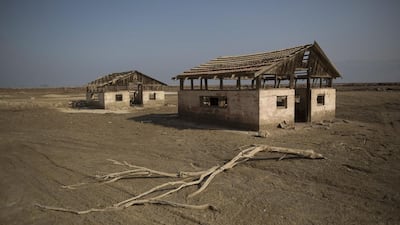
An abandoned old work camp on the southern side of the Dead Sea. -
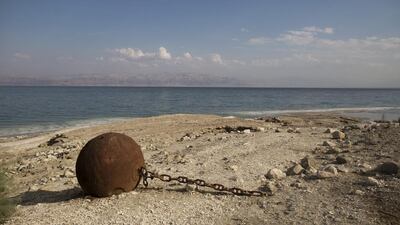
An old buoy used by the Israeli navy when they were stationed at the Dead Sea during the 1980s lies about 20 meters out of the water and marks were the water line was about 30 years ago. -

Dead palm trees stand in front of the Dead Sea coastal resort. -
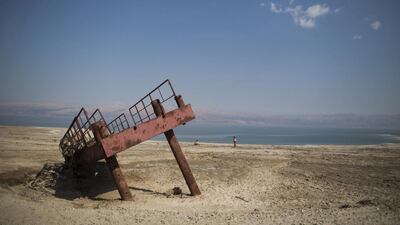
An old dock lies at the middle of the beach. -

A large sinkhole created by the decrease in water level at the Dead Sea coastal resort near Ein Gedi. -
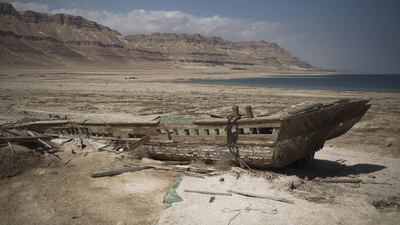
An abandoned tourist Boat shipwreck lying at the Dead Sea coastal resort. -
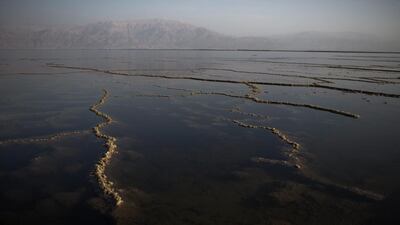
A drying pool of the Dead Sea salt processing factory on the southern side of the sea. -

A researcher from the Isareli Geological Institute of Limnological Research measures the Dead Sea depth from a rope covered with salt while sailing on the research ship ‘Taglit’ (Discovery) during their monthly research of the Dead Sea water level. -
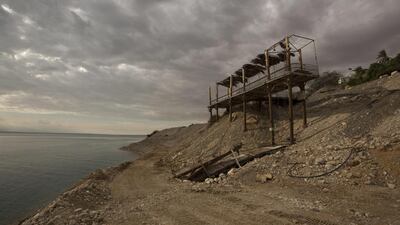
An old dock stands about 20 meters above the sea level mark where the water line was about 20 years ago.


Sinkholes are spreading because the Dead Sea is receding and layers of salty sediment near the shore become flushed with fresh groundwater and dissolve.
The holes were first noticed in significant numbers in the late 1980s. The Dead Sea has been shrinking since the 1960s, when the flow of the Jordan River, which empties into it, declined sharply.
The US had sought a decade earlier to head off this scenario – and reduce cross-border hostilities over water – by negotiating the Jordan Valley Unified Water Plan.
Known as the Johnston Plan – after US ambassador Eric Johnston, who between 1953 and 1955 helped develop the project – it aimed to solve water disputes between Jordan, Israel, Syria and Lebanon.
But the deal collapsed in the 1960s.
Israel, Syria and Jordan ended up diverting the Jordan River and its tributaries for their own uses, causing the Dead Sea to drop beyond its natural fluctuations.
Israel, by far, took the largest share of the water.
Syria dammed the Yarmouk River, the main tributary of the Jordan, which has subsequently declined into a polluted stream.
At Ghor Al Haditha, the region most hit by sinkholes on the southern edge of the Dead Sea, farmers still grow all sorts of produce – even bananas – further depleting groundwater from hills along the eastern side of the Dead Sea road.
But sinkholes are spreading in a northern direction, farmers say, limiting expansion of agriculture and affecting the roads and foundations of bridges in the area, as well as streams flowing from the hills.
Disruption to farming
Abu Alaa, a farmer in Ghor Al Haditha, considers himself lucky that sinkholes bypassed his land.
His property is worth around $14,000 per donum (1,000 square metres), compared with a few hundred dollars per donum for plots riddled with holes.
“The land cracks and deforms and in any moment, it could give way. Plots have been destroyed and others cannot no longer be farmed,” Abu Alaa said.
“There is no warning”, he added, recalling a neighbouring farmer who died after being swallowed by a sinkhole this year as he was tilling the land.
“The civil defence tried to rescue him. God rest his soul.”
Potash ponds further deplete water supply
Another human-caused disaster undermining the Dead Sea lies three kilometres away. It is Jordan’s potash industry and its huge evaporation ponds drawn from the shrinking lake.
EcoPeace Middle East, a regional environmental organisation, says that aside from the depletion of the Jordan River, mineral extraction on the Jordanian and Israeli side have “contributed to the demise of the Dead Sea".
The non-government organisation says potash ponds on the Jordanian and Israeli side are responsible for up to 40 per cent of the Dead Sea's depletion.
By some scientific estimates, the Dead Sea could disappear before the end of this century. In recent decades, it has lost one-third of its surface area.
Nizar Abu Jaber, a professor of geology at the German-Jordanian University in Madaba says the potash industry itself is threatened unless the imbalance between the water coming in and evaporation is solved.
Jordan and Israel have discussed over the past decade a mega-project to build a canal from the Red Sea to feed the Dead Sea, and use the difference in elevation to generate electricity.
The plan was abandoned this year over fears that it would prove a white elephant through not justifying the investment.
“The Dead Sea has never been as low as we have now and this is because of the human interference in the system,” Prof Abu Jaber said.
Prof Jaber said Israel might feel compelled to build a canal from the Mediterranean to the Dead Sea to feed it, which would be easier than the defunct “Red-Dead” project.
He cites much bigger investment in potash on the Israeli side.
“The problem would have to be dealt with ultimately from the Israeli side, unless they think the [effort] isn’t worth it,” Prof Abu Jaber said. “I have not asked them.”
“There is a fatalistic aspect,” he said, referring to the sinkholes in Ghor Al Haditha.
“But you can still pick tomatoes and peppers.”

