

Syria's defence minister and the Jordanian army's chief of staff came face to face in a rare meeting between the heads of the countries' militaries on Sunday.
The Jordanian military confirmed the meeting between Syrian Defence Minister and Chief of Staff Ali Ayyoub and his Jordanian counterpart Lt Gen Yousef Hunaiti.
The meeting comes after a Syrian military offensive in the town of Deraa, south of Damascus, an area of instability 13 kilometres north of the border with Jordan.
Amman joined a coalition of countries supporting armed Syrian opposition groups, but has since begun normalising ties with Damascus.
Russia had previously brokered a ceasefire in Deraa between the government of Bashar Al Assad and a local Syrian rebel group, but the truce broke down in July. Within a month of fighting more than 40,000 people fled the area, according to the UN Office for the Co-ordination of Humanitarian Affairs (OCHA).
Putin brokers deal
The truce, which was negotiated in August and came into effect in September, allowed rebels to lay down their arms and relocate to northern Syria, where opposition groups still hold ground, primarily in the governorate of Idlib. Russian military police had also been deployed on the ground in Deraa, purportedly to monitor the truce.
But fighting has resumed in the former rebel stronghold, which had been firmly controlled by the opposition until 2018, and the area has once again faced gruelling, siege-like conditions.
"The talks are within the concern to intensify future co-ordination over all common issues," Jordan's army said.
The Syrian army's pro-Iranian elite Fourth Division had for more than two months besieged the area where the first peaceful protests against authoritarian rule broke out in 2011 before security forces cracked down and unrest developed into civil war.
-
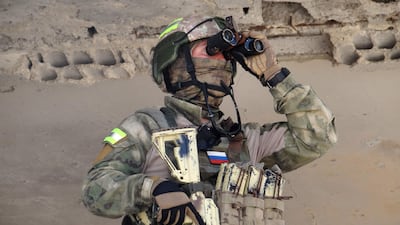
A Russian soldier uses binoculars during a patrol in the Syrian district of Deraa Al Balad in the southern province of Deraa. AFP -

Russian troops in the Syrian district of Deraa Al Balad. AFP -
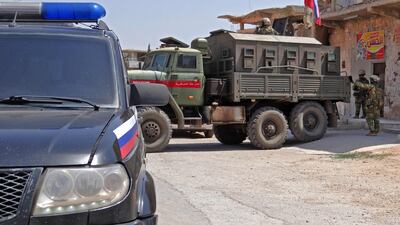
Three years after Syria's government retook control of the flashpoint southern province of Deraa, regime forces have clashed with rebels again, trapping thousands of civilians in the crossfire. AFP -
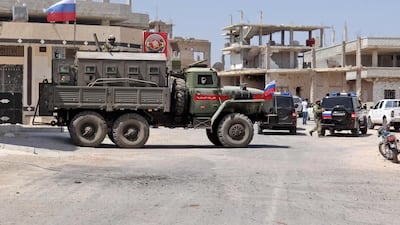
Nearly half of the population of the rebel-held Deraa Al Balad district have fled heavy shelling and ground battles. AFP -
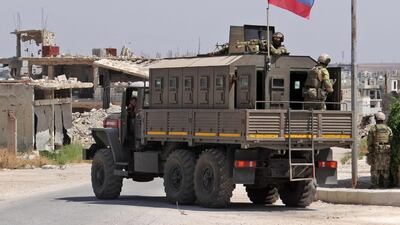
The United Nations warns that remaining civilians are cut off with dwindling supplies. AFP -
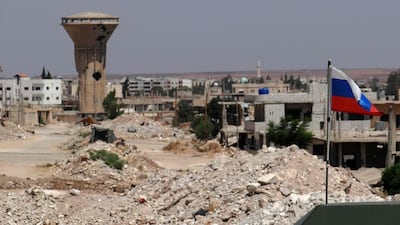
A Russian flag on a Russian military vehicle in the Syrian district of Deraa Al Balad. AFP


Jordan's King Abdullah, a staunch US ally, praised Russian President Vladimir Putin on a visit to Moscow in August where he said Russian troops who helped reverse the tide of Syria's conflict in Syrian President Bashar Al Assad's favour, had succeeded in stabilising the country.
Jordan had for years supported mainstream western-backed rebels who controlled southern Syria until a campaign by the Syrian army in 2018 aided by Russian air power and Iranian-backed militias retook the province.
Thousands of rebels, who once received arms and support funnelled through Jordan, handed over their weapons under surrender deals brokered by Moscow.
Russia gave guarantees to Israel, Jordan and the US at the time that it would prevent Iranian-backed militias from expanding their influence in the area that also borders the Israeli-occupied Golan Heights.
The retaking of Deraa by government forces earlier this month has brought with it control of several towns and villages that until recently defied state authority.
Jordan and Israel are alarmed by an expanding Iranian presence through its penetration of Syrian army units and the proliferation of Tehran-funded militias who now hold sway in southern Syria, senior western diplomats say.
Lebanon's Hezbollah has also consolidated its presence in the neighbouring Quneitra province.
The military talks between Syria and Jordan, sources said, also addressed a major increase in drug smuggling in recent months. Jordanian officials blame Lebanon's Iranian-backed Hezbollah for the surge.
But Hezbollah denies western allegations that it is behind a multi-billion dollar drug smuggling network that extends from Syria, Jordan and the Gulf.

