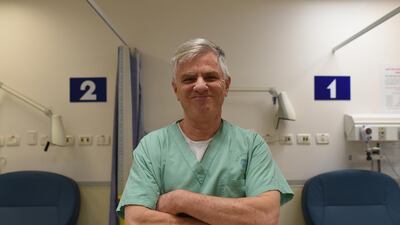

After successfully treating 30 patients with severe cases of Covid-19, Israeli scientists in Tel Aviv are hopeful their new drug can play a key role in saving lives and helping the world recover from the coronavirus pandemic.
“It’s difficult to see a patient with Covid-19 because they cannot breathe, it’s like drowning,” said Nadir Arber, who has led the study at Tel Aviv’s Ichilov Medical Centre.
“Now they can start to breathe again,” he said.
The drug developed by the team at Ichilov hospital prevents an overreaction of the immune system, which Dr Arber said affects 6 to 7 per cent of coronavirus patients.
“What we call the cytokine storm. Our immune system thinks there’s a big invasion, they’re shooting everywhere,” he said of the syndrome, which can be fatal.

Ichilov released its initial findings earlier this month, from a stage one trial of 30 patients aged between 37 and 78. All but one recovered quickly and they were discharged after four days, on average, Dr Arber said, shorter than the six-day period for coronavirus patients across Israel.
The treatment was stopped for one patient who was admitted to the intensive care unit, but she ultimately recovered.
“So this is it and now there is a huge demand from all over the world; I’m speaking to prime ministers, presidents, and this is very exciting,” said Dr Arber, who heads the hospital’s Integrated Cancer Prevention Centre.
The new drug harnesses a gene, known as CD24, that suppresses the immune system. Dr Arber has worked on the gene for 20 years.
Researchers placed CD24 on to exosomes – extremely small molecules derived from cell membranes – to develop a drug that patients can inhale.
“It goes directly to the lung. It’s sophisticated but it’s easy,” Dr Arber said.

While the initial results are promising and patients suffered no side effects, the research is in its infancy.
Phase two trials will expand the study to a few dozen patients and include a control group, while the third phase that may begin later this year will involve hundreds or potentially thousands of patients.
These broader studies will include patients internationally, although Dr Arber did not say which countries might be involved.
-

Medical personnel work inside the coronavirus intensive care unit at Sheba Medical Center, close to Tel Aviv. Rosie Scammell / The National -
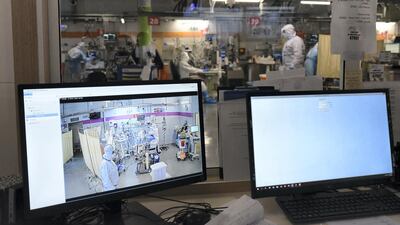
Medical personnel are seen on a screen in the observation room of the coronavirus intensive care unit at Sheba Medical Center. Rosie Scammell / The National -

Medical personnel work inside the coronavirus intensive care unit at Sheba Medical Center, close to Tel Aviv. Rosie Scammell / The National -

The Sheba Medical Centre coronavirus intensive care unit. In addition to this ward, there are numerous specialised coronavirus units at Sheba Medical Centre. They including one for children and another for psychiatric patients. Rosie Scammell for The National.


Greece has offered to participate in future trials of the “miracle drug”, Israeli Prime Minister Benjamin Netanyahu said Monday after separate meetings with his Greek counterpart, Kyriakos Mitsotakis, and Dr Arber.
Shiran Shapira, a doctor who runs the laboratory where the drug was developed, said she was feeling positive about the treatment’s potential.
“It’s really fast and easy to produce, and even cheap,” she said. “We were working on CD24 for two decades and with the exosomes for almost five years, so we had all the parts, and we just combined them and developed this technology.

As scientists develop new ways to treat Covid-19 and its effects, doctors have turned to existing drugs to help patients.
A UK study published in June found that dexamethasone, an anti-inflammatory steroid, cut the risk of death by more than a third among patients on ventilators.
Randy Cron, who in 2019 co-edited a book on the cytokine storm syndrome, said he predicted at the start of the pandemic that “immunosuppressive steroids are probably going to save the day”.
“Steroids aren’t a home run either, they saved maybe a third of the patients’ lives that got them, but that’s better than nothing,” he said.
The sense of urgency to tackle the pandemic and prevent patients’ immune systems going into overdrive has had one “silver lining” for Dr Cron – that people are learning about cytokine storm syndrome.
“If you don’t recognise a cytokine storm, you’re not going to treat it. And if you don’t treat it, patients are going to die,” said Dr Cron, a professor of paediatrics at the University of Alabama at Birmingham.
Aware of the grave risks of such a scenario, Bibi Ayesha, a doctor in New York, led a task force last year to identify patients at risk of developing the syndrome.
The vast majority of 288 patients included in the study were treated with steroids, while 31 were given biological treatment commonly known as antibodies.
“Biological therapy has a very narrow window,” said Dr Ayesha, a rheumatologist at Montefiore Medical Centre in New York. “If it’s [administered] early, it is proven to be beneficial.”
“There is no perfect cure, it’s the timing,” she said. She cautioned that to understand the most effective treatments, more data are needed.
“There has to be a combined effort where all these specialists can put their minds together and help the patient in a timely manner,” including rheumatologists and immunologists, she said.
Despite inoculation drives getting under way in the US, Israel and elsewhere, Dr Arber said the new drug will play an essential role in overcoming the pandemic.
“This, with vaccinations … we can go back to normal life,” he said. “We must go back to normal life.”
-
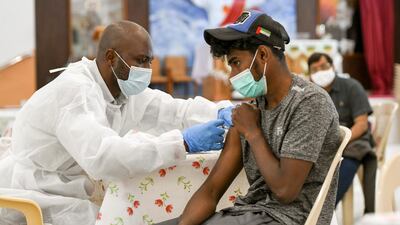
A man receives a dose of a vaccine against Covid-19 at St Paul’s Church in Abu Dhabi. Khushnum Bhandari / The National -

Pupils faced foggy conditions on their first day back at Gems United Indian School in Abu Dhabi. Victor Besa / The National -

Elvin Toro, 26, a former army medic, organises his syringes before giving out the next dose of the Covid-19 vaccine to a local resident at Central Falls High School in Central Falls, Rhode Island, USA. AFP -
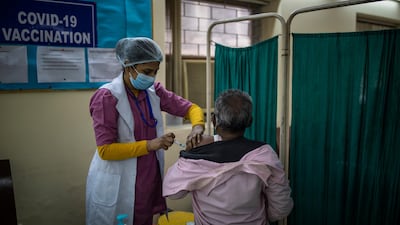
A health worker administers a Covid-19 vaccine to a municipal worker at a private hospital in New Delhi, India. AP Photo -
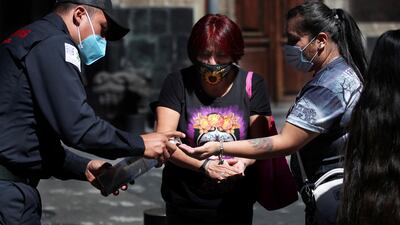
A firefighter gives disinfectant gel to women out shopping in Mexico City. AP Photo -

Britain's Prime Minister Boris Johnson visits the QuantuMDx Biotechnology company, which has developed a 30-minute PCR diagnostics device, in Newcastle, Britain. Reuters -
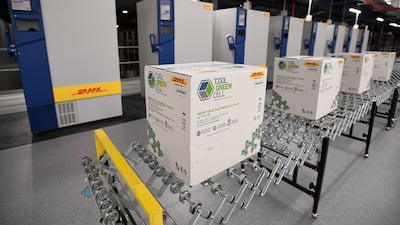
Packaging and fridges used to store Covid-19 vaccine are seen at a DHL facility in Sydney, Australia. EPA -

People wait in their vehicles to receive doses of Covid-19 vaccine at a drive-thru 'vaccination super station' operated by UC San Diego Health in downtown San Diego, California, USA. Reuters -

A girl slides at a playground in Barcelona, Spain. AP Photo -

A fruit vendor walks in front of a mural in Port-au-Prince, Haiti. EPA -

A vendor makes a flower bouquet at a market in Manila. AFP -

A couple sits at a 'Private Snow Globe' as they celebrate Valentine's day at Magical pub The Cauldron in New York. AFP