
In the kitchen of a 12th-century mosque in Baghdad, cooks are busy stirring thick chicken soup in a large steel pot while helpers ready packaging and tables in the dining hall.
Outside, staff roll out red prayer carpets on the newly cleaned marble floor of the inner yard of Sheikh Abdul Qader Al Gailani Mosque and Mausoleum.
"Baghdad has its own Ramadan atmosphere, but in this place the spiritual atmosphere is special and unique," the mosque's muezzin, Qais Al Adhami, tells The National shortly before calling for the sunset prayers, or maghrib, that marks the end to fasting.
“During Ramadan, the mosque’s Al Kheirat kitchen offers iftar meals for the poor to perpetuate a centuries-old tradition that started nearly 480 years ago,” Mr Al Adhami says as as dozens of worshippers gather.
Although Iraq is in the middle of a second wave of Covid-19, authorities eased restrictions on mosques during Ramadan this year, allowing the five daily prayers in addition to special taraweeh prayers that are performed at night during Ramadan.
-

People waiting for the prayer call near the mausoleum of Sheikh Abdul Qader Gailani during the month of Ramadan in Baghdad, Iraq. Haider Husseini / The National -
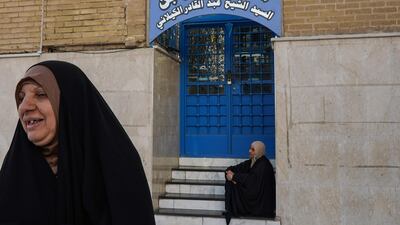
Women visit the shrine of Sheikh Abdul Qader Gailani during the month of Ramadan in Baghdad, Iraq. Haider Husseini / The National -
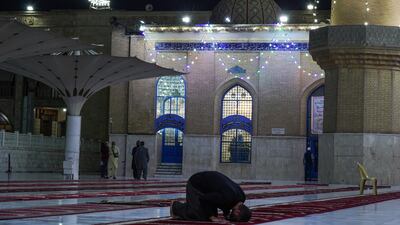
A man prays at the mausoleum of Sheikh Abdul Qader Gailani during the month of Ramadan, in the Iraqi capital of Baghdad. Haider Husseini / The National -

The clocktower at the mausoleum of Sheikh Abdul Qader Gailani in Baghdad. Haider Husseini / The National -

Worshippers at the Sheikh Abdul Qader Al Gailani Mosque and Mausoleum during the month of Ramadan, in Baghdad, Iraq. Haider Husseini / The National -

Men prepare food for Iftar inside the kitchen of the Sheikh Abdul Qader Al Gailani Mosque and Mausoleum in Baghdad, Iraq. Haider Husseini / The National -
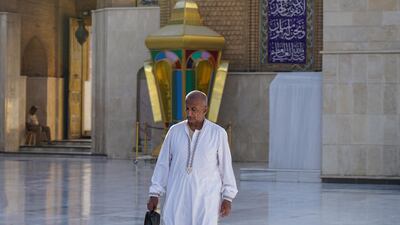
A man enters the mausoleum of Sheikh Abdul Qader Gailani in Baghdad, Iraq. Haider Husseini / The National -
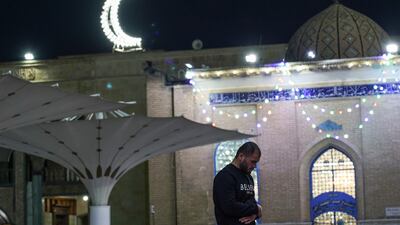
A man prays at the Sheikh Abdul Qader Al Gailani Mosque and Mausoleum during the month of Ramadan, in Baghdad, Iraq. Haider Husseini / The National -

Two men sit on the steps of the Sheikh Abdul Qader Al Gailani Mosque and Mausoleum during the month of Ramadan, in Baghdad, Iraq. Haider Husseini / The National -

People wait for prayer call at the Sheikh Abdul Qader Al Gailani Mosque and Mausoleum during the month of Ramadan, in Baghdad, Iraq. Haider Husseini / The National -
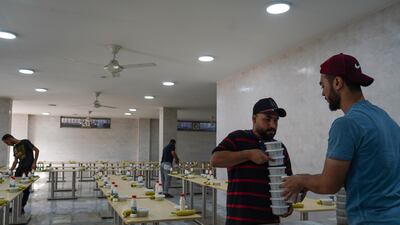
Food preparation inside the kitchen of the Sheikh Abdul Qader Al Gailani Mosque and Mausoleum during the month of Ramadan, in Baghdad, Iraq. Haider Husseini / The National -
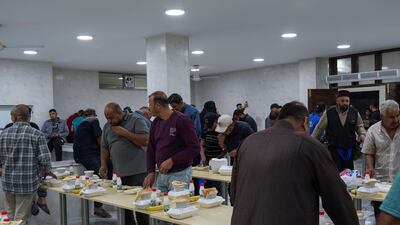
People break their fast at the Sheikh Abdul Qader Al Gailani Mosque and Mausoleum during the month of Ramadan, in Baghdad, Iraq. Haider Husseini / The National -
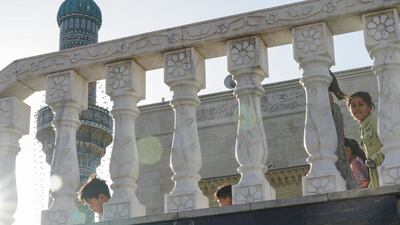
Children play at the Mausoleum of Abdul-Qadir Gilani during the holy month of Ramadan in Baghdad Iraq. -

People wait for prayer call at Sheikh Abdul Qader Gailani Mosque and Mausoleum in Baghdad Iraq. Haider Husseini / The National -

An aerial view of the Sheikh Abdul Qader Gailani Mosque and Mausoleum complex in Baghdad, Iraq. Haider Husseini / The National -
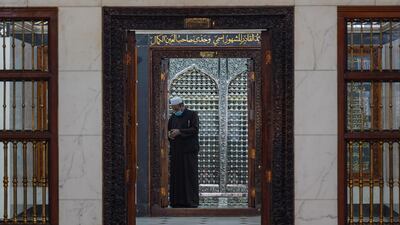
A man inside the shrine of Sheikh Abdul Qader Gailani in Baghdad, Iraq. Haider Husseini / The National -

A family taking a selfie inside the mausoleum of Sheikh Abdul Qader Gailani in Baghdad, Iraq. Sinan Mahmoud / The National


The easing of restrictions allowed Al Gailani's shrine and its kitchen to reopen its doors to worshippers and the less fortunate, whose numbers have increased over the past year because of the country's economic crisis triggered by plummeting oil prices and coronavirus regulations.
The sprawling mosque complex was originally a religious school known as Bab Al Azj, established in 1146 by the Hanbali scholar Sheikh Abu Saied Al Mubarak bin Ali Al Makhrami.
The school was handed over to Al Makhrami’s disciple Sheikh Al Gailani after his death in 1165. Al Gailani was buried in the mosque complex.
On the eastern side of the Tigris, the Sunni Sufi shrine in one of Baghdad's old neighbourhoods derives its name, Bab Al Sheikh, from Sheikh Al Gailani. It is revered by Sunnis and Shiites.
In addition to the tombs of Sheikh Al Gailani and his two sons, the mosque complex consists of a mosque and the Qadiriya Library, which houses thousands of rare books and manuscripts in Islamic studies.
Mr Al Adhami, an education supervisor at the Ministry of Education, has been the mosque muezzin for 27 years after inheriting the role from his father.
“Every Ramadan, the banquets are thrown and the people are happy spending time here to break their fast and pray in a spiritual atmosphere,” he says.
The mosque runs another kitchen across the street, which, he says, serves the poor two meals a day throughout the year.
In addition to soup, meals include a plate of rice with meat, bread, yoghurt and fruit.
There are more than 400 people registered to receive food and financial aid from the mosque, in addition to hundreds more who visit regularly, Mr Al Adhami said.
With the outbreak of coronavirus last year, the kitchen in the mosque was not able to operate because of government measures that included closing down mosques. The kitchen outside the mosque compound continued to offer meals, but only for collection from a small window.
The government eased restrictions this year to allow people to walk to the nearest mosque during Ramadan to perform prayers, including taraweeh.
"The number of those who are showing up for iftar inside the mosque is less than before. Only those who live nearby come, about 250 worshippers a day, due to the lockdown [that starts immediately after sunset]," he says.
“The poor used to come from all areas, even from other provinces.”
A festive mood has taken hold inside the complex.
A big crescent moon lantern adorns the main gate, while strings of colourful lights hang from the minarets and inner walls, along with Prophet Mohammed's hadith on the importance and grace of Ramadan.
Traditional Ramadan lanterns, known as fanous in Arabic, hang in a corner of the inner yard where families sit, reciting the Quran or watching their children play.
Some of the families bring their own iftar with them.
Zihoor Askar Mohammed's family moved from Bab Al Sheikh to Baghdad's Karrada district in the 1980s. But she still visits the mausoleum during Ramadan.
-
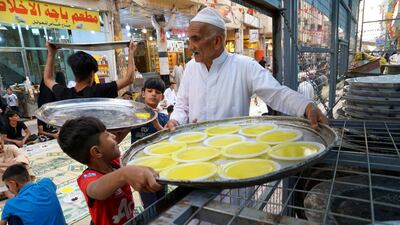
An Iraqi man with the help of a young boy carries plates filled with delicacies as people gather to break their fast at a free communal iftar in the central Iraqi city of Najaf. Reuters -
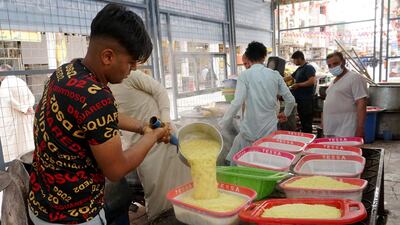
Volunteers prepare meals for a free communal iftar on a street in Najaf, Iraq. Reuters -

People gather to break their fast during a communal iftar on a street in the central Iraqi city of Najaf. Reuters -
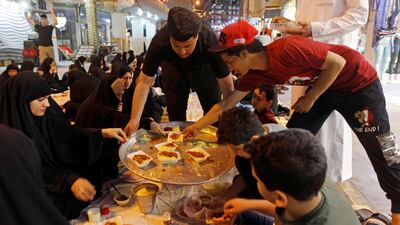
Women get ready to break their fast at a communal iftar in Najaf, Iraq. Reuters -
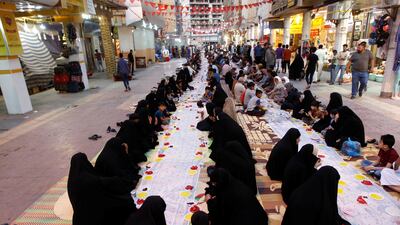
Women sit in rows to break their fast at a communal iftar in the central Iraqi city of Najaf. Reuters -

Men sit in rows awaiting the call of maghrib to break their fast in the Iraqi city of Najaf. Reuters -

A young boy serves food to women attending a communal iftar on a street in the central Iraqi city of Najaf. Reuters


“Ramadan is a blessed month and I’m here today to pray for the sick people, for Iraq and its people, for Islam and all Muslims everywhere,” the 56-year-old homemaker says after praying at the tomb.
“We always come here during Ramadan to pray, especially on Laylat Al Qadr," she says, referring to the night of Ramadan that Muslims believe the Quran was sent down from heaven.
The mother of six girls and two boys usually brings her iftar meal with her, but this time she left before sunset to reach home by the time lockdown kicked in.
Among the less fortunate waiting for iftar was a man in his seventies leaning against a wall.
“The atmosphere here brings tranquility to the people and makes them feel blessed,” said the man, who asked not to be identified.
The former agriculture ministry employee fled his home town of Ramadi five years ago when military operations were under way to drive out ISIS militants.
He rents a small room near by where he lives alone and sends most of his 500,000 Iraqi dinar (Dh1,256) pension to displaced relatives in the northern Kurdish region.
Like many Iraqis, he complains about the surge in prices during Ramadan caused by a government decision in December to devalue its currency by about 23 per cent against the US dollar. Iraq is heavily dependent on imports for goods and raw materials.
“The situation in Iraq in general is bad,” he says.
The burden on the people, he said, increased this year, mainly the poor and people are tired and feel it is unjust.
"Iraq is rich with its varied natural resources, everything is available here, why we are living like this?" he says as he accepts a packed meal and starts to walk away.
“It is sad to see the people of one of the richest countries in the world live like this.”

