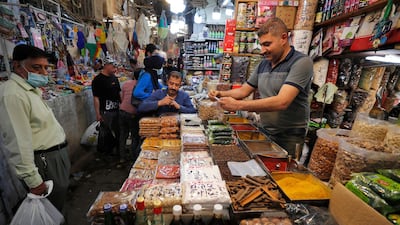
An Iraqi man sells food at the Shorja market in central Baghdad on April 12, 2021 ahead of the Muslim holy month of Ramadan after the easing of the curfew imposed by authorities amid the coronavirus COVID-19 pandemic. / AFP / AHMAD AL-RUBAYE
An Iraqi man sells food at the Shorja market in central Baghdad on April 12, 2021 ahead of the Muslim holy month of Ramadan after the easing of the curfew imposed by authorities amid the coronavirus C

Iraqis will observe Ramadan amid partial lockdown and soaring prices


Sinan Mahmoud
  • English
  • Arabic

Iraq on Monday announced a partial lockdown during Ramadan to prevent gatherings amid a new wave of coronavirus infections.

People will not be allowed to move freely between 8pm and 5am and there will be full lockdown on Fridays and Saturdays, the Higher Committee for Health and Public Safety said.

Pharmacies, bakeries, supermarkets and groceries are exempted from the full lockdown, while restaurants will be allowed to make food deliveries. Working hours at government offices will be shortened by a hour, and pupils of some classes can return to schools, it said.

The holy month will begin on Tuesday for Iraq's Sunni minority, and from Wednesday for Shiites. The difference is because each sect follows a different moon-sighting technique.

The Health Ministry reported 7,953 new cases on Monday and 44 deaths. The country registered 8,331 cases last Wednesday, the highest number of daily infections since the outbreak began.

The ninth month of the Islamic calendar, Ramadan is observed by Muslims across the world who abstain from food, drink, smoking and sex from daybreak to dusk. They offer extra prayers, read the Quran, show charity to the poor and cement friendships and family ties.

Usually, there is a festive atmosphere after sunset, with families and friends visiting each other or gathering at street cafes, playing traditional games like backgammon and cards or smoking shisha.

Houses across Baghdad have been decorated with traditional Ramadan lanterns, known as fanous in Arabic, and crescent moon lights. Some had posters on their doors that read: “Welcome Ramadan.”

Workers at supermarkets and sweets shops were busy stacking shelves with wide range of products favoured during Ramadan, but there were not many customers.

  • A Shiite Muslim pilgrim sits by lit candles outside the Shrine of Imam Mohammed al-Mahdi during the Shaabaniya ceremony, marking the middle of the Islamic month of Shaban and two weeks before the start of the holy fasting month of Ramadan, and on which Twelver Shiites commemorate the birth of Imam Mahdi (the sect's final Imam), in Iraq's central holy shrine city of Karbala on March 28, 2021. / AFP / Mohammed SAWAF
    A Shiite Muslim pilgrim sits by lit candles outside the Shrine of Imam Mohammed al-Mahdi during the Shaabaniya ceremony, marking the middle of the Islamic month of Shaban and two weeks before the start of the holy fasting month of Ramadan, and on which Twelver Shiites commemorate the birth of Imam Mahdi (the sect's final Imam), in Iraq's central holy shrine city of Karbala on March 28, 2021. / AFP / Mohammed SAWAF
  • Shiite Muslim pilgrims gather outside the Shrine of Imam Mohammed al-Mahdi during the Shaabaniya ceremony, marking the middle of the Islamic month of Shaban and two weeks before the start of the holy fasting month of Ramadan, and on which Twelver Shiites commemorate the birth of Imam Mahdi (the sect's final Imam), in Iraq's central holy shrine city of Karbala on March 28, 2021. / AFP / Mohammed SAWAF
    Shiite Muslim pilgrims gather outside the Shrine of Imam Mohammed al-Mahdi during the Shaabaniya ceremony, marking the middle of the Islamic month of Shaban and two weeks before the start of the holy fasting month of Ramadan, and on which Twelver Shiites commemorate the birth of Imam Mahdi (the sect's final Imam), in Iraq's central holy shrine city of Karbala on March 28, 2021. / AFP / Mohammed SAWAF
  • Muslims perform evening prayer at the Sunni shrine of Abdul-Qadir al-Gailani ahead of the upcoming Muslim fasting month of Ramadan in Baghdad, Iraq, Saturday, April 10, 2021. Ramadan is the ninth month of the Islamic lunar calendar and the holiest time of the year for Muslims. (AP Photo/Khalid Mohammed)
    Muslims perform evening prayer at the Sunni shrine of Abdul-Qadir al-Gailani ahead of the upcoming Muslim fasting month of Ramadan in Baghdad, Iraq, Saturday, April 10, 2021. Ramadan is the ninth month of the Islamic lunar calendar and the holiest time of the year for Muslims. (AP Photo/Khalid Mohammed)
  • Shiite Muslim pilgrims gather outside the Shrine of Imam Mohammed al-Mahdi during the Shaabaniya ceremony, marking the middle of the Islamic month of Shaban and two weeks before the start of the holy fasting month of Ramadan, and on which Twelver Shiites commemorate the birth of Imam Mahdi (the sect's final Imam), in Iraq's central holy shrine city of Karbala on March 28, 2021. / AFP / Mohammed SAWAF
    Shiite Muslim pilgrims gather outside the Shrine of Imam Mohammed al-Mahdi during the Shaabaniya ceremony, marking the middle of the Islamic month of Shaban and two weeks before the start of the holy fasting month of Ramadan, and on which Twelver Shiites commemorate the birth of Imam Mahdi (the sect's final Imam), in Iraq's central holy shrine city of Karbala on March 28, 2021. / AFP / Mohammed SAWAF
  • Shiite Muslim pilgrims light candles outside the Shrine of Imam Mohammed al-Mahdi during the Shaabaniya ceremony marking the middle of the Islamic month of Shaban and two weeks before the start of the holy fasting month of Ramadan, and on which Twelver Shiites commemorate the birth of Imam Mahdi (the sect's final Imam), in Iraq's central holy shrine city of Karbala on March 28, 2021. / AFP / Mohammed SAWAF
    Shiite Muslim pilgrims light candles outside the Shrine of Imam Mohammed al-Mahdi during the Shaabaniya ceremony marking the middle of the Islamic month of Shaban and two weeks before the start of the holy fasting month of Ramadan, and on which Twelver Shiites commemorate the birth of Imam Mahdi (the sect's final Imam), in Iraq's central holy shrine city of Karbala on March 28, 2021. / AFP / Mohammed SAWAF
  • A Shiite Muslim pilgrim lights candles outside the Shrine of Imam Mohammed al-Mahdi during the Shaabaniya ceremony, marking the middle of the Islamic month of Shaban and two weeks before the start of the holy fasting month of Ramadan, and on which Twelver Shiites commemorate the birth of Imam Mahdi (the sect's final Imam), in Iraq's central holy shrine city of Karbala on March 28, 2021. / AFP / Mohammed SAWAF
    A Shiite Muslim pilgrim lights candles outside the Shrine of Imam Mohammed al-Mahdi during the Shaabaniya ceremony, marking the middle of the Islamic month of Shaban and two weeks before the start of the holy fasting month of Ramadan, and on which Twelver Shiites commemorate the birth of Imam Mahdi (the sect's final Imam), in Iraq's central holy shrine city of Karbala on March 28, 2021. / AFP / Mohammed SAWAF

"In previous years, we couldn't cope with the demand and the influx of shoppers before and during Ramadan," supermarket owner Karim Mohammed, 55, told The National.

“The soaring prices of mainly food are discouraging Ramadan shoppers from stocking food for days or for the whole month,” he said as he stood amid piles of bags of pasta, rise and dairy products.

Iraq’s economy has suffered a double shock from falling oil prices and the coronavirus outbreak since last year.

Lack of funds forced the government to devalue its currency by about 23 per cent against the US dollar in December, pushing up the price of goods by up to 50 per cent as the country heavily depends on imports.

In a bid to encourage local manufacturers, the government imposed restrictions on importing some items, contributing to the increase in the prices as local supply is either not enough to meet the demand or dependent on imported raw materials.

“The government has devalued the currency and prevented the imports without any realistic calculations on the market,” Mr Mohammed said, and added that his revenues has dropped by at least 30 per cent.

The breaking of the fast usually means a variety of delicacies specially prepared for the occasion. But this year the soaring prices of food mean that many Iraqis will find it difficult to celebrate in their usual style.

Baghdad resident Riyadh Salman, who is working as a taxi driver in his retirement, considers himself lucky to be able to stock enough food for one week.

“Goods prices are on fire,” Mr Salman, 61, said as he picked up a box of bottled water from a supermarket.

“Of course, this situation has impacted us unlike previous Ramadans, when poor and middle-class could afford food on the table,” Mr Salman said.

He will distribute Ramadan packages to six families in his neighbourhood, each containing lentils, chickpeas, rice, cooking oil and a can of tomato paste.

Muslims perform evening prayer at the Sunni shrine of Abdul-Qadir Al Gailani in Baghdad, ahead of the start of Ramadan. AP

Since Sunday, Iraqis have been sending congratulatory messages as well as calling for not sharing pictures on social media of food that many families cannot afford.

During a live radio show, a woman burst out in anger.

“We can’t buy lamb meat and chicken this Ramadan, along with other items,” said the woman, who gave her name as Hiyam.

Ahmed Najeeb, 33, said that despite the hardships Iraqis needed to count on God and look forward.

“Yes, life is not easy one here. But we have to carry on and pray for better life and future,” he said.

“One good thing this Ramadan is the Iraqi Ramadan drama that we are going to see, unlike last year,” he laughed, standing near a big poster for one of the episodes.


What are NFTs?

Are non-fungible tokens a currency, asset, or a licensing instrument? Arnab Das, global market strategist EMEA at Invesco, says they are mix of all of three.

You can buy, hold and use NFTs just like US dollars and Bitcoins. “They can appreciate in value and even produce cash flows.”

However, while money is fungible, NFTs are not. “One Bitcoin, dollar, euro or dirham is largely indistinguishable from the next. Nothing ties a dollar bill to a particular owner, for example. Nor does it tie you to to any goods, services or assets you bought with that currency. In contrast, NFTs confer specific ownership,” Mr Das says.

This makes NFTs closer to a piece of intellectual property such as a work of art or licence, as you can claim royalties or profit by exchanging it at a higher value later, Mr Das says. “They could provide a sustainable income stream.”

This income will depend on future demand and use, which makes NFTs difficult to value. “However, there is a credible use case for many forms of intellectual property, notably art, songs, videos,” Mr Das says.

The White Lotus: Season three

Creator: Mike White

Starring: Walton Goggins, Jason Isaacs, Natasha Rothwell

Rating: 4.5/5

Key facilities
  • Olympic-size swimming pool with a split bulkhead for multi-use configurations, including water polo and 50m/25m training lanes
  • Premier League-standard football pitch
  • 400m Olympic running track
  • NBA-spec basketball court with auditorium
  • 600-seat auditorium
  • Spaces for historical and cultural exploration
  • An elevated football field that doubles as a helipad
  • Specialist robotics and science laboratories
  • AR and VR-enabled learning centres
  • Disruption Lab and Research Centre for developing entrepreneurial skills
FIXTURES

Nov 04-05: v Western Australia XI, Perth
Nov 08-11: v Cricket Australia XI, Adelaide
Nov 15-18 v Cricket Australia XI, Townsville (d/n)
Nov 23-27: 1ST TEST v AUSTRALIA, Brisbane
Dec 02-06: 2ND TEST v AUSTRALIA, Adelaide (d/n)
Dec 09-10: v Cricket Australia XI, Perth
Dec 14-18: 3RD TEST v AUSTRALIA, Perth
Dec 26-30 4TH TEST v AUSTRALIA, Melbourne
Jan 04-08: 5TH TEST v AUSTRALIA, Sydney

Note: d/n = day/night

MATCH INFO

Uefa Champions League semi-final, first leg
Bayern Munich v Real Madrid

When: April 25, 10.45pm kick-off (UAE)
Where: Allianz Arena, Munich
Live: BeIN Sports HD
Second leg: May 1, Santiago Bernabeu, Madrid

Stree

Producer: Maddock Films, Jio Movies
Director: Amar Kaushik
Cast: Rajkummar Rao, Shraddha Kapoor, Pankaj Tripathi, Aparshakti Khurana, Abhishek Banerjee
Rating: 3.5

Dubai works towards better air quality by 2021

Dubai is on a mission to record good air quality for 90 per cent of the year – up from 86 per cent annually today – by 2021.

The municipality plans to have seven mobile air-monitoring stations by 2020 to capture more accurate data in hourly and daily trends of pollution.

These will be on the Palm Jumeirah, Al Qusais, Muhaisnah, Rashidiyah, Al Wasl, Al Quoz and Dubai Investment Park.

“It will allow real-time responding for emergency cases,” said Khaldoon Al Daraji, first environment safety officer at the municipality.

“We’re in a good position except for the cases that are out of our hands, such as sandstorms.

“Sandstorms are our main concern because the UAE is just a receiver.

“The hotspots are Iran, Saudi Arabia and southern Iraq, but we’re working hard with the region to reduce the cycle of sandstorm generation.”

Mr Al Daraji said monitoring as it stood covered 47 per cent of Dubai.

There are 12 fixed stations in the emirate, but Dubai also receives information from monitors belonging to other entities.

“There are 25 stations in total,” Mr Al Daraji said.

“We added new technology and equipment used for the first time for the detection of heavy metals.

“A hundred parameters can be detected but we want to expand it to make sure that the data captured can allow a baseline study in some areas to ensure they are well positioned.”