


When Father Ammar Altony Yako set foot in Qaraqosh for the first time since ISIS overran his home town in 2014, he rushed to the priests’ house in the hope that the extremist group had not destroyed everything.
"It was a mess inside. All the documents, like marriage contracts, scattered on the ground," Father Yako told The National over the phone from Qaraqosh of his 2016 return to the town.
"I rushed upstairs when I remembered that the old manuscripts were stored in one of the rooms,” he said.
“They were in a very bad state."
The ISIS militants had "removed them from the shelves, took them out of their boxes and spread them on the ground with some torn out”, he said.
Among them was a gem: an Aramaic prayer book that is at least 500 years old, known as a Sidra in Syriac.

When ISIS militants took over the city of Mosul, they headed east to capture the towns and villages of the religiously-mixed Nineveh Plain, forcing at least 120,000 Christians from their ancestral homeland. At one point they controlled almost a third of Iraq’s territory.
For more than three years, the extremists wreaked havoc in the areas under their control. They persecuted ethnic and religious minorities, demolished places of worship, heritage and archaeological sites and artefacts they considered to be heretical.
Father Yako is haunted by the images of destruction he saw in Qaraqosh, the biggest Christian town in Nineveh Plain.
“Qaraqosh was eerily empty,” he said. “The scenes were painful, the devastation was massive, every beautiful thing in the town was either burned down or damaged.”
With the help of the army and Christian paramilitary troops, he gathered the nearly 100 manuscripts and took them to the nearby city of Erbil, the capital of the northern Kurdish region.
As Christian families began to trickle back when reconstruction began in 2017, the rescued manuscripts returned to Qaraqosh. An Italian NGO offered to help restore the damaged texts.
“I picked [the Sidra] because it was heavily damaged [and] contains details, mainly prayers for the whole year, that give it a religious value,” Father Yako said.
Returned to Qaraqosh
The 116-page book once belonged to Great Al Tahira Immaculate Conception Cathedral in Qaraqosh, the largest Syriac-Catholic church in the Middle East.
The prayers and hymns are written in two columns in beautiful calligraphy, with colourful illustrations on some pages. Its wooden cover was broken.
The writer did not not enter their name or the year the book was written, but it has been said to have been written sometime in the 14th or 15th century.
-
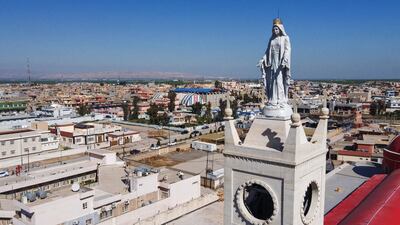
The statue of the Virgin Mary at the Syriac Catholic Church of the Immaculate Conception, or Al-Tahira Al-Kubra church, in the predominantly Christian town of Qaraqosh in Iraq. AFP -
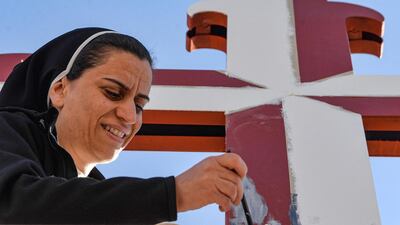
A nun adds a coat of paint to the crucifix at the Immaculate Mary Convent in Qaraqosh, in preparation for the visit of Pope Francis in March. AFP -

Policemen stand guard as maintenance work is carried out at the Church of the Immaculate Conception in Qaraqosh before the Pope's visit. EPA -

A fighter from the Nineveh Plain Protection Units, an Assyrian Christian militia, stands guard outside the Church of the Immaculate Conception in Qaraqosh. AFP -
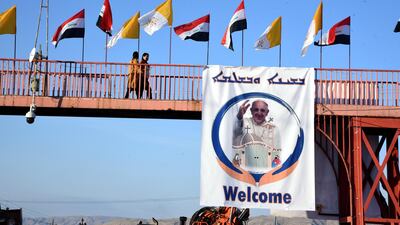
Iraqi and Vatican flags and a picture of Pope Francis in Qaraqosh, about 30 kilometres east of Mosul in northern Iraq. EPA -

A sign welcoming Pope Francis hangs outside the Syriac Catholic Church of St Thomas in Qaraqosh. AFP -
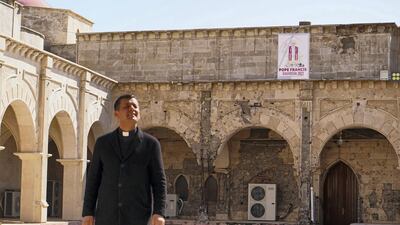
Father Ammar Yako, head of the Church of the Immaculate Conception, walks past a poster of Pope Francis days before his historic visit to Iraq. Getty -
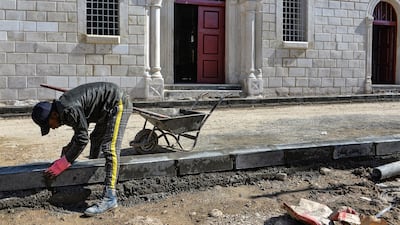
Workers prepare a path at the Church of the Immaculate Conception in Qaraqosh, Iraq. AFP -
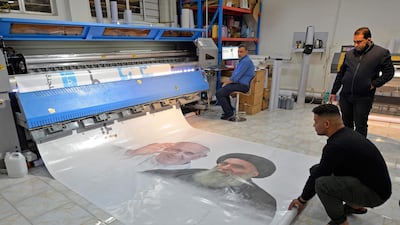
Iraqi men print a banner of Pope Francis and Shiite cleric Grand Ayatollah Ali Sistani at a factory in Najaf, before the first papal visit to Iraq. AFP -
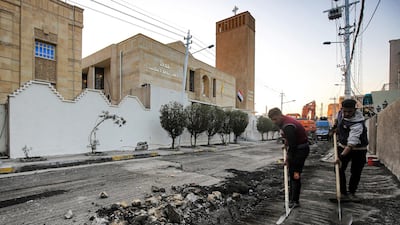
Municipal workers pave the road outside the Chaldean Catholic Church of St Joseph in preparation for the Pope's visit to Baghdad. AFP -
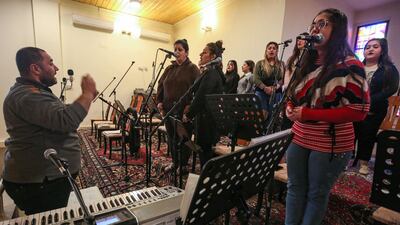
Members of a Christian choir rehearse at the Chaldean Catholic Church of St Joseph before the visit of Pope Francis. AFP -
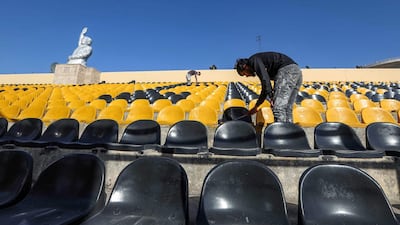
Workers prepare Franso Hariri Stadium in Erbil for the arrival of Pope Francis. AFP -
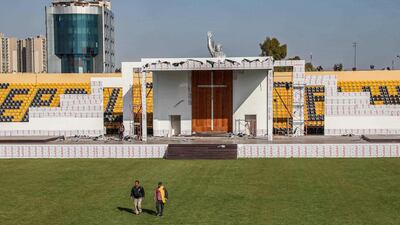
A stage has been set up at Franso Hariri Stadium in preparation for the papal visit to Iraq. AFP -
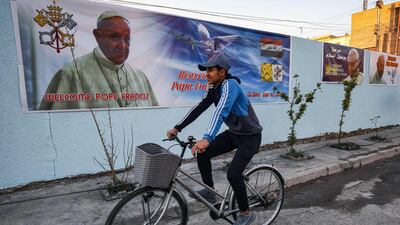
A poster of Pope Francis on the wall of the Chaldean Catholic Church of St Joseph in Baghdad. AFP -
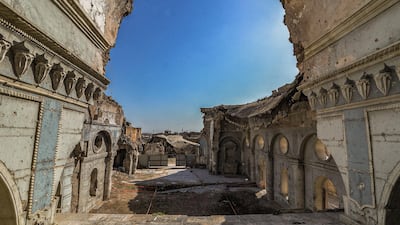
Al Tahera Syriac Catholic Church in the northern Iraqi city of Mosul, which was severely damaged by ISIS in 2017. Pope Francis is expected to pray there during his March visit. AFP -
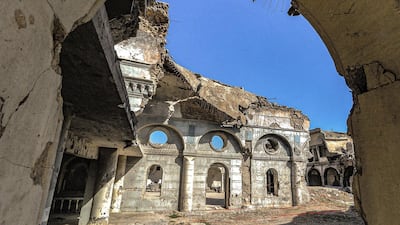
Al Tahera Syriac Catholic Church in Mosul was damaged by ISIS as the extremists were forced out of the city. AFP -
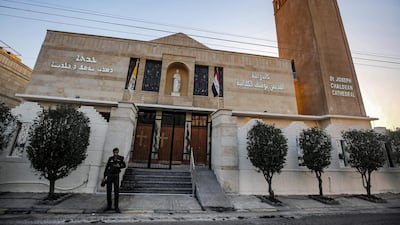
The Chaldean Catholic Church of St Joseph in Iraq's capital Baghdad. The Pope will visit the city in March. AFP -
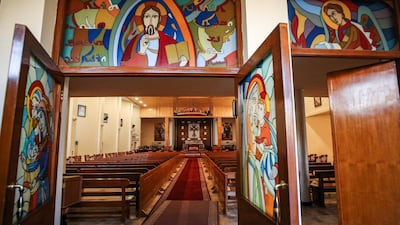
Inside the Chaldean Catholic Church of St Joseph in Baghdad. AFP -
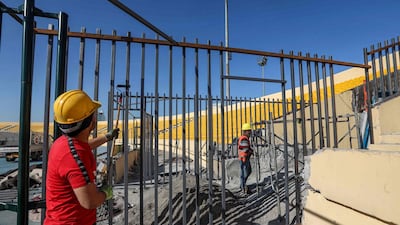
Workers at Franso Hariri Stadium in Erbil, the capital of Iraq's northern autonomous Kurdish region. The Pope will hold a Mass at the stadium in March. AFP -
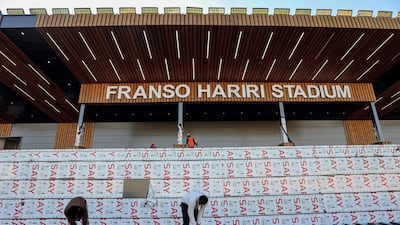
Workers finalise preparations for the Pope's visit to Franso Hariri Stadium in Erbil. AFP -
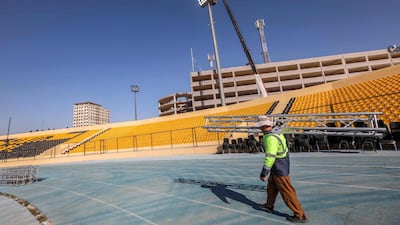
Pope Francis will hold a Mass at Franso Hariri Stadium in Erbil, the capital of Iraq's northern autonomous Kurdish region. AFP


The book was sent to Italy in 2018 where it underwent a thorough restoration process overseen by the Central Institute for the Conservation of Books (ICPAL) in Rome and funded by the Italian Ministry of Cultural Heritage.
In 2019 it was displayed at an international book fair in Italy where it was dubbed the “Refugee Book” as a silent witness to the the persecution Christians endured in Iraq.
It was supposed to return to its land of origin in 2020, but Covid-19 travel restrictions delayed the process.
Last month, the book was presented to Pope Francis to return during his four-day visit Iraq starting on Friday, which includes a stop in Qaraqosh.
“Today we are happy to return it symbolically into the hands of His Holiness to return it to its home, to its Church in that tormented land, as a sign of peace, of brotherhood,” Ivana Borsotto, the leader of the Federation of Christian Organisations in International Voluntary Service, was quoted by the Catholic News Agency as telling the pontiff.
Ms Borsotto added that although the final pages of the manuscript remain badly damaged, the prayers it contains “will continue to mark the liturgical year in Aramaic and still be sung by the people of the Nineveh Plains, reminding everyone that another future is still possible.”
Father Yako hopes that the success story of the “refugee book” will lead to restoring other damaged manuscripts.
“This is our heritage, history and civilisation that our ancestors left to us and that we have to protect. We have to consider it as a jewel so that we can leave it to our sons,” he said.
“Without heritage and culture there will be no future."

