• The statue of the Virgin Mary at the Syriac Catholic Church of the Immaculate Conception, or Al-Tahira Al-Kubra church, in the predominantly Christian town of Qaraqosh in Iraq. AFP
    The statue of the Virgin Mary at the Syriac Catholic Church of the Immaculate Conception, or Al-Tahira Al-Kubra church, in the predominantly Christian town of Qaraqosh in Iraq. AFP
  • A nun adds a coat of paint to the crucifix at the Immaculate Mary Convent in Qaraqosh, in preparation for the visit of Pope Francis in March. AFP
    A nun adds a coat of paint to the crucifix at the Immaculate Mary Convent in Qaraqosh, in preparation for the visit of Pope Francis in March. AFP
  • Policemen stand guard as maintenance work is carried out at the Church of the Immaculate Conception in Qaraqosh before the Pope's visit. EPA
    Policemen stand guard as maintenance work is carried out at the Church of the Immaculate Conception in Qaraqosh before the Pope's visit. EPA
  • A fighter from the Nineveh Plain Protection Units, an Assyrian Christian militia, stands guard outside the Church of the Immaculate Conception in Qaraqosh. AFP
    A fighter from the Nineveh Plain Protection Units, an Assyrian Christian militia, stands guard outside the Church of the Immaculate Conception in Qaraqosh. AFP
  • Iraqi and Vatican flags and a picture of Pope Francis in Qaraqosh, about 30 kilometres east of Mosul in northern Iraq. EPA
    Iraqi and Vatican flags and a picture of Pope Francis in Qaraqosh, about 30 kilometres east of Mosul in northern Iraq. EPA
  • A sign welcoming Pope Francis hangs outside the Syriac Catholic Church of St Thomas in Qaraqosh. AFP
    A sign welcoming Pope Francis hangs outside the Syriac Catholic Church of St Thomas in Qaraqosh. AFP
  • Father Ammar Yako, head of the Church of the Immaculate Conception, walks past a poster of Pope Francis days before his historic visit to Iraq. Getty
    Father Ammar Yako, head of the Church of the Immaculate Conception, walks past a poster of Pope Francis days before his historic visit to Iraq. Getty
  • Workers prepare a path at the Church of the Immaculate Conception in Qaraqosh, Iraq. AFP
    Workers prepare a path at the Church of the Immaculate Conception in Qaraqosh, Iraq. AFP
  • Iraqi men print a banner of Pope Francis and Shiite cleric Grand Ayatollah Ali Sistani at a factory in Najaf, before the first papal visit to Iraq. AFP
    Iraqi men print a banner of Pope Francis and Shiite cleric Grand Ayatollah Ali Sistani at a factory in Najaf, before the first papal visit to Iraq. AFP
  • Municipal workers pave the road outside the Chaldean Catholic Church of St Joseph in preparation for the Pope's visit to Baghdad. AFP
    Municipal workers pave the road outside the Chaldean Catholic Church of St Joseph in preparation for the Pope's visit to Baghdad. AFP
  • Members of a Christian choir rehearse at the Chaldean Catholic Church of St Joseph before the visit of Pope Francis. AFP
    Members of a Christian choir rehearse at the Chaldean Catholic Church of St Joseph before the visit of Pope Francis. AFP
  • Workers prepare Franso Hariri Stadium in Erbil for the arrival of Pope Francis. AFP
    Workers prepare Franso Hariri Stadium in Erbil for the arrival of Pope Francis. AFP
  • A stage has been set up at Franso Hariri Stadium in preparation for the papal visit to Iraq. AFP
    A stage has been set up at Franso Hariri Stadium in preparation for the papal visit to Iraq. AFP
  • A poster of Pope Francis on the wall of the Chaldean Catholic Church of St Joseph in Baghdad. AFP
    A poster of Pope Francis on the wall of the Chaldean Catholic Church of St Joseph in Baghdad. AFP
  • Al Tahera Syriac Catholic Church in the northern Iraqi city of Mosul, which was severely damaged by ISIS in 2017. Pope Francis is expected to pray there during his March visit. AFP
    Al Tahera Syriac Catholic Church in the northern Iraqi city of Mosul, which was severely damaged by ISIS in 2017. Pope Francis is expected to pray there during his March visit. AFP
  • Al Tahera Syriac Catholic Church in Mosul was damaged by ISIS as the extremists were forced out of the city. AFP
    Al Tahera Syriac Catholic Church in Mosul was damaged by ISIS as the extremists were forced out of the city. AFP
  • The Chaldean Catholic Church of St Joseph in Iraq's capital Baghdad. The Pope will visit the city in March. AFP
    The Chaldean Catholic Church of St Joseph in Iraq's capital Baghdad. The Pope will visit the city in March. AFP
  • Inside the Chaldean Catholic Church of St Joseph in Baghdad. AFP
    Inside the Chaldean Catholic Church of St Joseph in Baghdad. AFP
  • Workers at Franso Hariri Stadium in Erbil, the capital of Iraq's northern autonomous Kurdish region. The Pope will hold a Mass at the stadium in March. AFP
    Workers at Franso Hariri Stadium in Erbil, the capital of Iraq's northern autonomous Kurdish region. The Pope will hold a Mass at the stadium in March. AFP
  • Workers finalise preparations for the Pope's visit to Franso Hariri Stadium in Erbil. AFP
    Workers finalise preparations for the Pope's visit to Franso Hariri Stadium in Erbil. AFP
  • Pope Francis will hold a Mass at Franso Hariri Stadium in Erbil, the capital of Iraq's northern autonomous Kurdish region. AFP
    Pope Francis will hold a Mass at Franso Hariri Stadium in Erbil, the capital of Iraq's northern autonomous Kurdish region. AFP

How dangerous is Pope Francis' visit to Iraq? Thousands of Iraqi soldiers are on standby


Sinan Mahmoud
  • English
  • Arabic

Entire Iraqi cities will be locked down this weekend with the military out in force to ensure the safety of Pope Francis when he arrives on Friday for a three-day visit, security and Church officials told The National.

The leader of the Roman Catholic faith will meet officials and make public appearances in Baghdad, the southern cities of Najaf and Nasiriyah and the northern cities of Erbil, Mosul and Qaraqosh.

Given ongoing security issues – including an ISIS double suicide bombing in Baghdad in January – the military is taking no chances.

"There will be a solid security plan ...  in all cities the Pope will visit," said an Iraqi official in the team preparing the visit.

At the request of the Vatican, an Iraqi Airways flight will bring Pope Francis and his delegation from Rome. The Iraqi security forces will provide protection at all his stops, the source said.

US-trained special forces, known as the Golden or Special Division, will be in charge of protecting the Pope in all areas.

The federal police and army will form security perimeters around the elite forces.

Main streets will be blocked and only authorised persons will be able to move freely.

Unlike the nearly 50 countries Francis has visited since becoming Pope in March 2013, the security situation throughout Iraq is still fragile. Successive governments have struggled to maintain stability since the US-led invasion that toppled Saddam Hussein's regime 12 years ago.

ISIS cells are still able to launch lethal attacks more than three years after the group was driven from the areas it once controlled. Shiite militias regularly attack US bases and the Green Zone, home to government offices and diplomatic missions.

The Pope is not expected to visit downtown Nasiriyah, where anti-government protesters have clashed repeatedly with the security forces since October 2019.

It is unclear if the bloody uprising against corruption, nepotism, poor governance and unemployment will overshadow the pontiff's visit to Iraq's south when he visits the ancient Mesopotamian city of Ur, the birthplace of Abraham – the patriarch of the three great monotheistic religions.

Iraq's current stay-at-home measures to contain the Covid-19 virus are likely to be extended, officials said.

“That lockdown is expected to be extended to the end of the visit with a smaller number of exempted people in order to ensure security for the motorcade while it travels inside the cities,” one official said.

Because Iraq has been experiencing a surge in daily coronavirus infections since late January, the authorities reimposed strict national measures including a full lockdown on Fridays, Saturdays and Sundays.

For the rest of the week, lockdown begins at 8pm and ends at 5am.

But owing to the added risk in Iraq, Pope Francis might not undertake some of his more customary practices when visiting countries.

Papal visits to the Middle East - in pictures 

  • Pope Benedict XVI visits Bkerke, Lebanon in September 2012. AFP
    Pope Benedict XVI visits Bkerke, Lebanon in September 2012. AFP
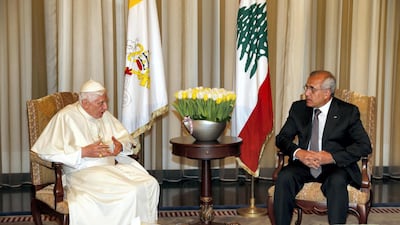
  • Pope Benedict XVI meets Muslim clerics while visiting Michel Suleiman, Lebanon's president at the time, at the Baabda presidential palace in September 2012. AFP
    Pope Benedict XVI meets Muslim clerics while visiting Michel Suleiman, Lebanon's president at the time, at the Baabda presidential palace in September 2012. AFP
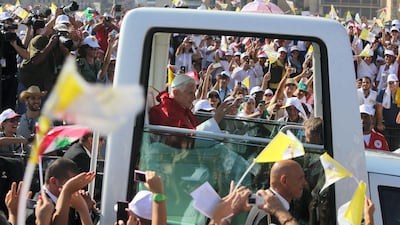
  • Lebanese Catholics cheer as Pope Benedict XVI arrives at the Maronite Christian heartland of Bkerke in 2012. AFP
    Lebanese Catholics cheer as Pope Benedict XVI arrives at the Maronite Christian heartland of Bkerke in 2012. AFP
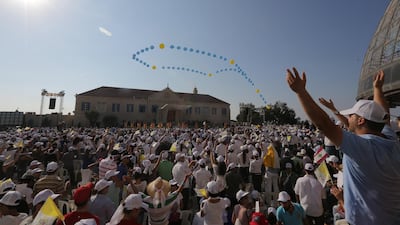
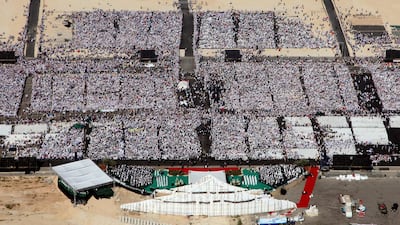
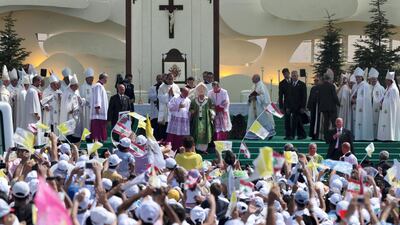
  • A large crowd attends a Mass held by Pope Benedict XVI in the Lebanese capital Beirut in September 2012. AFP
    A large crowd attends a Mass held by Pope Benedict XVI in the Lebanese capital Beirut in September 2012. AFP
  • Pope Benedict XVI waves to the crowd as he arrives to lead an open-air Mass at Beirut's waterfront on the final day of his visit to Lebanon in 2012. AFP
    Pope Benedict XVI waves to the crowd as he arrives to lead an open-air Mass at Beirut's waterfront on the final day of his visit to Lebanon in 2012. AFP
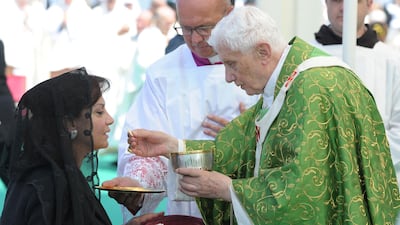
  • Wafaa, wife of Michel Suleiman, Lebanon's president at the time, receives communion from Pope Benedict XVI during the Mass in Beirut. AFP
    Wafaa, wife of Michel Suleiman, Lebanon's president at the time, receives communion from Pope Benedict XVI during the Mass in Beirut. AFP
  • Michel Suleiman, Lebanon's president at the time, meets Pope Benedict XVI before he departs Beirut. AFP
    Michel Suleiman, Lebanon's president at the time, meets Pope Benedict XVI before he departs Beirut. AFP
  • Pope Benedict XVI holds an open-air Mass in Beirut on the final day of his 2012 visit to Lebanon. AFP
    Pope Benedict XVI holds an open-air Mass in Beirut on the final day of his 2012 visit to Lebanon. AFP
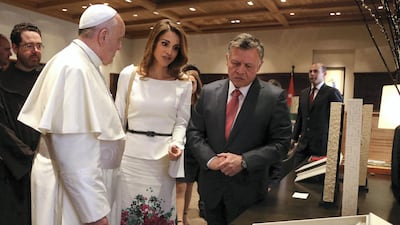
  • Jordan's King Abdullah II and his wife Queen Rania give Pope Francis a tour of the Royal Palace in Amman in 2014. AFP
    Jordan's King Abdullah II and his wife Queen Rania give Pope Francis a tour of the Royal Palace in Amman in 2014. AFP
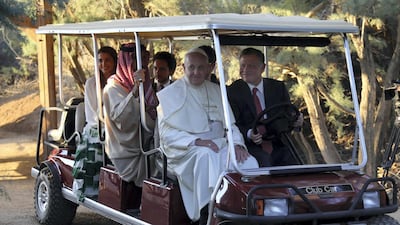
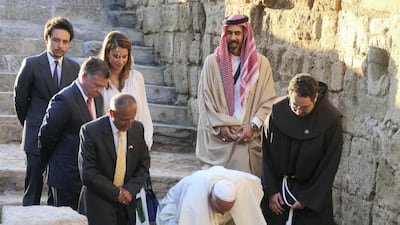
  • King Abdullah II of Jordan and Pope Francis visit Bethany, a site on the eastern bank of the River Jordan where some Christians believe Jesus was baptised. AFP
    King Abdullah II of Jordan and Pope Francis visit Bethany, a site on the eastern bank of the River Jordan where some Christians believe Jesus was baptised. AFP
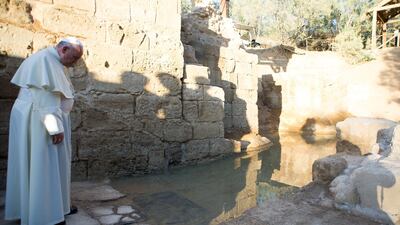
  • Pope Francis visits Bethany in 2014. Some Christians believe it was the site where Jesus was baptised. AFP
    Pope Francis visits Bethany in 2014. Some Christians believe it was the site where Jesus was baptised. AFP
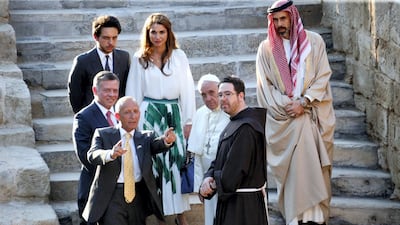
  • King Abdullah II of Jordan, Queen Rania, Crown Prince Hussein, the king's religious affairs adviser, Prince Ghazi bin Muhammad, and Pope Francis visit Bethany in 2014. AFP
    King Abdullah II of Jordan, Queen Rania, Crown Prince Hussein, the king's religious affairs adviser, Prince Ghazi bin Muhammad, and Pope Francis visit Bethany in 2014. AFP
  • King Abdullah II of Jordan, Queen Rania, Crown Prince Hussein, religious affairs adviser Prince Ghazi bin Muhammad and Pope Francis at the site on the eastern bank of the River Jordan where some Christians believe Jesus was baptised. AFP
    King Abdullah II of Jordan, Queen Rania, Crown Prince Hussein, religious affairs adviser Prince Ghazi bin Muhammad and Pope Francis at the site on the eastern bank of the River Jordan where some Christians believe Jesus was baptised. AFP
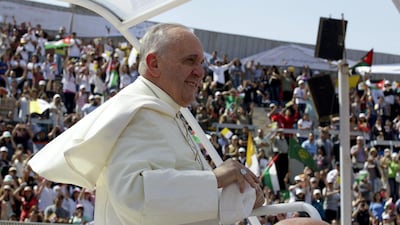
  • Pope Francis arrives to celebrate a Mass at the Amman Stadium in 2014. AFP
    Pope Francis arrives to celebrate a Mass at the Amman Stadium in 2014. AFP
  • Pope Francis greets the crowd at the Amman Stadium, where he held a Mass in 2014. AFP
    Pope Francis greets the crowd at the Amman Stadium, where he held a Mass in 2014. AFP
  • Pope Francis waves to the crowd as he leaves the stadium after holding a Mass during his 2014 trip to Jordan. AFP
    Pope Francis waves to the crowd as he leaves the stadium after holding a Mass during his 2014 trip to Jordan. AFP
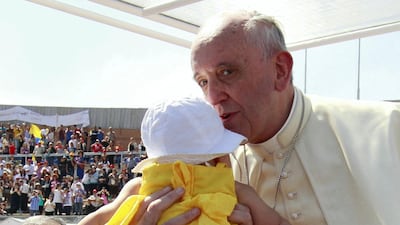
  • Pope Francis kisses a baby before holding a Mass in Amman in 2014. AFP
    Pope Francis kisses a baby before holding a Mass in Amman in 2014. AFP
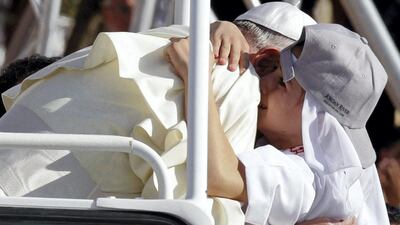
  • Pope Francis hugs a boy before holding a Mass at the Amman stadium during a visit to Jordan in 2014. AFP
    Pope Francis hugs a boy before holding a Mass at the Amman stadium during a visit to Jordan in 2014. AFP

The pontiff usually uses a specially designed bulletproof vehicle with a raised viewing area allowing him to see and be seen by crowds. This, however, might not be allowed in Iraq.

Three officials – two from the church and one at Baghdad International Airport – have ruled out using the so-called Popemobile.

Instead, he will greet crowds from inside an armoured vehicle.

The Pope usually stays at the residence of the Vatican's envoy to the country but officials have not said where the pontiff will reside.

Although the residence of Archbishop Mitja Leskovar is just outside the eastern edge of the heavily fortified Green Zone, the Vatican’s ambassador is currently in isolation within after testing positive for Covid-19.

Officials organising the visit could invite the Pope to stay inside the Green Zone or, possibly, at the presidential palace.

The 84-year-old pontiff has long expressed a desire to visit Iraq, the traditional home to many different Catholic, Orthodox and Eastern Rite churches.

The late Pope John Paul II wanted to visit Iraq in 2000, but was unable to go after negotiations with the government of Saddam Hussein broke down.

For decades, Iraq was home to a vibrant Christian community, where different faiths lived in peace among the country's Muslim majority and enjoyed government protection.

But their number started to dwindle after the 2003 US-led invasion that toppled Saddam and unleased extremism and violence in the country.


Best Academy: Ajax and Benfica

Best Agent: Jorge Mendes

Best Club : Liverpool   

 Best Coach: Jurgen Klopp (Liverpool)  

 Best Goalkeeper: Alisson Becker

 Best Men’s Player: Cristiano Ronaldo

 Best Partnership of the Year Award by SportBusiness: Manchester City and SAP

 Best Referee: Stephanie Frappart

Best Revelation Player: Joao Felix (Atletico Madrid and Portugal)

Best Sporting Director: Andrea Berta (Atletico Madrid)

Best Women's Player:  Lucy Bronze

Best Young Arab Player: Achraf Hakimi

 Kooora – Best Arab Club: Al Hilal (Saudi Arabia)

 Kooora – Best Arab Player: Abderrazak Hamdallah (Al-Nassr FC, Saudi Arabia)

 Player Career Award: Miralem Pjanic and Ryan Giggs

FIXTURES

Saturday, November 3
Japan v New Zealand
Wales v Scotland
England v South Africa
Ireland v Italy

Saturday, November 10
Italy v Georgia
Scotland v Fiji
England v New Zealand
Wales v Australia
Ireland v Argentina
France v South Africa

Saturday, November 17
Italy v Australia
Wales v Tonga
England v Japan
Scotland v South Africa
Ireland v New Zealand

Saturday, November 24
|Italy v New Zealand
Scotland v Argentina
England v Australia
Wales v South Africa
Ireland v United States
France v Fiji

Griselda
%3Cp%3E%3Cstrong%3EDirector%3A%3C%2Fstrong%3E%C2%A0Andr%C3%A9s%20Baiz%3C%2Fp%3E%0A%3Cp%3E%3Cstrong%3EStarring%3A%C2%A0%3C%2Fstrong%3ESof%C3%ADa%20Vergara%2C%20Alberto%20Guerra%2C%20Juliana%20Aiden%20Martinez%3C%2Fp%3E%0A%3Cp%3E%3Cstrong%3ERating%3A%3C%2Fstrong%3E%204%2F5%3C%2Fp%3E%0A
Classification of skills

A worker is categorised as skilled by the MOHRE based on nine levels given in the International Standard Classification of Occupations (ISCO) issued by the International Labour Organisation. 

A skilled worker would be someone at a professional level (levels 1 – 5) which includes managers, professionals, technicians and associate professionals, clerical support workers, and service and sales workers.

The worker must also have an attested educational certificate higher than secondary or an equivalent certification, and earn a monthly salary of at least Dh4,000. 

Ten tax points to be aware of in 2026

1. Domestic VAT refund amendments: request your refund within five years

If a business does not apply for the refund on time, they lose their credit.

2. E-invoicing in the UAE

Businesses should continue preparing for the implementation of e-invoicing in the UAE, with 2026 a preparation and transition period ahead of phased mandatory adoption. 

3. More tax audits

Tax authorities are increasingly using data already available across multiple filings to identify audit risks. 

4. More beneficial VAT and excise tax penalty regime

Tax disputes are expected to become more frequent and more structured, with clearer administrative objection and appeal processes. The UAE has adopted a new penalty regime for VAT and excise disputes, which now mirrors the penalty regime for corporate tax.

5. Greater emphasis on statutory audit

There is a greater need for the accuracy of financial statements. The International Financial Reporting Standards standards need to be strictly adhered to and, as a result, the quality of the audits will need to increase.

6. Further transfer pricing enforcement

Transfer pricing enforcement, which refers to the practice of establishing prices for internal transactions between related entities, is expected to broaden in scope. The UAE will shortly open the possibility to negotiate advance pricing agreements, or essentially rulings for transfer pricing purposes. 

7. Limited time periods for audits

Recent amendments also introduce a default five-year limitation period for tax audits and assessments, subject to specific statutory exceptions. While the standard audit and assessment period is five years, this may be extended to up to 15 years in cases involving fraud or tax evasion. 

8. Pillar 2 implementation 

Many multinational groups will begin to feel the practical effect of the Domestic Minimum Top-Up Tax (DMTT), the UAE's implementation of the OECD’s global minimum tax under Pillar 2. While the rules apply for financial years starting on or after January 1, 2025, it is 2026 that marks the transition to an operational phase.

9. Reduced compliance obligations for imported goods and services

Businesses that apply the reverse-charge mechanism for VAT purposes in the UAE may benefit from reduced compliance obligations. 

10. Substance and CbC reporting focus

Tax authorities are expected to continue strengthening the enforcement of economic substance and Country-by-Country (CbC) reporting frameworks. In the UAE, these regimes are increasingly being used as risk-assessment tools, providing tax authorities with a comprehensive view of multinational groups’ global footprints and enabling them to assess whether profits are aligned with real economic activity. 

Contributed by Thomas Vanhee and Hend Rashwan, Aurifer