Dear brothers and sisters,
This blessed place brings us back to our origins, to the sources of God’s work, to the birth of our religions.
Here, where Abraham our father lived, we seem to have returned home. It was here that Abraham heard God’s call; it was from here that he set out on a journey that would change history.
We are the fruits of that call and that journey. God asked Abraham to raise his eyes to heaven and to count its stars.
In those stars, he saw the promise of his descendants; he saw us.
Today we, Jews, Christians and Muslims, together with our brothers and sisters of other religions, honour our father Abraham by doing as he did: we look up to heaven and we journey on earth.
We look up to heaven.
Thousands of years later, as we look up to the same sky, those same stars appear. They illumine the darkest nights because they shine together.
Heaven thus imparts a message of unity: the Almighty above invites us never to separate ourselves from our neighbours.
The otherness of God points us towards others, towards our brothers and sisters.
Yet if we want to preserve fraternity, we must not lose sight of heaven.
May we – the descendants of Abraham and the representatives of different religions – sense that, above all, we have this role: to help our brothers and sisters to raise their eyes and prayers to heaven.
We all need this because we are not self-sufficient.
Man is not omnipotent; we cannot make it on our own.
If we exclude God, we end up worshipping the things of this earth.
-
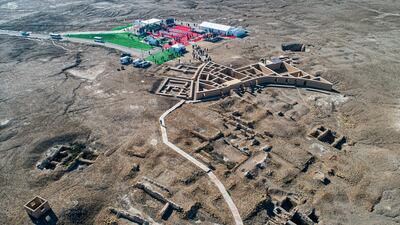
An aerial photo shows the 6,000-year-old archaeological site of Ur amid preparations for Pope Francis' visit near Nasiriyah. AP Photo -
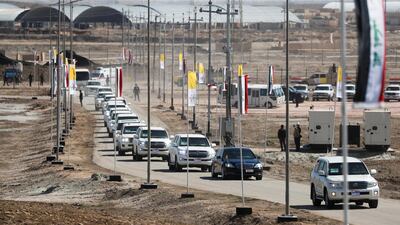
Pope Francis arrives in a limousine to hold inter-religious prayer at the ancient archeological site of Ur, traditionally believed to be the birthplace of Abraham, in Ur near Nassiriya. Reuters -
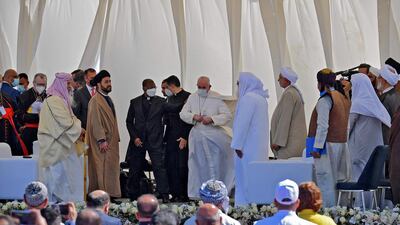
Pope Francis is received at the House of Abraham in the ancient city of Ur in southern Iraq's Dhi Qar province. AFP -
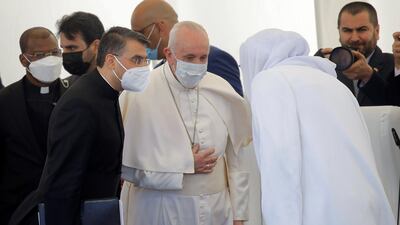
Pope Francis arrives to hold inter-religious prayer at the ancient archeological site of Ur, traditionally believed to be the birthplace of Abraham, in Ur near Nassiriya. Reuters -
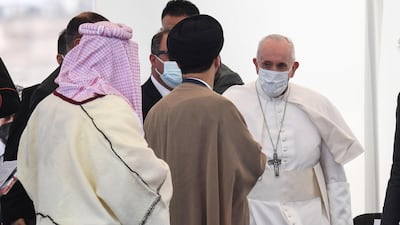
Pope Francis attends a interreligious meeting at the Plain of Ur, Nassirya. EPA -
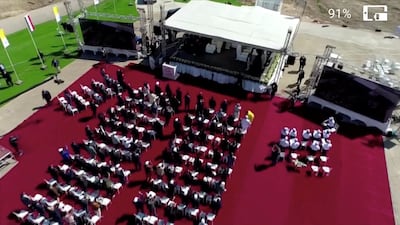
Pope Francis arrives to hold inter-religious prayer at the ancient archeological site of Ur, traditionally believed to be the birthplace of Abraham, in Ur near Nassiriya. Reuters -
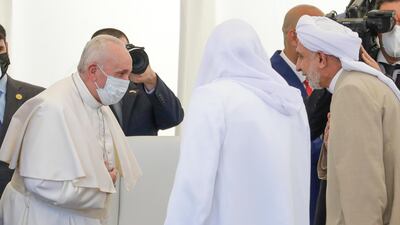
Pope Francis arrives at an interreligious meeting near the archaeological area of the Sumerian city-state of Ur, 20 kilometers south-west of Nasiriyah. AP Photo -
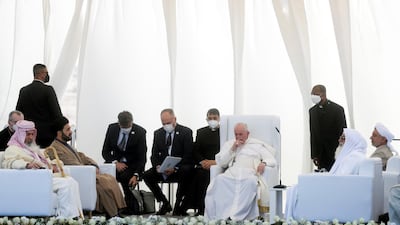
Pope Francis attends the inter-religious prayer at the ancient archeological site of Ur, traditionally believed to be the birthplace of Abraham, in Ur near Nassiriya. Reuters -
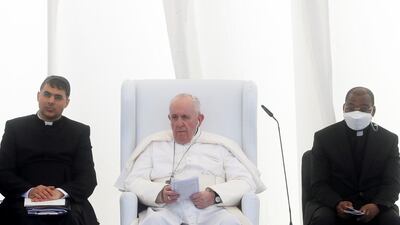
Pope Francis attends the inter-religious prayer at the ancient archeological site of Ur, traditionally believed to be the birthplace of Abraham, in Ur near Nassiriya. Reuters -
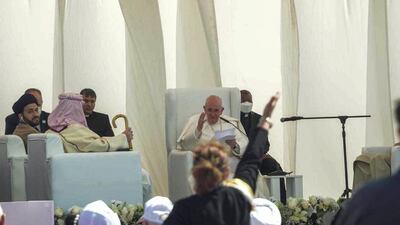
Pope Francis smiles and waves at a women that threw a kiss to him. Haider Husseini/ The National


Worldly goods, which lead so many people to be unconcerned with God and others, are not the reason why we journey on earth.
We raise our eyes to heaven in order to raise ourselves from the depths of our vanity; we serve God in order to be set free from enslavement to our egos, because God urges us to love.
This is true religiosity: to worship God and to love our neighbour.
In today’s world, which often forgets or presents distorted images of the Most High, believers are called to bear witness to his goodness, to show his paternity through our fraternity.
From this place, where faith was born, from the land of our father Abraham, let us affirm that God is merciful and that the greatest blasphemy is to profane his name by hating our brothers and sisters.
Hostility, extremism and violence are not born of a religious heart: they are betrayals of religion.
We believers cannot be silent when terrorism abuses religion; indeed, we are called unambiguously to dispel all misunderstandings.
Let us not allow the light of heaven to be overshadowed by the clouds of hatred!
Dark clouds of terrorism, war and violence have gathered over this country. All its ethnic and religious communities have suffered.
In particular, I would like to mention the Yazidi community, which has mourned the deaths of many men and witnessed thousands of women, girls and children kidnapped, sold as slaves, subjected to physical violence and forced conversions.
-

Pope Francis gestures as he boards a plane to depart for Rome, at Baghdad International Airport in Baghdad. Reuters -
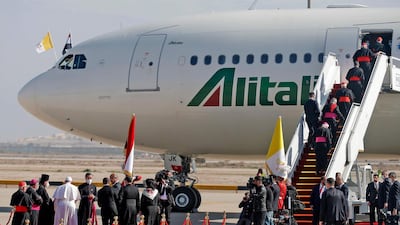
Cardinals and ranking Catholic clergymen board the Alitalia Airbus A330 aircraft as Pope Francis bids farewell to other bishops and Iraq's President Barham Saleh and his wife Sarbagh before departing from the Iraqi capital's Baghdad International. AFP -
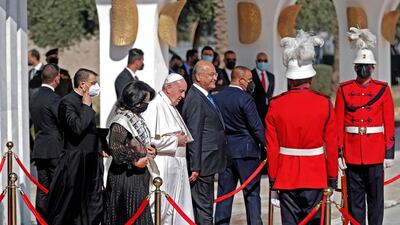
Iraq's President Barham Saleh and his wife Sarbagh escort Pope Francis during the farewell ceremony for the pontiff at the Iraqi capital's Baghdad International Airport. AFP -
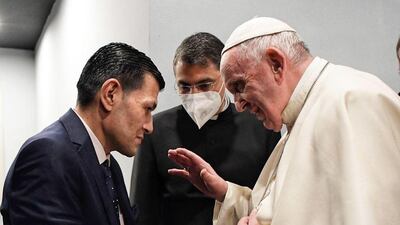
Pope Francis meets Abdullah Kurdi, father of little Alan, who was shipwrecked with his brother and mother on the Turkish coast in September 2015 while he was trying to reach Europe with his family, at the end of a Mass in the Erbil Stadium. EPA -
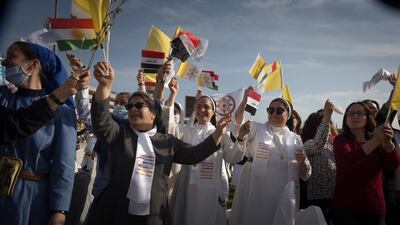
Nuns cheer and dance at the Franso Hariri Stadium in Erbil, Iraq. Getty Images -
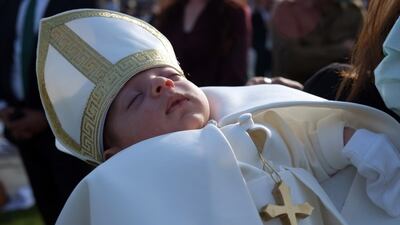
A baby dressed in papal outfit during a mass with Pope Francis at the Erbil Stadium. EPA -
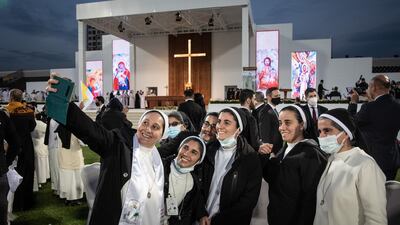
Nuns take a selfie after the completion of a mass conducted by Pope Francis. Getty Images -
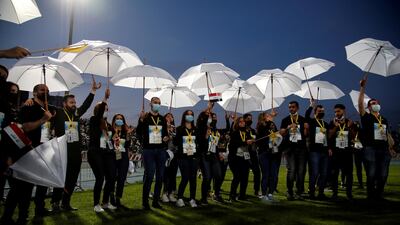
People carry umbrellas as they celebrate after a mass led by Pope Francis at the Franso Hariri Stadium in Erbil, Iraq. Reuters -

Pope Francis conducts mass at the Franso Hariri Stadium. Getty Images -
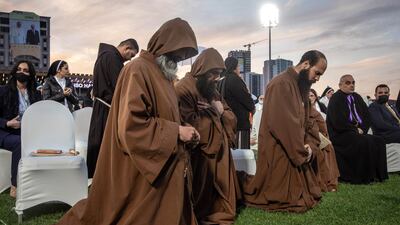
Monks pray during a mass conducted by Pope Francis at the Franso Hariri Stadium. Getty Images -
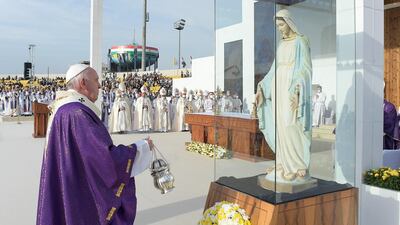
Pope Francis blesses a statue of the Virgin Mary at a mass at the Franso Hariri Stadium. EPA -
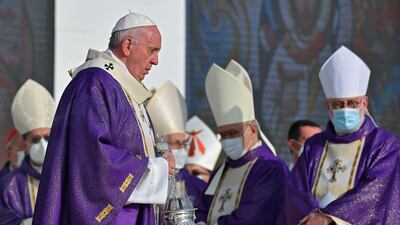
Pope Francis walks with an incense censer as he leads mass at the Franso Hariri Stadium. AFP -
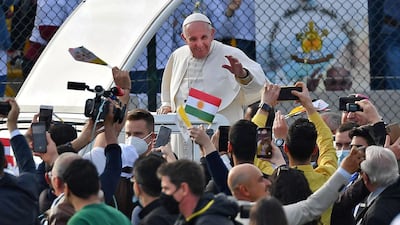
Pope Francis blesses people as he arrives in the popemobile vehicle at the Franso Hariri Stadium in Erbil. AFP -
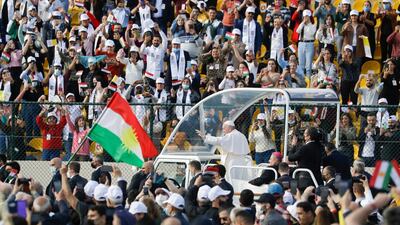
Pope Francis arrives on the popemobile to celebrate Mass at the Franso Hariri Stadium in Erbil. AP Photo -

Nuns wave flags of Iraq, Kurdistan, and the Holy See as they wait for the arrival of Pope Francis at the Franso Hariri Stadium in Erbil. AFP -
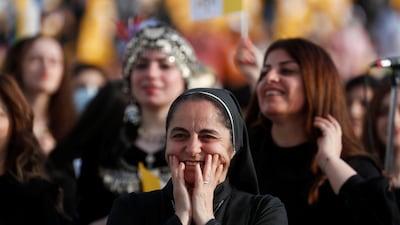
A faithful waits for Pope Francis to hold Mass at Franso Hariri Stadium in Erbil. Reuters -

Pope Francis blessing people as he arrives in the popemobile vehicle at the Franso Hariri Stadium. AFP -
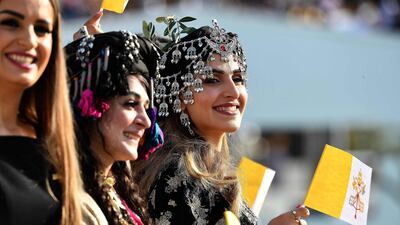
Young women dressed in traditional Kurdish clothing wave flags of the Holy See as they wait for the arrival of Pope Francis at the Franso Hariri Stadium in Erbil. AFP -
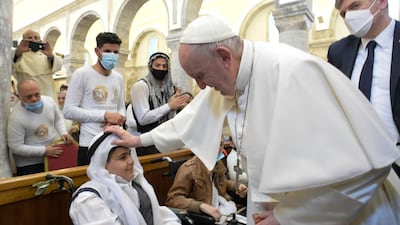
Pope Francis arrives to hold a mass at the Grand Immaculate Church, in Qaraqosh. Reuters -
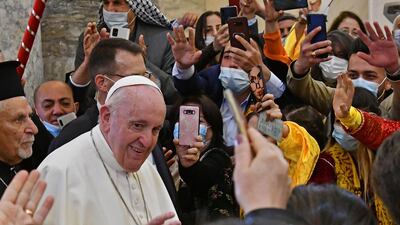
Pope Francis is greeted by people as he arrives at the Syriac Catholic Church of the Immaculate Conception (al-Tahira-l-Kubra), in the predominantly Christian town of Qaraqosh. AFP -
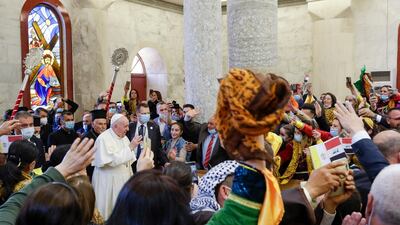
Pope Francis arrives at a meeting with local residents at the Church of the Immaculate Conception in Qaraqosh. AP Photo -
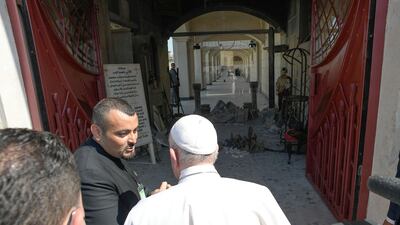
Pope Francis visits the town before holding a mass at the Grand Immaculate Church, in Qaraqosh. Reuters -
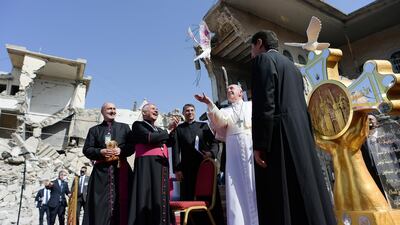
Pope Francis releases a white dove during a prayer for war victims at 'Hosh al-Bieaa', Church Square, in Mosul's Old City. Reuters -
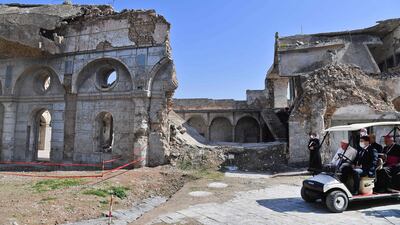
Pope Francis rides in a golf cart at the ruins of the Syriac Catholic Church of the Immaculate Conception. AFP -
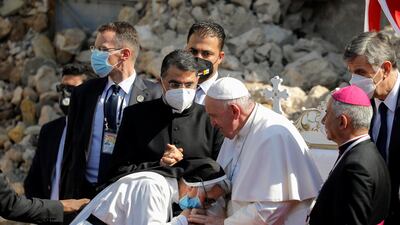
A nun kisses the hand of Pope Francis during a prayer for war victims at 'Hosh al-Bieaa', Church Square, in Mosul's Old City. Reuters -
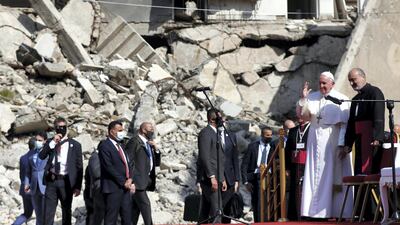
Pope Francis arrives to pray for war victims at 'Hosh al-Bieaa', Church Square, in Mosul's old city. Reuters -
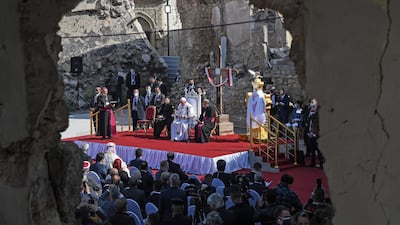
Pope Francis attends a prayer for the victims of the war at Church Square, Mosul. EPA -
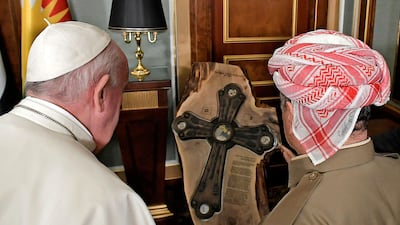
Pope Francis and the leader of the Kurdistan Democratic Party (KDP) Masud Barzani viewing a gift sculpture of a Chaldean cross during their meeting in Arbil, the capital of Iraq's northern autonomous Kurdish region. AFP -
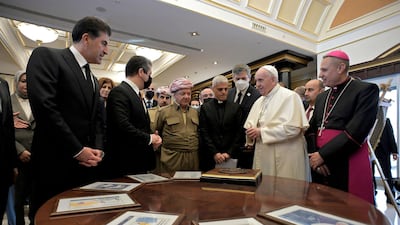
Pope Francis meeting with the President of the autonomous Kurdistan Region Nechirvan Barzani, the Prime Minister of the 9th cabinet of the Kurdistan Regional Government Mansour Barzani, and the leader of the Kurdistan Democratic Party (KDP) Masud Barzani in Arbil. AFP -

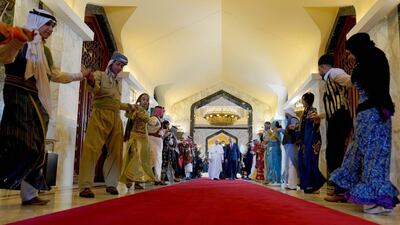
Pope Francis greets Iraqis dressed in traditional outfits upon his arrival at Erbil airport, in the capital of the northern Iraqi Kurdish autonomous region. AFP -
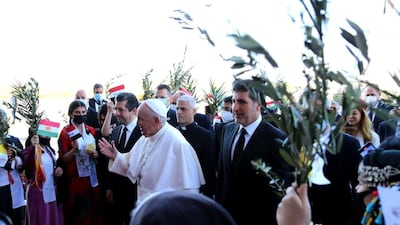
Pope Francis walks with Masrour Barzani, Prime Minister of Kurdistan region, and President of the Kurdistan region in Iraq Nechirvan Barzani, upon his arrival at Erbil International Airport. Reuters -
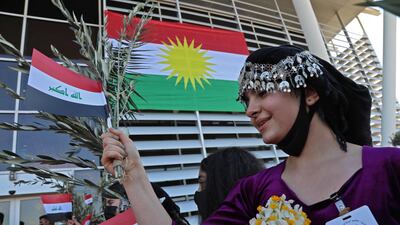
Iraqi women dressed in traditional outfits hold palm leafs as they welcome Pope Francis upon his arrival at Erbil airport. AFP -
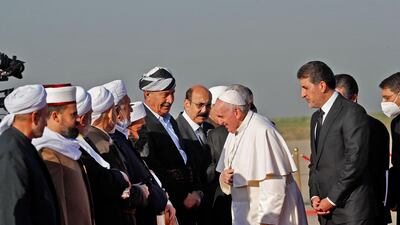
Mansour Barzani, Prime Minister of the 9th cabinet of the Kurdistan Regional Government looks on , as Pope Francis greets religious dignitaries at the Erbil airport. AFP -
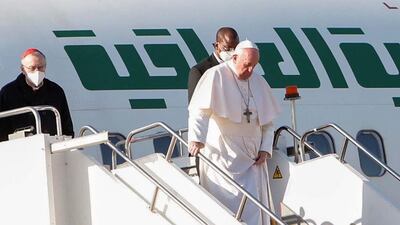
Pope Francis arrives at Erbil International Airport in Iraq. Reuters -
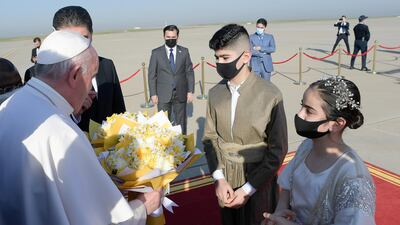
Pope Francis is welcomed at Erbil International Airport in Erbil. Reuters -
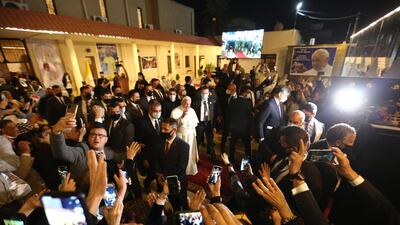
Pope Francis greets people as he leave the Chaldean Cathedral of Saint Joseph. Getty Images -
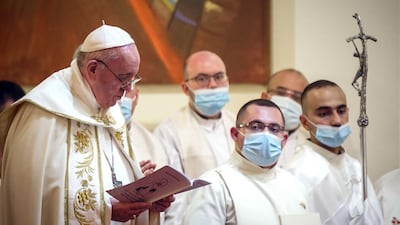
Pope Francis leads mass at Baghdad's Saint Joseph Cathedral. AFP -
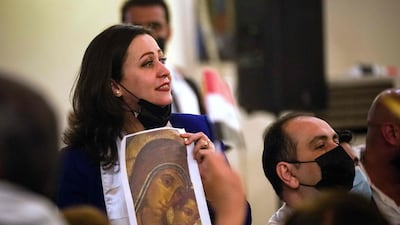
Iraqi Christian worshippers attend the mass led by the Pope at Baghdad's Saint Joseph Cathedral. AFP -
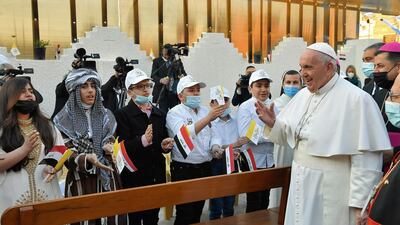
Pope Francis greeted by children upon his arrival for a mass at Baghdad's Saint Joseph Cathedral. AFP -
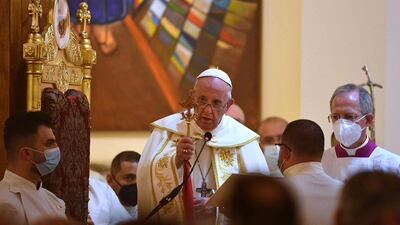
Pope Francis blesses the congregation as he leads mass at Baghdad's Saint Joseph Cathedral. AFP -
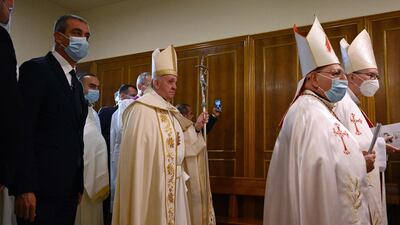
Pope Francis arrives to lead mass at Baghdad's Saint Joseph Cathedral. AFP -
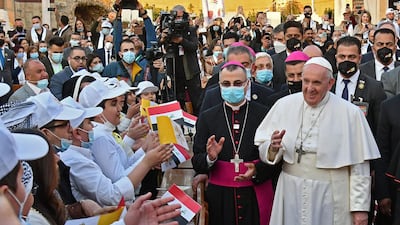
Pope Francis is greeted by children upon his arrival at Baghdad's Saint Joseph Cathedral. AFP -
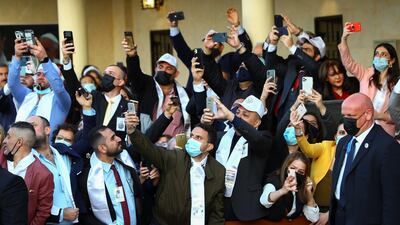
People take pictures with their mobiles upon the arrival of Pope Francis. Reuters -
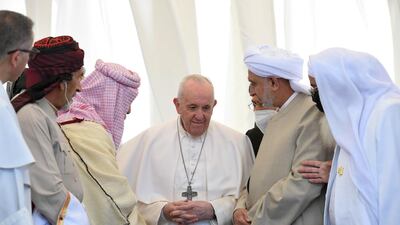
Pope Francis speaks to Iraqi religious figures during an interfaith service at the House of Abraham in the ancient city of Ur in Iraq's southern Dhi Qar province. EPA -

Pope Francis speaks to Iraqi religious figures during an interfaith service at the House of Abraham in the ancient city of Ur. EPA -
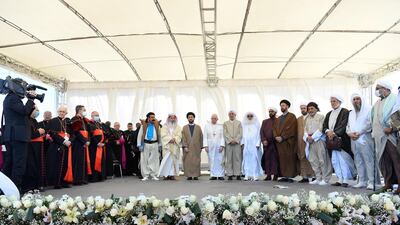
Pope Francis speaks to Iraqi religious figures during an interfaith service at the House of Abraham in the ancient city of Ur. EPA -
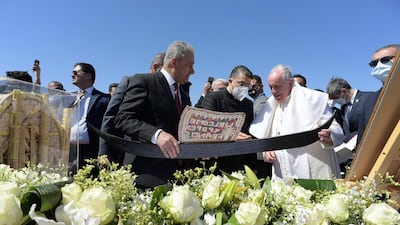
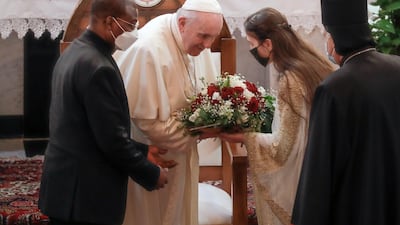
Pope Francis is seen behind flowers at an interfaith service at the House of Abraham in the ancient city of Ur. EPA -
Pope Francis smiles and waves at a women that threw a kiss to him. Haider Husseini/ The National -
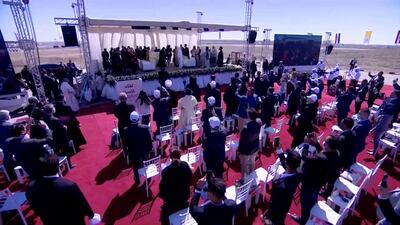
People attend an inter-religious ceremony in Ur near Nassiriya. Reuters -
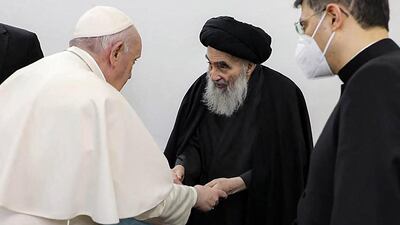
Grand Ayatollah Ali al-Sistani meeting with Pope Francis and his delegation, at his home in the holy city of Najaf. AFP -
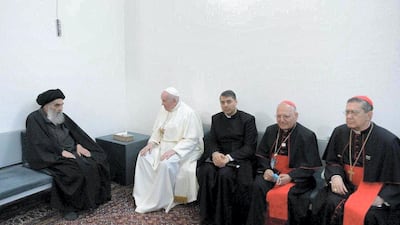
Pope Francis, accompanied by clerics, and Iraq's top Shiite cleric, Grand Ayatollah Ali Al Sistani, meet in Najaf. Courtesy of the Vatican -
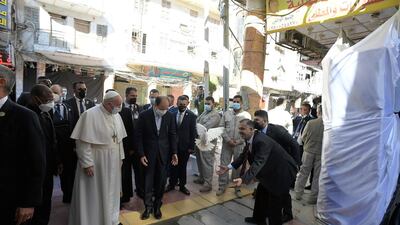
Pope Francis's meeting with Iraq's top Shiite cleric, Grand Ayatollah Ali Al Sistani, in Najaf, followed months of negotiations between Najaf and the Vatican. Reuters -

Pope Francis smiles with Iraq's prime minister Mustafa Al Kadhimi on arrival at Baghdad airport. Handout from the office of the Prime Minister of Iraq -
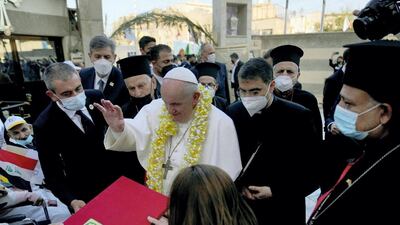
The Pope visits Our Lady of Salvation Church. Courtesy of the Prime Minister office -
Pope Francis is welcomed upon his arrival at the Our Lady of Salvation Church. AP Photo -
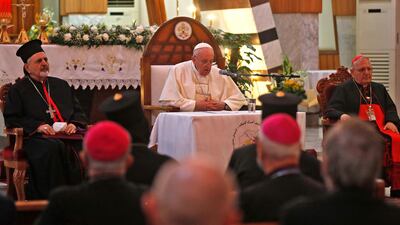
Pope Francis speaks in the Our Lady of Salvation Church. AFP -
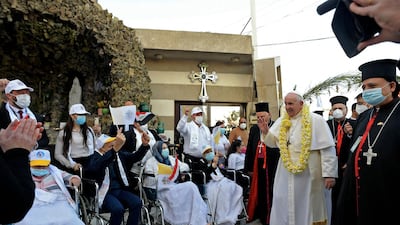
Pope Francis greets people in front of the the Our Lady of Salvation Church. AFP -
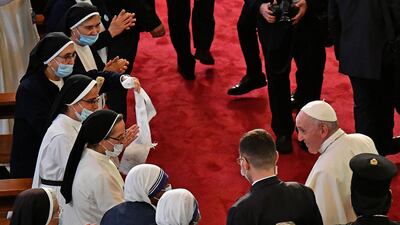
Nuns welcome Pope Francis at the Our Lady of Salvation Church. AFP -
Iraq's President Barham Salih speaks with Pope Francis during a welcoming ceremony at the Presidental Palace in Baghdad. Reuters -
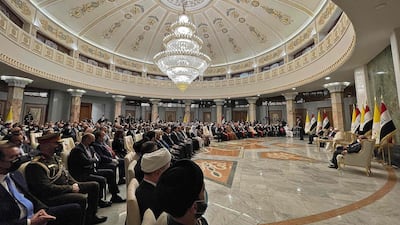
Iraqi President Barham Salih welcomes Pope Francis at the Presidential Palace. AFP -
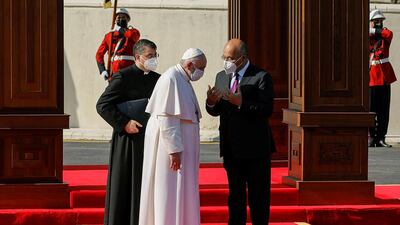
Pope Francis walk with Iraq's prime minister Mustafa Al Kadhimi on arrival at Baghdad airport. Handout from the office of the Prime Minister of Iraq -
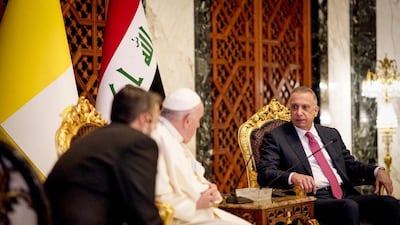
Pope Francis talks with Iraq's prime minister Mustafa Al Kadhimi on arrival in Baghdad. Handout from the office of the Prime Minister of Iraq -
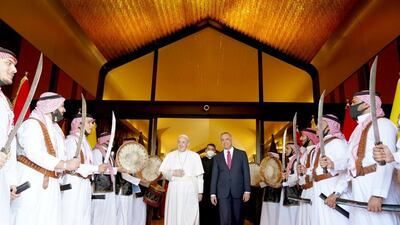
Pope Francis walks with Iraq's prime minister Mustafa Al Kadhimi on arrival at Baghdad airport. Handout from the office of the Prime Minister of Iraq -
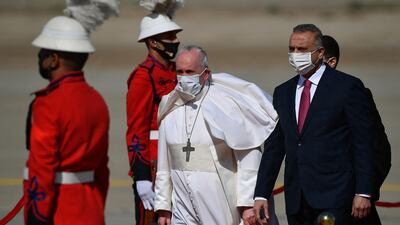
Pope Francis walks alongside Iraq's Prime Minister Mustafa Al Kadhimi upon his arrival in Baghdad. AFP -
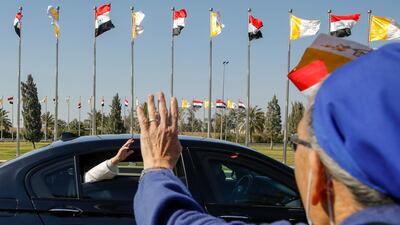
Pope Francis waves to the crowd upon his arrival in Baghdad. Reuters -
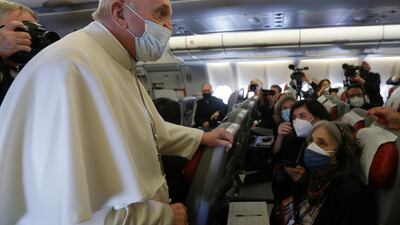
Pope Francis speaks to journalists aboard the plane heading to Iraq. AP Photo -
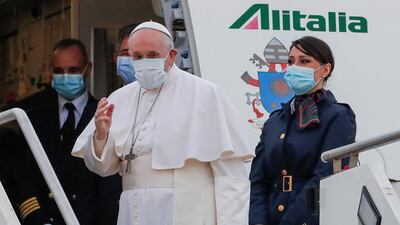
Pope Francis waves as he boards the plane for his visit to Iraq, at Leonardo da Vinci-Fiumicino Airport in Rome, Italy. Reuters -
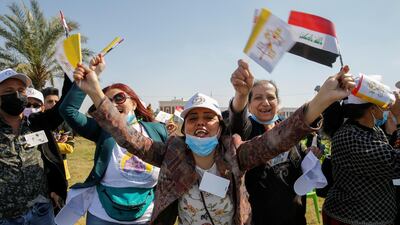
People holding Iraqi and Vatican flags as they wait for the arrival of Pope Francis, at Baghdad Airport Road, in Baghdad, Iraq. Reuters -
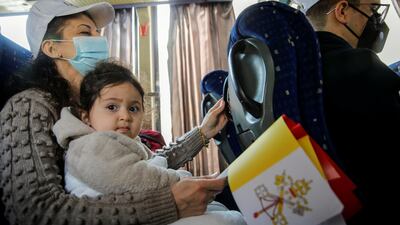
A Christian woman holds the Vatican flag as she heads to the airport to wait for the arrival of Pope Francis, in Baghdad, Iraq. Reuters


Today, let us pray for those who have endured these sufferings, for those who are still dispersed and abducted, that they may soon return home.
And let us pray that freedom of conscience and freedom of religion will everywhere be recognised and respected; these are fundamental rights, because they make us free to contemplate the heaven for which we were created.
When terrorism invaded the north of this beloved country, it wantonly destroyed part of its magnificent religious heritage, including the churches, monasteries and places of worship of various communities.
Yet, even at that dark time, some stars kept shining.
I think of the young Muslim volunteers of Mosul, who helped to repair churches and monasteries, building fraternal friendships on the rubble of hatred, and those Christians and Muslims who today are restoring mosques and churches together.
Professor Ali Thajeel spoke too of the return of pilgrims to this city.
It is important to make pilgrimages to holy places, for it is the most beautiful sign on earth of our yearning for heaven.
To love and protect holy places, therefore, is an existential necessity, in memory of our father Abraham, who in various places raised to heaven altars of the Lord.
May the great Patriarch help us to make our respective sacred places oases of peace and encounter for all!
By his fidelity to God, Abraham became a blessing for all peoples; may our presence here today, in his footsteps, be a sign of blessing and hope for Iraq, for the Middle East and for the whole world.
Heaven has not grown weary of the earth: God loves every people, every one of his daughters and sons!
Let us never tire of looking up to heaven, of looking up to those same stars that, in his day, our father Abraham contemplated.
We journey on earth.
For Abraham, looking up to heaven, rather than being a distraction, was an incentive to journey on earth, to set out on a path that, through his descendants, would lead to every time and place.
It all started from here, with the Lord who brought him forth from Ur.
His was a journey outward, one that involved sacrifices.
Abraham had to leave his land, home and family.
-
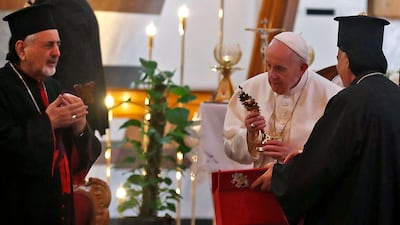
Pope Francis receives an ornamental gift after his sermon at the Our Lady of Salvation Church. AFP -
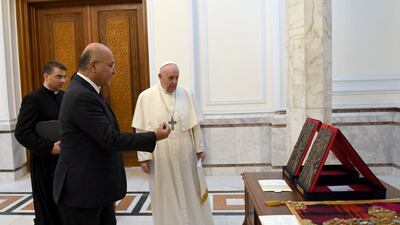
Pope Francis receives gifts from Iraqi President Barham Salih, two stone carvings by the late Iraqi artist Mohammed Ghani Hikmat, and a hand embroidered cross in gold thread and semi precious stones with a head cap from Kurdistan. Office of the President -
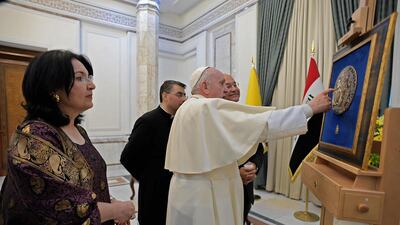
Iraqi President Barham Salih and his wife Sarbagh show Pope Francis one of the presidential gifts. AFP -
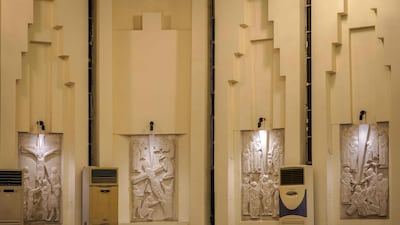
Four of the 14 pieces of "The Way of Suffering", sculpted plaques representing the stations of the cross by late Iraqi artist Mohammed Ghani Hikmat, are displayed at the Chaldean Catholic Church of the Ascension. Hikmat's son Yasser made a miniature of the fourth station stele which will be presented as a gift to Pope Francis. SFP -
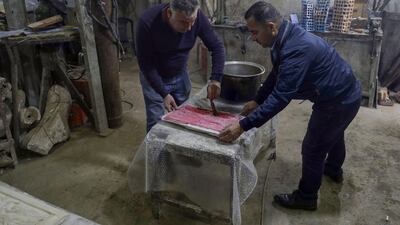
Iraqi artist Yasser Hikmat, son of sculptor Mohammed Ghani Hikmat works on the piece at a workshop in Lebanon's capital Beirut. AFP -
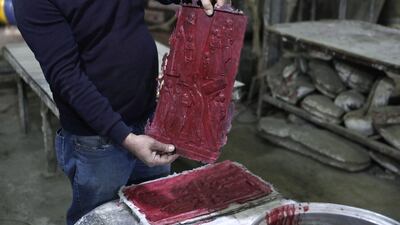
Yasser's work is a miniature of one of his late father's 14 sculptures. AFP -

Yasser Hikmat displays a finished piece at a workshop in Beirut. AFP -

Iraqi priest Ammar Yaqo looks on as Karjiya Baqtar embroiders a precious prayer shawl using golden thread, to gift to Pope Francis during his upcoming visit to her Iraqi hometown Qaraqosh. AFP


Yet by giving up his own family, he became the father of a family of peoples.
Something similar also happens to us: on our own journey, we are called to leave behind those ties and attachments that, by keeping us enclosed in our own groups, prevent us from welcoming God’s boundless love and from seeing others as our brothers and sisters.
We need to move beyond ourselves, because we need one another.
The pandemic has made us realise that “no one is saved alone”.
Still, the temptation to withdraw from others is never-ending, yet at the same time we know that “the notion of ‘every man for himself’ will rapidly degenerate into a free-for-all that would prove worse than any pandemic”.
Amid the tempests we are currently experiencing, such isolation will not save us.
Nor will an arms race or the erection of walls that will only make us all the more distant and aggressive.
Nor the idolatry of money, for it closes us in on ourselves and creates chasms of inequality that engulf humanity.
Nor can we be saved by consumerism, which numbs the mind and deadens the heart.
The way that heaven points out for our journey is another: the way of peace.
It demands, especially amid the tempest, that we row together on the same side.
It is shameful that, while all of us have suffered from the crisis of the pandemic, especially here, where conflicts have caused so much suffering, anyone should be concerned simply for his own affairs.
There will be no peace without sharing and acceptance, without a justice that ensures equity and advancement for all, beginning with those most vulnerable.
There will be no peace unless peoples extend a hand to other peoples.
There will be no peace as long as we see others as them and not us.
There will be no peace as long as our alliances are against others, for alliances of some against others only increase divisions.
Peace does not demand winners or losers, but rather brothers and sisters who, for all the misunderstandings and hurts of the past, are journeying from conflict to unity.
Let us ask for this in praying for the whole Middle East. Here I think especially of neighbouring war-torn Syria.
The Patriarch Abraham, who today brings us together in unity, was a prophet of the Most High.
An ancient prophecy says that the peoples “shall beat their swords into ploughshares, and their spears into pruning hooks”.
This prophecy has not been fulfilled; on the contrary, swords and spears have turned into missiles and bombs.
From where, then, can the journey of peace begin?
From the decision not to have enemies.
Anyone with the courage to look at the stars, anyone who believes in God, has no enemies to fight.
He or she has only one enemy to face, an enemy that stands at the door of the heart and knocks to enter.
That enemy is hatred.
While some try to have enemies more than to be friends, while many seek their own profit at the expense of others, those who look at the stars of the promise, those who follow the ways of God, cannot be against someone, but for everyone.
They cannot justify any form of imposition, oppression and abuse of power; they cannot adopt an attitude of belligerence.
Dear friends, is all this possible?
Father Abraham, who was able to hope against all hope, encourages us.
Throughout history, we have frequently pursued goals that are overly worldly and journeyed on our own, but with the help of God, we can change for the better.
It is up to us, today’s humanity, especially those of us, believers of all religions, to turn instruments of hatred into instruments of peace.
It is up to us to appeal firmly to the leaders of nations to make the increasing proliferation of arms give way to the distribution of food for all.
It is up to us to silence mutual accusations in order to make heard the cry of the oppressed and discarded in our world: all too many people lack food, medicine, education, rights and dignity!
It is up to us to shed light on the shady maneuvers that revolve around money and to demand that money not end up always and only reinforcing the unbridled luxury of a few.
It is up to us preserve our common home from our predatory aims.
It is up to us to remind the world that human life has value for what it is and not for what it has.
That the lives of the unborn, the elderly, migrants and men and women, whatever the colour of their skin or their nationality, are always sacred and count as much as the lives of everyone else!
It is up to us to have the courage to lift up our eyes and look at the stars, the stars that our father Abraham saw, the stars of the promise.
The journey of Abraham was a blessing of peace.
Yet it was not easy: he had to face struggles and unforeseen events.
We too have a rough journey ahead, but like the great Patriarch, we need to take concrete steps, to set out and seek the face of others, to share memories, gazes and silences, stories and experiences.
I was struck by the testimony of Dawood and Hasan, a Christian and a Muslim who, undaunted by the differences between them, studied and worked together.
Together they built the future and realised that they are brothers. In order to move forward, we too need to achieve something good and concrete together.
This is the way, especially for young people, who must not see their dreams cut short by the conflicts of the past!
It is urgent to teach them fraternity, to teach them to look at the stars.
This is a real emergency; it will be the most effective vaccine for a future of peace. For you, dear young people, are our present and our future!
Only with others can the wounds of the past be healed.
Rafah told us of the heroic example of Najy, from the Sabean Mandean community, who lost his life in an attempt to save the family of his Muslim neighbour.
How many people here, amid the silence and indifference of the world, have embarked upon journeys of fraternity!
Rafah also told us of the unspeakable sufferings of the war that forced many to abandon home and country in search of a future for their children.
Thank you, Rafah, for having shared with us your firm determination to stay here, in the land of your fathers.
May those who were unable to do so, and had to flee, find a kindly welcome, befitting those who are vulnerable and suffering.
It was precisely through hospitality, a distinctive feature of these lands, that Abraham was visited by God and given the gift of a son, when it seemed that all hope was past.
Brothers and sisters of different religions, here we find ourselves at home, and from here, together, we wish to commit ourselves to fulfilling God’s dream that the human family may become hospitable and welcoming to all his children; that looking up to the same heaven, it will journey in peace on the same earth.

