Iraq's cabinet suspended the health minister after at least 82 people were killed and 110 injured when an oxygen tank exploded late on Saturday at a hospital treating Covid-19 patients on the outskirts of Baghdad, a statement carried by state media said on Sunday.
The explosion caused a huge fire in the pulmonary intensive care unit on the second floor of the Ibn Al Khateeb hospital in Jisr Diyala district, the head of the Iraqi Civil Defence said.
"Iraqi Prime Minister Mustafa Al Kadhimi suspended Minister of Health, Hassan Al Tamimi, the Governor of Baghdad, Mohammed Ata and the Director of Rusafa Health department," said a statement by his office following an urgent cabinet session to discuss the incident.
The investigation, to be lead by the interior minister and carried out by senior officials, will identify and hold accountable those responsible for the incident, the statement said.
The cabinet ordered the investigation to be finalised within five days and the findings to be submitted back to it for review.
The semi-official Independent Human Rights Commission said the blast “was a crime against patients exhausted by Covid-19 who put their lives in the hands of the Health Ministry and its institutions and instead of being treated, perished in flames".
A member of the commission, Ali Al Bayati, tweeted that 28 patients on ventilators battling severe symptoms of the coronavirus were among the dead.
The ministry of health should be responsible for the incident, Mr Al Bayati told The National.
"The absence of occupational safety and prevention requirements in health institutions is the main problem and reason of such repeated fire accidents," he said.
“Elderly and [coronavirus] patients were on pulmonary devices and that made it impossible for them to move,” Maj Gen Kadhim Bohan told state-run TV as firefighters battled flames behind him.
“The inferno and the smoke led to fatalities and injuries among them.”
Maj Gen Bohan said there were no safety systems in the three-storey building.
"Unfortunately, there were no protection teams, no fire extinguishers and no fire-detection systems," he said. The flammable material of the false ceiling, the official said, made the situation worse.
A man who had been visiting his brother described people jumping out of windows to escape.
"The fire spread, like fuel ... I took my brother out to the street, next to the checkpoint. Then I came [back] and went up from there. To the last floor, that did not burn. I found a girl suffocating, about 19 years old, she was suffocating, she was about to die," Ahmed Zaki told Reuters news agency.
"I took her on my shoulders and I ran down. People were jumping... Doctors fell on the cars. Everyone was jumping. And I kept going up from there, got people and come down again,” Mr Zaki said.
President Barham Salih said corruption and mismanagement are responsible for the fire.
"The tragedy of Ibn Al Khatib Hospital is a wound for the whole nation. Sympathising with those who lost their lives in not enough," Mr Salih said on Twitter.
He called for "accountability towards the negligence and a comprehensive and serious review of the performance of institutions to ensure that such disasters are not repeated."
Parliament is set to meet tomorrow to discuss and investigate the incident.
Prime Minister Mustafa Al Kadhimi announced a three-day mourning period for the victims and ordered an investigation into the blast.
Mr Al Kadhimi on Sunday dismissed the director general of the Baghdad Health Department in the Al Rusafa area, where the hospital is located. He also fired the director of Ibn Al Khatib Hospital and its director of engineering and maintenance, according to a statement from the Health Ministry and his office.
Casualty numbers were still being assessed after the fire was extinguished early on Sunday morning. Health officials said there were between 200 and 300 patients in the hospital.
Videos and pictures of the scene showed hundreds of firefighters and residents of the area trying to put out the fire and rescue patients. Patients' relatives were seen crying hysterically and beating their heads and chests in grief.
The prime minister described the incident as a “setback” and blamed negligence.
Authorities will investigate the director of the hospital, the heads of security and maintenance, and other officials, Mr Al Kadhimi said.
The prime minister's official Twitter account said he ordered safety inspections to be conducted on all medical facilities within a week.
The United Nations expressed "shock and pain at the enormity of the tragic incident".
The UN mission in Iraq said special envoy Jeanine Hennis-Plasschaert offered her deepest condolences to the families of those who lost their lives and wished the injured a speedy recovery.
Ms Plasschaert also called for "stronger protection measures to ensure that such a disaster cannot reoccur".
-
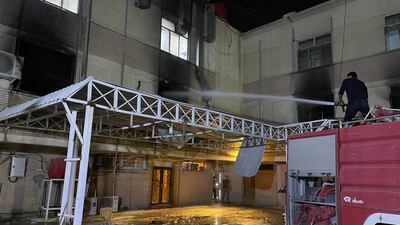
Firefighters extinguish a fire that broke out at Ibn Al Khateeb hospital, south of Baghdad, EPA -
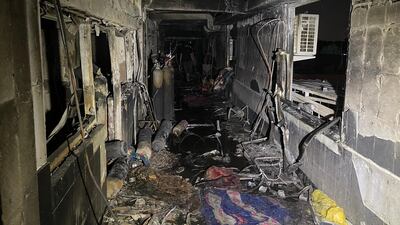
Aftermath of a fire that ripped through the intensive care unit of Ibn Al Khateeb hospital, south of Iraq's capital Baghdad. EPA -
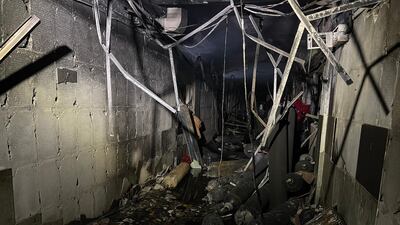
Parts of the walls and windows of the second floor of Ibn Al Khateeb hospital in Baghdad were blackened by soot from the fire. EPA -
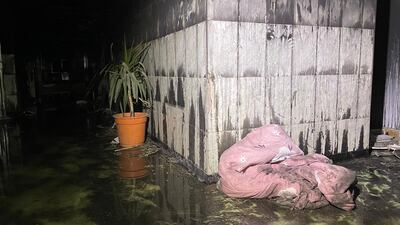
At least 82 people died and another 110 injured when a fire broke out following the explosion of an oxygen tank at Ibn Al Khateeb hospital in the Iraqi capital Baghdad. EPA -
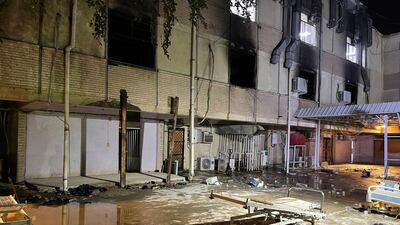
Investigative teams are looking for the cause of an oxygen tank explosion in an intensive care unit for coronavirus patients at Ibn Al Khateeb hospital, south of Baghdad. EPA -
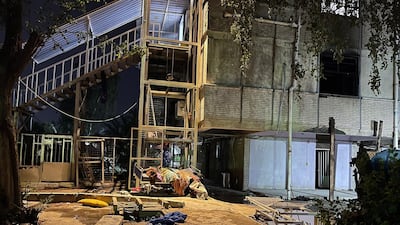
The Ibn Al Khateeb hospital in southern Baghdad where a fire broke out following the explosion of an oxygen tank on April 24, 2021. EPA -
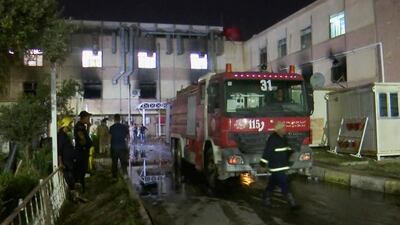
A firefighting vehicle arrives at the scene of a fire that erupted in a Baghdad hospital's intensive care unit for coronavirus patients. AP -
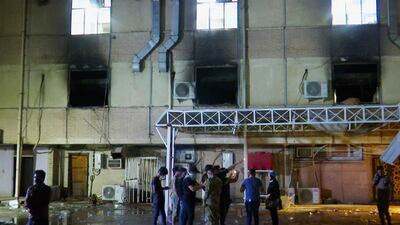
First responders work at the scene of a fire at Ibn Al Qateeb hospital, south of Baghdad. AP -
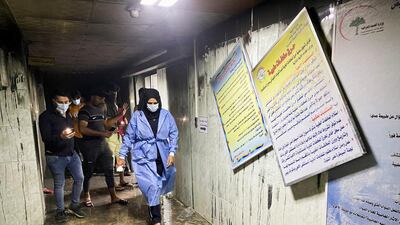
People and medical staff walk through the Ibn Al Khateeb hospital in Baghdad after a fire caused by an oxygen tank explosion. Reuters -
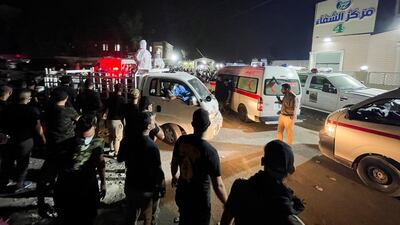
People gather outside the Ibn Al Khateeb hospital in Baghdad after a fire caused by an oxygen tank explosion. Reuters -
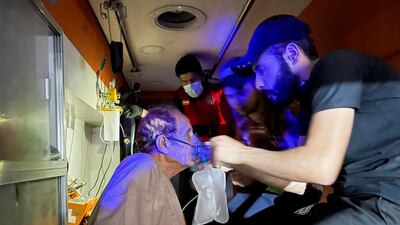
A Covid-19 patient is prepared for rescue in an ambulance outside Ibn Al Khateeb hospital in Baghdad. Reuters -
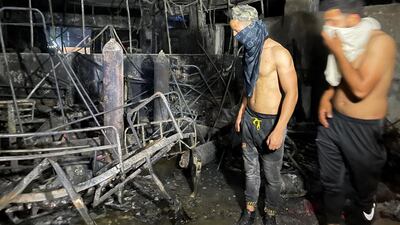
People look at dmage from an explosion and fire at Ibn Al Khateeb hospital in Baghdad. Reuters -
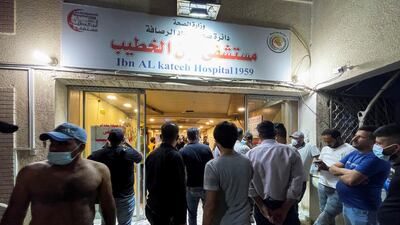
People gather at Ibn Al Khateeb hospital after a fire caused by an oxygen tank explosion. Reuters -
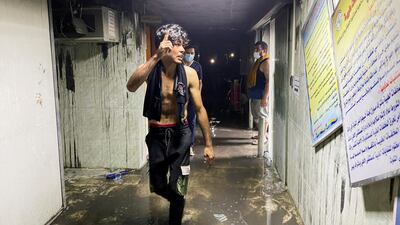
People walk through the Ibn Al Khateeb hospital after the oxygen tank explosion and fire. Reuters -

Medics attend to a Covid-19 patient in an ambulance outside Ibn Al Khateeb hospital, after a fire caused by an oxygen tank explosion. Reuters


It is still unclear what caused the oxygen tank to explode, but a medical worker at the hospital blamed a patient's relative for using a heater next to it.
The incident sparked calls on social media for the sacking of the Health Minister, Hassan Al Tamimi, and anger over inefficiency and corruption in the country.
“Everything in Iraq can explode in your face and kill you, even the oxygen tank that is supposed to help you breathe,” activist Omar Al Janai wrote on Twitter.
“Corruption has gnawed the state and the only victim is the people,” he added.
"Not only coronavirus is killing us, we are being killed by the corruption and inefficiency of successive Iraqi governments," said another Twitter user.
Iraqi hospitals have been battered by decades of war, sanctions and corruption. The pandemic has put the country’s healthcare system on the brink of collapse with an acute shortage of medical staff and equipment.
Much of Iraq’s health infrastructure was built during the 1970s and 1980s. Most medicines and medical supplies are only available on the black market and medical staff are dying from Covid-19 because of a lack of protection.
Many coronavirus patients prefer not to go to crowded hospitals and receive treatment at home.
Iraq is in a new wave of the pandemic that pushed the number of Covid-19 cases past one million on Wednesday. On Saturday, the country registered 6,967 new cases and 43 deaths, taking the total number of infections to 1,025,288 and fatalities to 15,217 since the first infections were reported in February last year.
The ministry said it carries out about 40,000 tests daily among a population of 40 million.

