• Fireworks light up the sky over the Basra International Stadium during the opening ceremony of the 25th Arabian Gulf Cup in Basra, southern Iraq, on Friday, January 6. Getty
    Fireworks light up the sky over the Basra International Stadium during the opening ceremony of the 25th Arabian Gulf Cup in Basra, southern Iraq, on Friday, January 6. Getty
  • This is the first time Iraq has hosted the Gulf Cup since 1979. Getty
    This is the first time Iraq has hosted the Gulf Cup since 1979. Getty
  • A performance at the opening ceremony. Iraqis hope hosting the tournament will help kick off a national recovery, after 40 years of turmoil. Getty
    A performance at the opening ceremony. Iraqis hope hosting the tournament will help kick off a national recovery, after 40 years of turmoil. Getty
  • Artists entertain the Basra crowd. Iraq has won the tournament three times - including when it was held in Baghdad 43 years ago. Getty
    Artists entertain the Basra crowd. Iraq has won the tournament three times - including when it was held in Baghdad 43 years ago. Getty
  • The 65,000-capacity Basra International Stadium bathed in light before the cup got under way with Iraq playing Oman. The game ended 0-0. Getty Images
    The 65,000-capacity Basra International Stadium bathed in light before the cup got under way with Iraq playing Oman. The game ended 0-0. Getty Images
  • Iraqi Prime Minister Mohammed Shia Al Sudani, centre, at Basra International Stadium, with Fifa president Gianni Infantino to his right. Mr Al Sudani opened the tournament and welcomed the eight teams and their fans. Photo: Iraqi Prime Minister Media Office
    Iraqi Prime Minister Mohammed Shia Al Sudani, centre, at Basra International Stadium, with Fifa president Gianni Infantino to his right. Mr Al Sudani opened the tournament and welcomed the eight teams and their fans. Photo: Iraqi Prime Minister Media Office
  • Performers at the opening ceremony. Competing for the Gulf Cup are: Iraq, the UAE, Saudi Arabia, Oman, Kuwait, Bahrain, Qatar and Yemen. Getty
    Performers at the opening ceremony. Competing for the Gulf Cup are: Iraq, the UAE, Saudi Arabia, Oman, Kuwait, Bahrain, Qatar and Yemen. Getty
  • The spectacular Arabian Gulf Cup opening ceremony at Basra International Stadium. The tournament takes place from January 6 to January 19.
    The spectacular Arabian Gulf Cup opening ceremony at Basra International Stadium. The tournament takes place from January 6 to January 19.

Arabian Gulf Cup kicks off in Basra with elaborate opening ceremony


Sinan Mahmoud
  • English
  • Arabic

The Gulf Cup began with fanfare on Friday in Iraq’s southern city of Basra, sparking hopes of a bright future for the country’s embattled football prospects.

For Iraqis, hosting the biennial event will turn a new page in the troubled history of their country, boost relations with Gulf neighbours and represent a crucial move towards full national recovery.

Iraqi Prime Minister Mohammed Shia Al Sudani formally kicked off the tournament, hailing it as a “historic moment” which demonstrates “brotherhood among the Arab brothers in the Gulf”.

“Dear sport fans, thanks for your presence,” he said. “On your behalf and in the name of Iraq, we welcome the brothers, the visitors, the teams and the fans in the land in Iraq, the land of Mesopotamia and Basra.

“We wish all teams success and enjoyment to the fans.”

Mr Al Sudani was joined by Fifa President Gianni Infantino, Iraq's Speaker of Parliament Muhammad Al Halbousi and the heads of the Gulf football federations.

As the sun set over the port city, the mood in and around Basra International Stadium was festive and electric with anticipation.

By the afternoon, more than 10,000 foreign fans had arrived in the city, located a short distance from Iraq's borders with Kuwait and Iran, an official from Basra's provincial government said.

Thousands of people gathered at the stadium, known as the Trunk of the Palm, its design inspired by the southern city's palm trees. It was filled to its 65,000-person capacity with more soaking up the atmosphere outside.

Some fans pushed the guards back at one gate, breaking into the stadium perimeter, but no large disruption was caused.

As the ceremony began, poet Hazim Jabir, actress Enas Talib, actor Jawad Al Shakarchi and singer Hussam Alrassam took to the field, dressed in elaborate costumes in a performance that told the story of the city’s rich history and culture.

Once the ceremony wrapped up, the tone in the stadium shifted from excitement to intense focus as Iraq and Oman faced off in the first game of the tournament.

Prime Minister Mohammed Al Sudani at the 25th Arabian Gulf Cup opening ceremony, Basra International Stadium. Photo: Media Office of the Prime Minister, Iraq

Travel to the stadium before the ceremony and opening matches snarled up traffic in the city. Others walked to the stadium, waving the Iraqi flag or wrapping it around their shoulders. Songs welcoming the participating teams blared from cars.

Those who couldn’t secure tickets packed the public square to see the opening ceremony on a big screen.

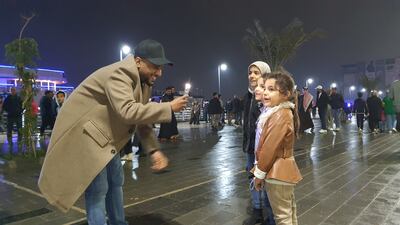
“Thank God the opening ceremony was very beautiful and well organised; I didn’t expect that, to be honest,” Ali Ibrahim told The National as he joined hundreds of fans in the city’s Tayaran Square.

Mr Ibrahim, 23, and his cousin were draped in the Iraqi flag.

“We are very proud of our Basra, which has become an international city now,” he said.

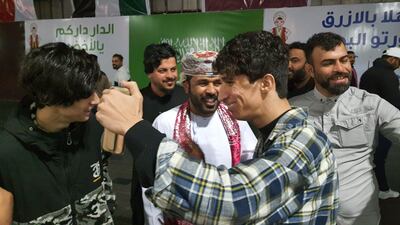
  • Iraqis mingle with fans from other countries during the Arabian Gulf Cup being held in Basra, Iraq from January 6 to 19. All photos: Sinan Mahmoud / The National
    Iraqis mingle with fans from other countries during the Arabian Gulf Cup being held in Basra, Iraq from January 6 to 19. All photos: Sinan Mahmoud / The National
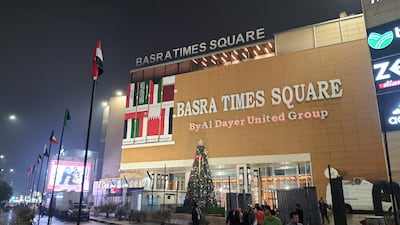
  • The flags of the eight countries taking part in the tournament are displayed all across the southern port city. Sinan Mahmoud / The National.
    The flags of the eight countries taking part in the tournament are displayed all across the southern port city. Sinan Mahmoud / The National.
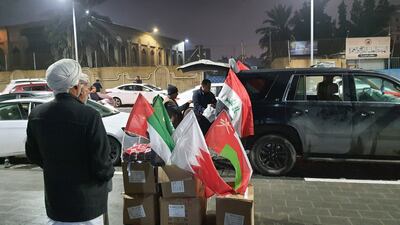
  • A street vendor sells flags of participating countries at Basra Corniche
    A street vendor sells flags of participating countries at Basra Corniche
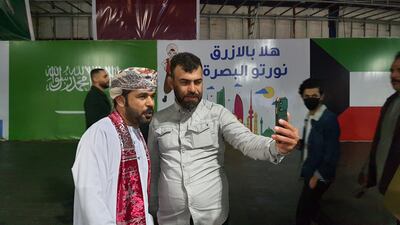
  • Omani fan Yahya Al Hashemi, 35, poses for a selfie with an Iraqi fan at Basra Corniche
    Omani fan Yahya Al Hashemi, 35, poses for a selfie with an Iraqi fan at Basra Corniche
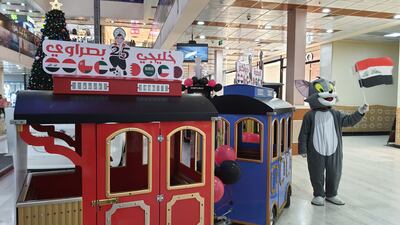
  • A statue of the mascot for the 25th edition of the Gulf Cup, Sinbad the Sailor – one of the region's legendary characters
    A statue of the mascot for the 25th edition of the Gulf Cup, Sinbad the Sailor – one of the region's legendary characters
  • Omani journalist Salah Al Saadi recording Iraqi girls singing on Basra Corniche
    Omani journalist Salah Al Saadi recording Iraqi girls singing on Basra Corniche
  • Football fans crowded the corniche in Basra
    Football fans crowded the corniche in Basra
  • Basra residents are proud to host the tournament after several attempts since 2010, when the security situation started to improve
    Basra residents are proud to host the tournament after several attempts since 2010, when the security situation started to improve
  • Flags of participating countries, hats, sports merchandise and souvenirs are displayed in shops and street stalls in Basra
    Flags of participating countries, hats, sports merchandise and souvenirs are displayed in shops and street stalls in Basra

“It is really amazing to see the tournament eventually kicked off after waiting so many years,” Dhirgham Amir told The National.

Mr Amir, 20, came with his brother and sister to Al Tayaran Square.

“This will definitely change how Iraq looks like to the whole world as a dangerous place ravaged with terrorism,” he said, putting his nine-year old sister on his shoulders.

“A bright future mainly in sport is waiting Iraq,” he added.

The biennial Arabian Gulf Cup first took place in 1970. The last time it was held in Iraq was in 1979, when the hosts were crowned champions. Iraq also won in 1984 and 1988.

The event features teams from the Gulf Co-operation Council countries — Kuwait, Saudi Arabia, Bahrain, Oman, Qatar and UAE — as well as Iraq and Yemen.

The most recent event was held in 2019 in Qatar and was won by Bahrain.

A bright future

“It is a step forward to retain Iraq’s normal position in the fields of sport, culture and society,” Basra Governor Asaad Al Eidani said before the start of the tournament. “It is a message to the whole world that we are capable.”

The UN Assistance Mission for Iraq echoed those sentiments.

“By hosting the cup, Iraq showcases the unifying power of sports and its ability to harbour peaceful and respectful competition. We wish Iraq and its people a successful tournament,” the agency wrote on Twitter.

The eight teams playing in the tournament are divided into two groups.

Group A consists of Iraq, Saudi Arabia, Oman and Yemen, while Group B features the UAE, Bahrain, Kuwait and Qatar.

The winners and runners-up of each group proceed to the semi-finals on January 16 — where the winners of Group A play the runners-up of Group B, and the Group B winners take on the runners-up from Group A.

On January 19, the winners of the semi-finals meet in the Gulf Cup final.

How%20to%20avoid%20getting%20scammed
%3Cul%3E%0A%3Cli%3ENever%20click%20on%20links%20provided%20via%20app%20or%20SMS%2C%20even%20if%20they%20seem%20to%20come%20from%20authorised%20senders%20at%20first%20glance%3C%2Fli%3E%0A%3Cli%3EAlways%20double-check%20the%20authenticity%20of%20websites%3C%2Fli%3E%0A%3Cli%3EEnable%20Two-Factor%20Authentication%20(2FA)%20for%20all%20your%20working%20and%20personal%20services%3C%2Fli%3E%0A%3Cli%3EOnly%20use%20official%20links%20published%20by%20the%20respective%20entity%3C%2Fli%3E%0A%3Cli%3EDouble-check%20the%20web%20addresses%20to%20reduce%20exposure%20to%20fake%20sites%20created%20with%20domain%20names%20containing%20spelling%20errors%3C%2Fli%3E%0A%3C%2Ful%3E%0A

Mercer, the investment consulting arm of US services company Marsh & McLennan, expects its wealth division to at least double its assets under management (AUM) in the Middle East as wealth in the region continues to grow despite economic headwinds, a company official said.

Mercer Wealth, which globally has $160 billion in AUM, plans to boost its AUM in the region to $2-$3bn in the next 2-3 years from the present $1bn, said Yasir AbuShaban, a Dubai-based principal with Mercer Wealth.

Within the next two to three years, we are looking at reaching $2 to $3 billion as a conservative estimate and we do see an opportunity to do so,” said Mr AbuShaban.

Mercer does not directly make investments, but allocates clients’ money they have discretion to, to professional asset managers. They also provide advice to clients.

“We have buying power. We can negotiate on their (client’s) behalf with asset managers to provide them lower fees than they otherwise would have to get on their own,” he added.

Mercer Wealth’s clients include sovereign wealth funds, family offices, and insurance companies among others.

From its office in Dubai, Mercer also looks after Africa, India and Turkey, where they also see opportunity for growth.

Wealth creation in Middle East and Africa (MEA) grew 8.5 per cent to $8.1 trillion last year from $7.5tn in 2015, higher than last year’s global average of 6 per cent and the second-highest growth in a region after Asia-Pacific which grew 9.9 per cent, according to consultancy Boston Consulting Group (BCG). In the region, where wealth grew just 1.9 per cent in 2015 compared with 2014, a pickup in oil prices has helped in wealth generation.

BCG is forecasting MEA wealth will rise to $12tn by 2021, growing at an annual average of 8 per cent.

Drivers of wealth generation in the region will be split evenly between new wealth creation and growth of performance of existing assets, according to BCG.

Another general trend in the region is clients’ looking for a comprehensive approach to investing, according to Mr AbuShaban.

“Institutional investors or some of the families are seeing a slowdown in the available capital they have to invest and in that sense they are looking at optimizing the way they manage their portfolios and making sure they are not investing haphazardly and different parts of their investment are working together,” said Mr AbuShaban.

Some clients also have a higher appetite for risk, given the low interest-rate environment that does not provide enough yield for some institutional investors. These clients are keen to invest in illiquid assets, such as private equity and infrastructure.

“What we have seen is a desire for higher returns in what has been a low-return environment specifically in various fixed income or bonds,” he said.

“In this environment, we have seen a de facto increase in the risk that clients are taking in things like illiquid investments, private equity investments, infrastructure and private debt, those kind of investments were higher illiquidity results in incrementally higher returns.”

The Abu Dhabi Investment Authority, one of the largest sovereign wealth funds, said in its 2016 report that has gradually increased its exposure in direct private equity and private credit transactions, mainly in Asian markets and especially in China and India. The authority’s private equity department focused on structured equities owing to “their defensive characteristics.”

Updated: January 07, 2023, 10:57 AM