


Five Iraqi soldiers have been killed in two separate attacks in country’s north, amid a surge in violence by terrorists.
The deadliest took place in Al Dibis, near the northern city of Kirkuk, when a roadside bomb was detonated on Wednesday as an Iraqi army unit passed, killing three soldiers and wounding two, including an officer, a security official said.
Another bomb exploded in the Makhmour area outside the northern city of Mosul on the same day, killing two soldiers and wounding three, another officer said.
On Sunday, a bomb struck a federal police convoy in the Riyadh area, south of Kirkuk, and was followed by an ambush that killed nine officers and left several wounded, the government said.
One militant was killed in the exchange of fire, it said.
ISIS claimed responsibility for that attack on its Telegram channel.
A day later, militants on motorbikes killed eight civilians in a remote village in nearby Diyala province.
-
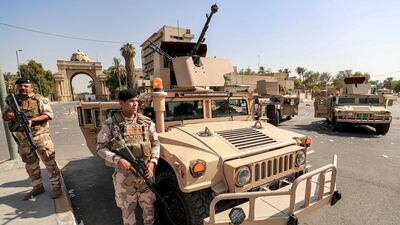
Iraqi army forces guard the entrance of the high-security Green Zone in Baghdad. AFP -
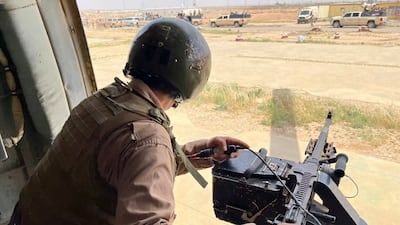
An Iraqi army helicopter takes off at a base in Sinjar on a mission to clear out a Kurdish-linked militia. AP -
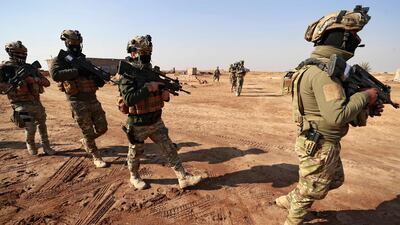
Iraq's Rapid Intervention forces patrol a village in the Hawi Al Azim area of Diyala province. AFP -
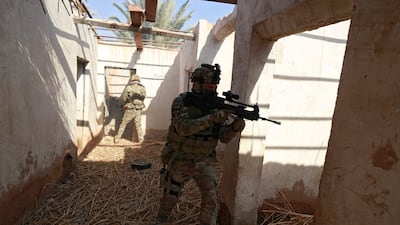
Iraqi forces inspect a structure in a village in Diyala. AFP -
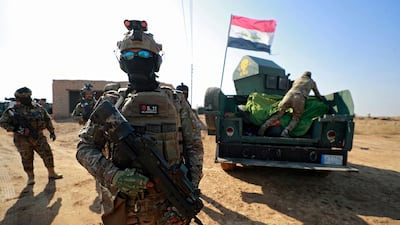
Soldiers patrolling in Diyala province. AFP -

Members of Iraq's Rapid Intervention forces in a village in the Hawi Al Azim area. AFP -
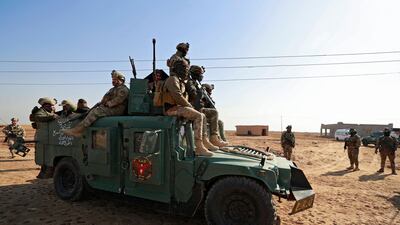
Iraqi forces patrol in Diyala province. AFP -

Iraqi forces in the Hawi Al Azim area. AFP -
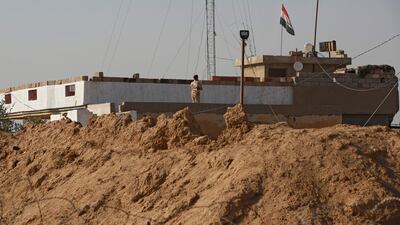
A military base in Diyala that was attacked by ISIS. AFP -

Military vehicles at Al Waleed air base near Al Tanf in Iraq. Reuters


No group has yet to claim responsibility for the attacks on Monday and Wednesday, which bore the hallmarks of ISIS.
The latest attacks bring the death toll since Sunday to 22.
Also on Wednesday, Iraqi Prime Minister Mohammed Shia Al Sudani, who is also the commander-in-chief of the armed forces, chaired a security meeting with senior security officials to discuss the latest attacks.
Mr Shia Al Sudani ordered military commanders “to re-evaluate their plans and to change the military tactics used in the areas where there are remnants of the terrorist gangs”, his office said after the meeting.
He also ordered the adoption of unconventional fighting methods that would weaken the capabilities of ISIS and limits its movement.
“The commander-in-chief of the armed forces stressed that what happened would not pass without retribution for the perpetrators,” Mr Shia Al Sudani's office said.
ISIS seized large parts of Iraqi and Syrian territory in the middle of 2014 and declared a so-called “caliphate.”
In late 2017, the group was declared territorially defeated in Iraq. However, it still continues to pose serious security risks through hit-and-run attacks, bombings and abductions across several provinces.
The extremist group is particularly active in areas disputed by Baghdad and regional authorities in the Kurdistan Region due to a lack of security presence from both sides.

