Mosul is a noisy city.
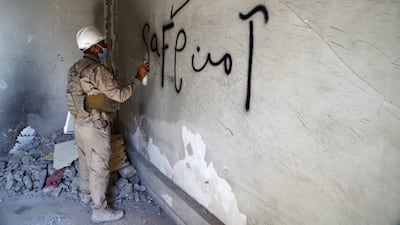
Unlike other metropolises, it is not the sounds of daily commuters or planes soaring over head that fill the air, but the thrums and bangs of cranes knocking down unstable structures, bulldozers removing rubble and drill hammers reverberating across Iraq’s northern city.
Five years after it was retaken from ISIS in a battle that left much of it in ruins, construction in the capital of Nineveh province is continuing, albeit slowly.
For some, the reconstruction is bearing fruit.
Hadla Hussein Youssif, 80, sitting in the open courtyard of her house, the fragrance of a Eucalyptus tree wafting in the air, says her home in the Old City was recently reconstructed by the United Nations Development Programme (UNDP), which has spent hundreds of millions on the city.
“There is nothing left that they didn’t do,” she says of ISIS's efforts to destroy her home, but gestures at the newness of a nearby small garden where trees of fig, grape and lemon have been planted.
The peaceful calm of the scene is a small salve on the traumatic memories of the extremists' arrival.
The mother of 10 said her sons put her on their shoulders to flee the fighting after a rocket hit the house.
A thriving city turned to ashes
Mosul was the first city to fall into the hands of ISIS during their blitz in mid-2014. It was the crown jewel of the extremist group’s “caliphate” that was declared in large areas of Iraq and Syria.
In October 2016, Iraqi security forces backed by a US-led international coalition launched what was known as the world’s biggest urban battle since the Second World War.
They announced the end of combat operations in mid-2017. It took six more months to claw back surrounding areas and announce that ISIS was defeated across Iraq.
But the price of victory came with a grim toll: tens of thousands died, millions were displaced and entire towns and neighbourhoods were reduced to rubble.
“It’s a miracle that we survived,” Ms Youssif's son Faris Shaaban says, recalling how he narrowly missed being hit by a mortar round when he tried to get water from the nearby Tigris River.
“We went through indescribable circumstances with no food or water, people were boiling wheat to eat. It was a real famine. Adding to that [ISIS] tried to shoot and kill anyone fleeing,” Mr Shaaban, 53, added.
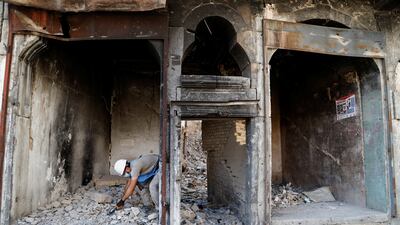
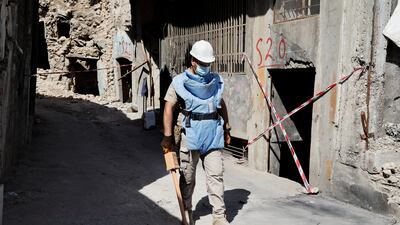
Five years later and the scars of war are still in every corner of the city. Many houses and building are levelled with some still peppered with bullets, while the twisted and charred wreckage of cars are still seen in the streets.
Signs of the last fight that took place in the western side of the city are also still there. Large parts of that side, mainly in the Old City where ISIS made their last stand, are still in ruins and it is eerily quiet, like a ghost city.
A $372 million bill
Shortly after the recapture of the eastern side of the city, the UNDP, in conjunction with local and international non-governmental organisations, started work on restoring key services so that the displaced families could return and create short-term jobs.
“Mosul is in a fundamentally different place than it was in mid-2017 when it was liberated,” Zena Ali Ahmed, resident representative for UNDP Iraq, told The National.
As of May 2022, UNDP has completed 906 projects worth approximately US$295 million in Mosul. Another 58 projects worth about $77m are currently under way.
There are slightly more than 10,000 houses that have been rehabilitated for more than 100,000 beneficiaries, the organisation says. All the city’s water treatment plants are pumping and electricity is now back to eight hours a day in winter and up to 14 hours in summer.
But there is work left to do — an estimated 20,000 houses have been destroyed in the city and many thousands more damaged, she said.
The UNDP takes into consideration specific criteria in selecting which homes get priority in rebuilding. These include the state of disrepair — damage must not exceed over 60 per cent of the property — and most importantly that the house will be safe after rehabilitation, said the leader of the Housing Team, Faris Abdul-Sattar Hussein.
Among other projects, the organisation has also rehabilitated 164 schools for 96,000 students in addition to college halls, laboratories and libraries at universities as well as police stations and the main court house.
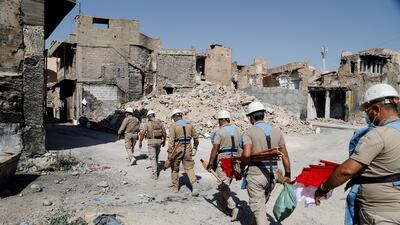
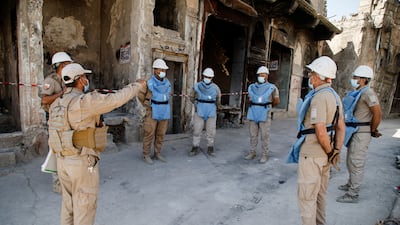
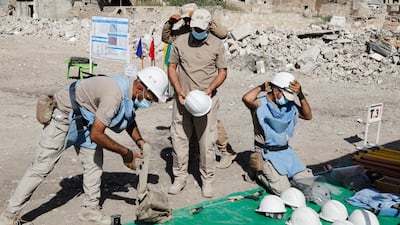
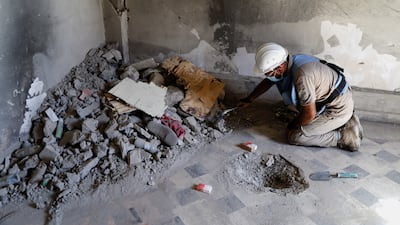
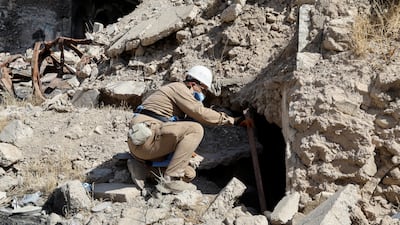
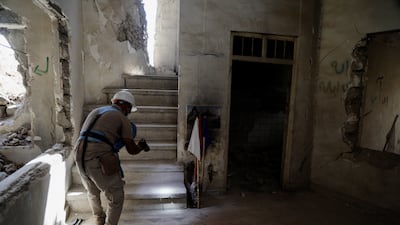
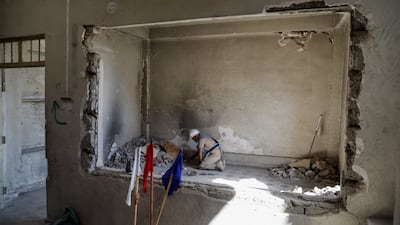
One of the main hindrances to the population's return was the threat of unexploded ordinance. The UN demining agency UNMAS has already cleared more than 60,000 explosive hazards.
“By now, the city is largely free of unexploded hazards, though some are still found in rubble on occasion,” Ms Ahmed said.
An uncertain future
Mosul's people continue to show courage and resilience as their city is returning to life. They all agree that the city is now better than before, but are divided on what the future holds.
Maan Muhsin Hamid greeted the UNDP Housing Team who are rehabilitating his house in the Old City’s Khazrach neighbourhood. With a gentle demeanour and soft voice, he proudly spoke about the history of the house, which he says once belonged to a famous Christian doctor.
“My city will never die,” Mr Hamid, 52, told The National, while standing inside the house as workers in yellow helmets plastered rocks on to the wall with gypsum.
As a poet, his description of Mosul can't help but be lyrical.
“It gets sick, but it will not die,” he said.
“We just want to live in peace, we want nothing else but peace,” he added. Mr Hamid sobs quietly as he recounts a familiar tale to many fellow residents — losing family members during the battle for liberation, when two rockets landed nearby.
“Our city is the city of peace … we love people, we love nations, we love other sects and [ethnic] groups, we love each other. We don’t like destruction, we are peaceful people,” he continued.
“I as a poet, give me a pen, give me flowers, gardens. I will write poetry, I will write for love, I will write for children, I will write for people, I will write for life.”
He rails about the injustice Moslawis have faced, and concerns for the future of Iraq.
He is mainly concerned about the political wrangling and rising tension over forming the new government eight months since holding national elections, fearing it could send the country back to the sectarian warfare it witnessed between 2006 and 2008.
The impact of the political crisis adds to the woes of residents as the economy dips, public services become scarce and jobs harder to secure.
“The picture is not quite rosy,” the deputy governor for planning affairs, Raad Al Abasi, told The National in his office on Tuesday.
“But, since late 2019, we have adopted a new approach in regard to management, different plans have been set and we have made a big and quality stride in public services, and now we are carrying out key strategic projects.”
He says 325 schools have been rebuilt and work to build new 92 schools is to start soon. The government has raised hospital capacity to 2,500 from 600 after ISIS, and five additional hospitals are being built, with a view to providing 5,000 beds.

More from Neighbourhood Watch:
The specs
Engine: 2.9-litre twin-turbo V6
Power: 540hp at 6,500rpm
Torque: 600Nm at 2,500rpm
Transmission: Eight-speed auto
Kerb weight: 1580kg
Price: From Dh750k
On sale: via special order
David Haye record
Total fights: 32
Wins: 28
Wins by KO: 26
Losses: 4
'The Predator'
Dir: Shane Black
Starring: Olivia Munn, Boyd Holbrook, Keegan-Michael Key
Two and a half stars
COMPANY%20PROFILE
%3Cp%3E%3Cstrong%3ECompany%20name%3A%3C%2Fstrong%3E%20Sav%3Cbr%3E%3Cstrong%3EStarted%3A%3C%2Fstrong%3E%202021%3Cbr%3E%3Cstrong%3EFounder%3A%3C%2Fstrong%3E%20Purvi%20Munot%3Cbr%3E%3Cstrong%3EBased%3A%3C%2Fstrong%3E%20Dubai%3Cbr%3E%3Cstrong%3EIndustry%3A%3C%2Fstrong%3E%20FinTech%3Cbr%3E%3Cstrong%3EFunding%3A%3C%2Fstrong%3E%20%24750%2C000%20as%20of%20March%202023%3Cbr%3E%3Cstrong%3EInvestors%3A%3C%2Fstrong%3E%20Angel%20investors%3C%2Fp%3E%0A
Electric scooters: some rules to remember
- Riders must be 14-years-old or over
- Wear a protective helmet
- Park the electric scooter in designated parking lots (if any)
- Do not leave electric scooter in locations that obstruct traffic or pedestrians
- Solo riders only, no passengers allowed
- Do not drive outside designated lanes
Maestro
%3Cp%3E%3Cstrong%3EDirector%3A%20%3C%2Fstrong%3EBradley%20Cooper%3C%2Fp%3E%0A%3Cp%3E%3Cstrong%3EStarring%3A%20%3C%2Fstrong%3EBradley%20Cooper%2C%20Carey%20Mulligan%2C%20Maya%20Hawke%3C%2Fp%3E%0A%3Cp%3E%3Cstrong%3ERating%3A%3C%2Fstrong%3E%203%2F5%3C%2Fp%3E%0A
The specs
Engine: 2.0-litre 4cyl turbo
Power: 261hp at 5,500rpm
Torque: 405Nm at 1,750-3,500rpm
Transmission: 9-speed auto
Fuel consumption: 6.9L/100km
On sale: Now
Price: From Dh117,059
UAE squad v Australia
Rohan Mustafa (C), Ashfaq Ahmed, Chirag Suri, Rameez Shahzad, Fahad Nawaz, Amjed Gul, Shaiman Anwar, Ahmed Raza, Imran Haider, Muhammad Naveed, Amir Hayat, Ghulam Shabir (WK), Qadeer Ahmed, Tahir Latif, Zahoor Khan
Key figures in the life of the fort
Sheikh Dhiyab bin Isa (ruled 1761-1793) Built Qasr Al Hosn as a watchtower to guard over the only freshwater well on Abu Dhabi island.
Sheikh Shakhbut bin Dhiyab (ruled 1793-1816) Expanded the tower into a small fort and transferred his ruling place of residence from Liwa Oasis to the fort on the island.
Sheikh Tahnoon bin Shakhbut (ruled 1818-1833) Expanded Qasr Al Hosn further as Abu Dhabi grew from a small village of palm huts to a town of more than 5,000 inhabitants.
Sheikh Khalifa bin Shakhbut (ruled 1833-1845) Repaired and fortified the fort.
Sheikh Saeed bin Tahnoon (ruled 1845-1855) Turned Qasr Al Hosn into a strong two-storied structure.
Sheikh Zayed bin Khalifa (ruled 1855-1909) Expanded Qasr Al Hosn further to reflect the emirate's increasing prominence.
Sheikh Shakhbut bin Sultan (ruled 1928-1966) Renovated and enlarged Qasr Al Hosn, adding a decorative arch and two new villas.
Sheikh Zayed bin Sultan (ruled 1966-2004) Moved the royal residence to Al Manhal palace and kept his diwan at Qasr Al Hosn.
Sources: Jayanti Maitra, www.adach.ae
PRESIDENTS CUP
Draw for Presidents Cup fourball matches on Thursday (Internationals first mention). All times UAE:
02.32am (Thursday): Marc Leishman/Joaquin Niemann v Tiger Woods/Justin Thomas
02.47am (Thursday): Adam Hadwin/Im Sung-jae v Xander Schauffele/Patrick Cantlay
03.02am (Thursday): Adam Scott/An Byeong-hun v Bryson DeChambeau/Tony Finau
03.17am (Thursday): Hideki Matsuyama/CT Pan v Webb Simpson/Patrick Reed
03.32am (Thursday): Abraham Ancer/Louis Oosthuizen v Dustin Johnson/Gary Woodland
Countries recognising Palestine
France, UK, Canada, Australia, Portugal, Belgium, Malta, Luxembourg, San Marino and Andorra
More from Rashmee Roshan Lall
Real estate tokenisation project
Dubai launched the pilot phase of its real estate tokenisation project last month.
The initiative focuses on converting real estate assets into digital tokens recorded on blockchain technology and helps in streamlining the process of buying, selling and investing, the Dubai Land Department said.
Dubai’s real estate tokenisation market is projected to reach Dh60 billion ($16.33 billion) by 2033, representing 7 per cent of the emirate’s total property transactions, according to the DLD.
Infobox
Western Region Asia Cup Qualifier, Al Amerat, Oman
The two finalists advance to the next stage of qualifying, in Malaysia in August
Results
UAE beat Iran by 10 wickets
Kuwait beat Saudi Arabia by eight wickets
Oman beat Bahrain by nine wickets
Qatar beat Maldives by 106 runs
Monday fixtures
UAE v Kuwait, Iran v Saudi Arabia, Oman v Qatar, Maldives v Bahrain
KILLING OF QASSEM SULEIMANI
Infiniti QX80 specs
Engine: twin-turbocharged 3.5-liter V6
Power: 450hp
Torque: 700Nm
Price: From Dh450,000, Autograph model from Dh510,000
Available: Now
Company profile
Name: Thndr
Started: October 2020
Founders: Ahmad Hammouda and Seif Amr
Based: Cairo, Egypt
Sector: FinTech
Initial investment: pre-seed of $800,000
Funding stage: series A; $20 million
Investors: Tiger Global, Beco Capital, Prosus Ventures, Y Combinator, Global Ventures, Abdul Latif Jameel, Endure Capital, 4DX Ventures, Plus VC, Rabacap and MSA Capital
Mobile phone packages comparison
Final scores
18 under: Tyrrell Hatton (ENG)
- 14: Jason Scrivener (AUS)
-13: Rory McIlroy (NIR)
-12: Rafa Cabrera Bello (ESP)
-11: David Lipsky (USA), Marc Warren (SCO)
-10: Tommy Fleetwood (ENG), Chris Paisley (ENG), Matt Wallace (ENG), Fabrizio Zanotti (PAR)
Mercer, the investment consulting arm of US services company Marsh & McLennan, expects its wealth division to at least double its assets under management (AUM) in the Middle East as wealth in the region continues to grow despite economic headwinds, a company official said.
Mercer Wealth, which globally has $160 billion in AUM, plans to boost its AUM in the region to $2-$3bn in the next 2-3 years from the present $1bn, said Yasir AbuShaban, a Dubai-based principal with Mercer Wealth.
“Within the next two to three years, we are looking at reaching $2 to $3 billion as a conservative estimate and we do see an opportunity to do so,” said Mr AbuShaban.
Mercer does not directly make investments, but allocates clients’ money they have discretion to, to professional asset managers. They also provide advice to clients.
“We have buying power. We can negotiate on their (client’s) behalf with asset managers to provide them lower fees than they otherwise would have to get on their own,” he added.
Mercer Wealth’s clients include sovereign wealth funds, family offices, and insurance companies among others.
From its office in Dubai, Mercer also looks after Africa, India and Turkey, where they also see opportunity for growth.
Wealth creation in Middle East and Africa (MEA) grew 8.5 per cent to $8.1 trillion last year from $7.5tn in 2015, higher than last year’s global average of 6 per cent and the second-highest growth in a region after Asia-Pacific which grew 9.9 per cent, according to consultancy Boston Consulting Group (BCG). In the region, where wealth grew just 1.9 per cent in 2015 compared with 2014, a pickup in oil prices has helped in wealth generation.
BCG is forecasting MEA wealth will rise to $12tn by 2021, growing at an annual average of 8 per cent.
Drivers of wealth generation in the region will be split evenly between new wealth creation and growth of performance of existing assets, according to BCG.
Another general trend in the region is clients’ looking for a comprehensive approach to investing, according to Mr AbuShaban.
“Institutional investors or some of the families are seeing a slowdown in the available capital they have to invest and in that sense they are looking at optimizing the way they manage their portfolios and making sure they are not investing haphazardly and different parts of their investment are working together,” said Mr AbuShaban.
Some clients also have a higher appetite for risk, given the low interest-rate environment that does not provide enough yield for some institutional investors. These clients are keen to invest in illiquid assets, such as private equity and infrastructure.
“What we have seen is a desire for higher returns in what has been a low-return environment specifically in various fixed income or bonds,” he said.
“In this environment, we have seen a de facto increase in the risk that clients are taking in things like illiquid investments, private equity investments, infrastructure and private debt, those kind of investments were higher illiquidity results in incrementally higher returns.”
The Abu Dhabi Investment Authority, one of the largest sovereign wealth funds, said in its 2016 report that has gradually increased its exposure in direct private equity and private credit transactions, mainly in Asian markets and especially in China and India. The authority’s private equity department focused on structured equities owing to “their defensive characteristics.”
Who has lived at The Bishops Avenue?
- George Sainsbury of the supermarket dynasty, sugar magnate William Park Lyle and actress Dame Gracie Fields were residents in the 1930s when the street was only known as ‘Millionaires’ Row’.
- Then came the international super rich, including the last king of Greece, Constantine II, the Sultan of Brunei and Indian steel magnate Lakshmi Mittal who was at one point ranked the third richest person in the world.
- Turkish tycoon Halis Torprak sold his mansion for £50m in 2008 after spending just two days there. The House of Saud sold 10 properties on the road in 2013 for almost £80m.
- Other residents have included Iraqi businessman Nemir Kirdar, singer Ariana Grande, holiday camp impresario Sir Billy Butlin, businessman Asil Nadir, Paul McCartney’s former wife Heather Mills.
Hunting park to luxury living
- Land was originally the Bishop of London's hunting park, hence the name
- The road was laid out in the mid 19th Century, meandering through woodland and farmland
- Its earliest houses at the turn of the 20th Century were substantial detached properties with extensive grounds
Killing of Qassem Suleimani
If you go…
Emirates launched a new daily service to Mexico City this week, flying via Barcelona from Dh3,995.
Emirati citizens are among 67 nationalities who do not require a visa to Mexico. Entry is granted on arrival for stays of up to 180 days.
Jigra
Starring: Alia Bhatt, Vedang Raina, Manoj Pahwa, Harsh Singh