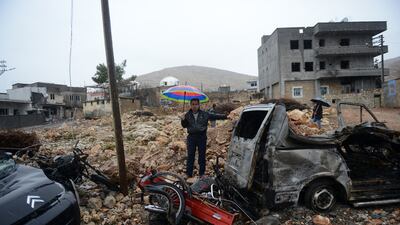
Turkish soldiers take part in operations in the Metina and Avasin-Basyan regions of northern Iraq. Getty

Turkish military base in northern Iraq comes under attack


Ismaeel Naar
  • English
  • Arabic

A military base that hosts Turkish troops in the Iraqi district of Bashiqa, north-east of Mosul, has been attacked.

Several rockets and drones were used to hit the Zlikan base in the northern Nineveh province, the Kurdish Rudaw network reported, quoting a security source. No casualties have been reported yet.

The presence of Turkish troops at the base has caused tensions between Iraq and Turkey, which justifies its presence in the region on its fight against the Kurdistan Workers' Party, or PKK, which is outlawed by Ankara.

Turkey has maintained several outposts in northern Iraq since 2016 and in April Ankara began one of its largest military operations in northern Iraq against the PKK, Operation Claw-Lock.

In addition to the PKK, several Iran-backed groups in Iraq strongly oppose the presence of Turkish troops and have launched rocket and drone attacks.

  • A group of PKK soldiers walk near their base camp high in the mountains of northern Iraq on June 1, 2004. Reuters
    A group of PKK soldiers walk near their base camp high in the mountains of northern Iraq on June 1, 2004. Reuters
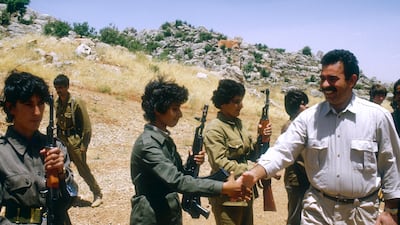
  • Kurdistan Workers' Party (PKK) leader Abdullah Ocalan greets women soldiers at the Mahsun Korkmaz Academy military training camp in Lebanon on June, 18, 1988. Getty Images
    Kurdistan Workers' Party (PKK) leader Abdullah Ocalan greets women soldiers at the Mahsun Korkmaz Academy military training camp in Lebanon on June, 18, 1988. Getty Images
  • Peshmerga and Turkish soldiers prepare to storm a hill on October 23, 1992, near a stronghold held by the PKK in Hakurk Valley. AFP
    Peshmerga and Turkish soldiers prepare to storm a hill on October 23, 1992, near a stronghold held by the PKK in Hakurk Valley. AFP
  • Abdullah Ocalan was abducted in Nairobi in 1999 by the Turkish National Intelligence Agency (MIT), with assistance from the US, and taken to Turkey. Reuters
    Abdullah Ocalan was abducted in Nairobi in 1999 by the Turkish National Intelligence Agency (MIT), with assistance from the US, and taken to Turkey. Reuters
  • Turkish riot police detain a Kurdish protester following a demonstration in central Istanbul on April 2, 2006. Reuters
    Turkish riot police detain a Kurdish protester following a demonstration in central Istanbul on April 2, 2006. Reuters
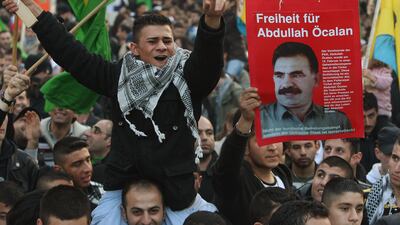
  • A man holds a sign demanding freedom for imprisoned Kurdish leader Abdullah Ocalan at a protest of mostly Kurdish demonstrators on November 4, 2007, in Berlin, Germany. Getty Images
    A man holds a sign demanding freedom for imprisoned Kurdish leader Abdullah Ocalan at a protest of mostly Kurdish demonstrators on November 4, 2007, in Berlin, Germany. Getty Images
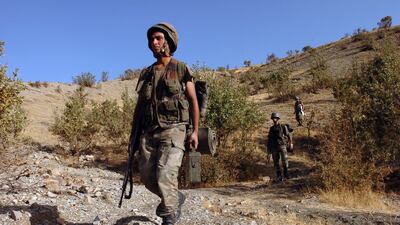
  • Turkish army commandos on patrol near the Iraq border on October 27, 2007, in the Uludere district of Sirnak province, south-eastern Turkey. Getty Images
    Turkish army commandos on patrol near the Iraq border on October 27, 2007, in the Uludere district of Sirnak province, south-eastern Turkey. Getty Images
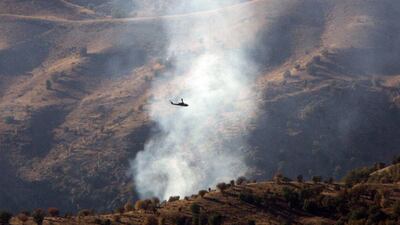
  • A Turkish helicopter flies over the Cudi Mountains during an attack on an outlawed PKK camp October 30, 2007, in Sirnak province, near the Iraq border. AFP
    A Turkish helicopter flies over the Cudi Mountains during an attack on an outlawed PKK camp October 30, 2007, in Sirnak province, near the Iraq border. AFP
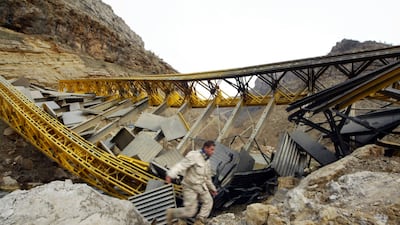
  • A ruined bridge lies in northern Iraq's Kurdistan region during fighting between Turkish forces and PKK fighters on February 24, 2008. AFP
    A ruined bridge lies in northern Iraq's Kurdistan region during fighting between Turkish forces and PKK fighters on February 24, 2008. AFP
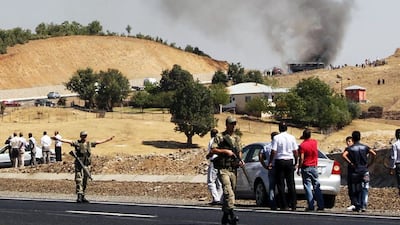
  • Turkish soldiers stand guard as smokes rises from a bus that was attacked by members of the PKK on September 18, 2012, in Bingol. AFP
    Turkish soldiers stand guard as smokes rises from a bus that was attacked by members of the PKK on September 18, 2012, in Bingol. AFP
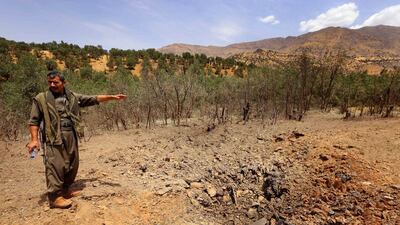
  • A member of the PKK inspects a crater reportedly caused by an air strike by Turkish warplanes on July 29, 2015, in the Qandil Mountains in northern Iraq. AFP
    A member of the PKK inspects a crater reportedly caused by an air strike by Turkish warplanes on July 29, 2015, in the Qandil Mountains in northern Iraq. AFP
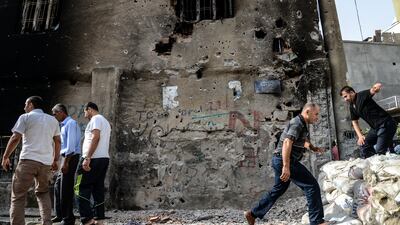
  • Locals assess the damage following clashes between Turkish forces and PKK militants in the Kurdish-majority city of Cizre, in south-eastern Turkey, on September 12, 2015. AFP
    Locals assess the damage following clashes between Turkish forces and PKK militants in the Kurdish-majority city of Cizre, in south-eastern Turkey, on September 12, 2015. AFP
  • People return to their homes in Dargecit after a curfew imposed by the Turkish government was lifted on December 30, 2015, in Mardin province. AFP
    People return to their homes in Dargecit after a curfew imposed by the Turkish government was lifted on December 30, 2015, in Mardin province. AFP
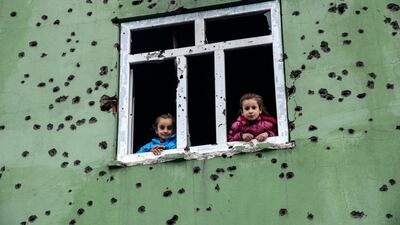
  • Children look out from a window of a bullet-scarred house in the Kurdish town of Silopi in south-eastern Turkey, near the border with Iraq, on January 19, 2016. AFP
    Children look out from a window of a bullet-scarred house in the Kurdish town of Silopi in south-eastern Turkey, near the border with Iraq, on January 19, 2016. AFP
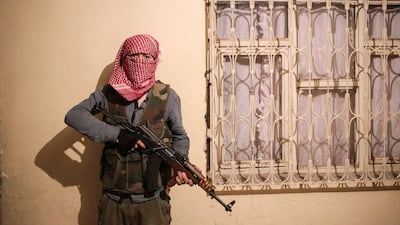
  • A member of the Patriotic Revolutionary Youth Movement (YDG-H), a division of the PKK, stands guard in the south-eastern Turkish city of Nusaybin on February 25, 2016. Getty Images
    A member of the Patriotic Revolutionary Youth Movement (YDG-H), a division of the PKK, stands guard in the south-eastern Turkish city of Nusaybin on February 25, 2016. Getty Images

Those attacks have followed public threats by groups in Iraq's Popular Mobilisation Forces, an umbrella group of militias ostensibly under federal government control, but that are largely tied to Iran.

The Iraqi government has condemned PMF attacks on Turkish forces in northern areas, but has limited control on PMF units. An Iraqi citizen was killed in an attack on May 22.

The latest strike comes a day after Turkish President Recep Tayyip Erdogan said the military would soon “clear” what he called terrorists from the northern Syrian towns of Manbij and Tel Rifaat.

It was a reference to Syria’s main Kurdish militia, known as the People’s Protection Units, or YPG.

Mr Erdogan has been speaking about a new incursion for weeks without saying when such an offensive would start.

Turkey has launched four major operations in northern Syria since 2016, mainly against the YPG. Ankara considers the PKK and YPG as one and the same.


In numbers: China in Dubai

The number of Chinese people living in Dubai: An estimated 200,000

Number of Chinese people in International City: Almost 50,000

Daily visitors to Dragon Mart in 2018/19: 120,000

Daily visitors to Dragon Mart in 2010: 20,000

Percentage increase in visitors in eight years: 500 per cent

RACE CARD

6.30pm Al Maktoum Challenge Round-1 Group 1 (PA) Dh119,373 (Dirt) 1,600m

7.05pm Handicap (TB) Dh102,500 (D) 1,200m

7.40pm Handicap (TB) Dh105,000 (Turf) 1,800m

8.15pm UAE 1000 Guineas Trial (TB) Dh183,650 (D) 1,400m

9.50pm Handicap (TB) Dh105,000 (D) 1,600m

9.25pm Handicap (TB) Dh95,000 (T) 1,000m

Dr Amal Khalid Alias revealed a recent case of a woman with daughters, who specifically wanted a boy.

A semen analysis of the father showed abnormal sperm so the couple required IVF.

Out of 21 eggs collected, six were unused leaving 15 suitable for IVF.

A specific procedure was used, called intracytoplasmic sperm injection where a single sperm cell is inserted into the egg.

On day three of the process, 14 embryos were biopsied for gender selection.

The next day, a pre-implantation genetic report revealed four normal male embryos, three female and seven abnormal samples.

Day five of the treatment saw two male embryos transferred to the patient.

The woman recorded a positive pregnancy test two weeks later. 

Pox that threatens the Middle East's native species

Camelpox

Caused by a virus related to the one that causes human smallpox, camelpox typically causes fever, swelling of lymph nodes and skin lesions in camels aged over three, but the animal usually recovers after a month or so. Younger animals may develop a more acute form that causes internal lesions and diarrhoea, and is often fatal, especially when secondary infections result. It is found across the Middle East as well as in parts of Asia, Africa, Russia and India.

Falconpox

Falconpox can cause a variety of types of lesions, which can affect, for example, the eyelids, feet and the areas above and below the beak. It is a problem among captive falcons and is one of many types of avian pox or avipox diseases that together affect dozens of bird species across the world. Among the other forms are pigeonpox, turkeypox, starlingpox and canarypox. Avipox viruses are spread by mosquitoes and direct bird-to-bird contact.

Houbarapox

Houbarapox is, like falconpox, one of the many forms of avipox diseases. It exists in various forms, with a type that causes skin lesions being least likely to result in death. Other forms cause more severe lesions, including internal lesions, and are more likely to kill the bird, often because secondary infections develop. This summer the CVRL reported an outbreak of pox in houbaras after rains in spring led to an increase in mosquito numbers.

U19 WORLD CUP, WEST INDIES

UAE group fixtures (all in St Kitts)

  • Saturday 15 January: UAE beat Canada by 49 runs 
  • Thursday 20 January: v England 
  • Saturday 22 January: v Bangladesh 

UAE squad:

Alishan Sharafu (captain), Shival Bawa, Jash Giyanani, Sailles
Jaishankar, Nilansh Keswani, Aayan Khan, Punya Mehra, Ali Naseer, Ronak Panoly,
Dhruv Parashar, Vinayak Raghavan, Soorya Sathish, Aryansh Sharma, Adithya
Shetty, Kai Smith  

Conflict, drought, famine

Estimates of the number of deaths caused by the famine range from 400,000 to 1 million, according to a document prepared for the UK House of Lords in 2024.
It has been claimed that the policies of the Ethiopian government, which took control after deposing Emperor Haile Selassie in a military-led revolution in 1974, contributed to the scale of the famine.
Dr Miriam Bradley, senior lecturer in humanitarian studies at the University of Manchester, has argued that, by the early 1980s, “several government policies combined to cause, rather than prevent, a famine which lasted from 1983 to 1985. Mengistu’s government imposed Stalinist-model agricultural policies involving forced collectivisation and villagisation [relocation of communities into planned villages].
The West became aware of the catastrophe through a series of BBC News reports by journalist Michael Buerk in October 1984 describing a “biblical famine” and containing graphic images of thousands of people, including children, facing starvation.

Band Aid

Bob Geldof, singer with the Irish rock group The Boomtown Rats, formed Band Aid in response to the horrific images shown in the news broadcasts.
With Midge Ure of the band Ultravox, he wrote the hit charity single Do They Know it’s Christmas in December 1984, featuring a string of high-profile musicians.
Following the single’s success, the idea to stage a rock concert evolved.
Live Aid was a series of simultaneous concerts that took place at Wembley Stadium in London, John F Kennedy Stadium in Philadelphia, the US, and at various other venues across the world.
The combined event was broadcast to an estimated worldwide audience of 1.5 billion.

Mercer, the investment consulting arm of US services company Marsh & McLennan, expects its wealth division to at least double its assets under management (AUM) in the Middle East as wealth in the region continues to grow despite economic headwinds, a company official said.

Mercer Wealth, which globally has $160 billion in AUM, plans to boost its AUM in the region to $2-$3bn in the next 2-3 years from the present $1bn, said Yasir AbuShaban, a Dubai-based principal with Mercer Wealth.

Within the next two to three years, we are looking at reaching $2 to $3 billion as a conservative estimate and we do see an opportunity to do so,” said Mr AbuShaban.

Mercer does not directly make investments, but allocates clients’ money they have discretion to, to professional asset managers. They also provide advice to clients.

“We have buying power. We can negotiate on their (client’s) behalf with asset managers to provide them lower fees than they otherwise would have to get on their own,” he added.

Mercer Wealth’s clients include sovereign wealth funds, family offices, and insurance companies among others.

From its office in Dubai, Mercer also looks after Africa, India and Turkey, where they also see opportunity for growth.

Wealth creation in Middle East and Africa (MEA) grew 8.5 per cent to $8.1 trillion last year from $7.5tn in 2015, higher than last year’s global average of 6 per cent and the second-highest growth in a region after Asia-Pacific which grew 9.9 per cent, according to consultancy Boston Consulting Group (BCG). In the region, where wealth grew just 1.9 per cent in 2015 compared with 2014, a pickup in oil prices has helped in wealth generation.

BCG is forecasting MEA wealth will rise to $12tn by 2021, growing at an annual average of 8 per cent.

Drivers of wealth generation in the region will be split evenly between new wealth creation and growth of performance of existing assets, according to BCG.

Another general trend in the region is clients’ looking for a comprehensive approach to investing, according to Mr AbuShaban.

“Institutional investors or some of the families are seeing a slowdown in the available capital they have to invest and in that sense they are looking at optimizing the way they manage their portfolios and making sure they are not investing haphazardly and different parts of their investment are working together,” said Mr AbuShaban.

Some clients also have a higher appetite for risk, given the low interest-rate environment that does not provide enough yield for some institutional investors. These clients are keen to invest in illiquid assets, such as private equity and infrastructure.

“What we have seen is a desire for higher returns in what has been a low-return environment specifically in various fixed income or bonds,” he said.

“In this environment, we have seen a de facto increase in the risk that clients are taking in things like illiquid investments, private equity investments, infrastructure and private debt, those kind of investments were higher illiquidity results in incrementally higher returns.”

The Abu Dhabi Investment Authority, one of the largest sovereign wealth funds, said in its 2016 report that has gradually increased its exposure in direct private equity and private credit transactions, mainly in Asian markets and especially in China and India. The authority’s private equity department focused on structured equities owing to “their defensive characteristics.”

While you're here
Profile Box

Company/date started: 2015

Founder/CEO: Mohammed Toraif

Based: Manama, Bahrain

Sector: Sales, Technology, Conservation

Size: (employees/revenue) 4/ 5,000 downloads

Stage: 1 ($100,000)

Investors: Two first-round investors including, 500 Startups, Fawaz Al Gosaibi Holding (Saudi Arabia)

THE SPECS

2020 Toyota Corolla Hybrid LE

Engine: 1.8 litre combined with 16-volt electric motors

Transmission: Automatic with manual shifting mode

Power: 121hp

Torque: 142Nm

Price: Dh95,900

Updated: June 02, 2022, 2:24 PM