


Mobs believed to be the followers of Moqtada Al Sadr have torched and demolished offices and mosques of a controversial Shiite cleric in Iraq who sees building small monuments over graves as being against Islamic principles.
Cemeteries in the country often have shrine-like structures built over grave plots, while well-known Imams often have mausoleums over their resting places.
During a Friday sermon in Al Hamza Al Gharbi district south of Babil province, cleric Ali Moussa Al Masoudi, an aide to the controversial cleric Mahmoud Al Sharkhi, questioned the religious legitimacy of building over graves and turning some of them to places of worship.
Mr Al Masoudi also criticised setting dates for religious events and rituals related to revered saints who are buried in these graves. He did not name any of the revered Shiites shrines across Iraq.
He argued that the existence of tombs is against the guidelines of the Prophet Mohammed, who “once ordered [his cousin] Imam Ali to demolish and level the graves and don’t build over them”.
His comments caused widespread anger among Shiites, who consider constructing, preserving and visiting mausoleums of their revered Imams an essential part of Islam’s Shiism school.
On Monday Mr Al Sadr, a populist Iraqi Shiite cleric, gave Mr Al Sarkhi three days to distance himself from Mr Al Masoudi “otherwise I will deal with him and people like him according to the law, religious law and social custom”.
Iraqi security forces have been rounding up dozens of Mr Al Sarkhi’s followers in different parts of central and southern Iraq, including Mr Al Masoudi.
Authorities have also issued an arrest warrant against Mr Al Sarkhi, whose whereabouts is unknown.
The Interior Ministry accused Mr Al Sarkhi’s group of following an “extremist ideology to spread sedition and to abuse the religious symbols and revered shrines”.
Videos on social media showed mobs breaking into Mr Al Sarkhi’s offices and setting them on fire. Some showed bulldozers demolishing the mosques he runs, a move that has been criticised and rejected by Mr Al Sadr.
Mr Al Sarkhi has risen to prominence since the 2003 US-led invasion that toppled the Saddam Hussein regime. Unlike other Shiite factions, his group opposed the entire political process established by the Americans and successive governments.
He has also been strongly opposed to US and Iranian influence in Iraq, although he supports the establishment of an Iranian-style Islamic theocracy.
He believes himself to be the supreme religious authority above all other senior religious leaders known as ayatollahs, including spiritual Shiite cleric Ali Al Sistani, challenging their authority on revered shrines and religious institutions.
He once claimed that he shared tea with the revered Imam Al Mahdi, whom Shiites believe disappeared during the 9th century and will one day reappear to bring salvation to believers.
He was also against fighting ISIS and Mr Al Sistani’s 2014 decree to take up arms to drive the militants out of northern and western Iraq. Instead, he called for dialogue with the terrorist group despite its hardline demands.
Since 2003, his followers have clashed with Al Sadr followers as well as US and Iraqi troops. So far his followers have not retaliated.
Imam Moussa Al Kadhim commemoration - in pictures
-
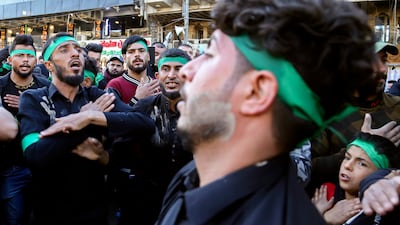
Shiite pilgrims in Baghdad beat themselves as a sign of grief outside the golden-domed shrine of Imam Moussa Al Kadhim, who died at the end of the eight century. AP -
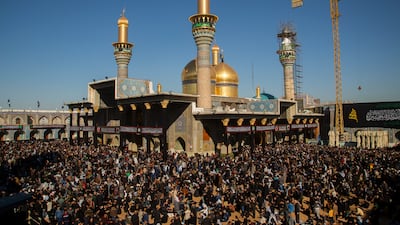
He was a great-grandson of the Prophet Mohammed and one of the 12 holiest imams revered by Shiites. AP -
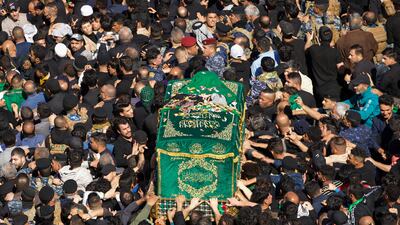
Worshippers carry a symbolic coffin at the golden-domed shrine of Imam Moussa Al Kadhim during the annual commemoration of his death. AP -
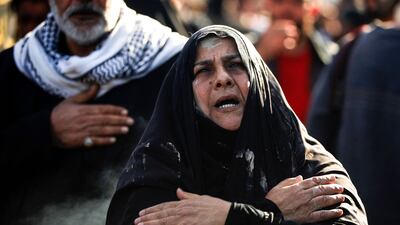
An Iraqi mourner laments the death of the seventh Shiite Imam Moussa Al Kadhim, as crowds gather around his shrine in Baghdad's northern district of Kadhimiya. AFP -

The pilgrimage to the golden-domed shrine is one of several major Shiite religious events that draw tens of thousands of pilgrims, not only from Iraq but also from abroad. AFP -

Iraqi Shiite worshippers gather at the Holy Shrine of Imam Moussa Al Kadhim, in Baghdad. EPA -

Imam Moussa Al Kadhim is one of the 12 holiest imams revered by Shiites. EPA -

Worshippers beat their chests in a ritual, during a procession. EPA -
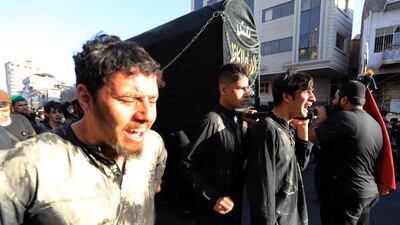
Pilgrims weep as they carry a symbolic coffin of Imam Moussa Al Kadhim. EPA -
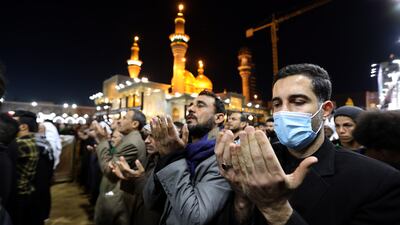
Worshippers pray. EPA -
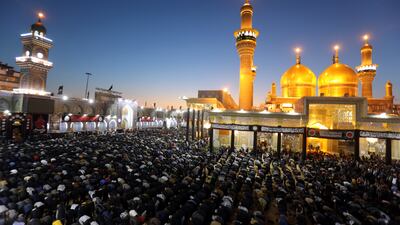
Many of the pilgrims had walked long distances to reach the shrine. EPA -

Pilgrims commemorate Imam Moussa Al Kadhim. Reuters



