


Iraq’s Shiite populist cleric Moqtada Al Sadr grew more defiant on Wednesday against Tehran-backed rivals who have derailed the election of the country’s new president.
For the third time, the deeply divided parliament failed to hold a scheduled session when it was boycotted by the pro-Iran parties, a tactic analysts said was to gain political leverage.
“I will not come to an agreement with you,” Mr Al Sadr said after his tripartite “Save the Nation Alliance” failed to achieve the two-thirds quorum needed to hold an electoral session.
“Any agreement [with you] means the end of the country.”
Mr Al Sadr, whose bloc won the most seats, 73, in the October 10 national elections, has formed the largest political group by teaming up with other parties.
-
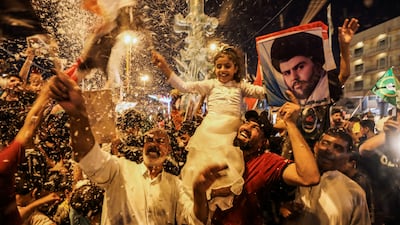
Supporters of the movement of Shiite cleric Moqtada Al Sadr celebrate in Najaf, Iraq, after preliminary results of the country’s parliamentary election were announced. Reuters -

Judge Jalil Adnan Khalaf (C), the chairman of Iraq’s Independent High Electoral Commission, speaks in the capital, Baghdad. AFP -

EU observers of the election hold a press conference in Baghdad. AP -
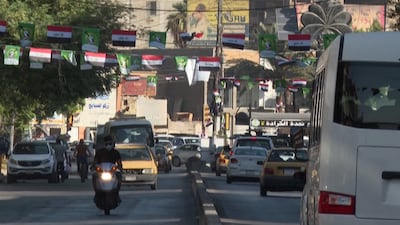
Iraqi flags are strung across a street. -
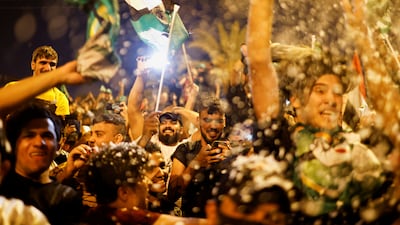
Sadrists celebrate after preliminary results of Iraq’s parliamentary election were announced in Baghdad on October 11. Reuters -
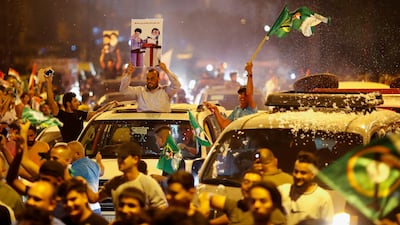
Supporters of Shiite cleric Moqtada Al Sadr celebrate after preliminary results were announced. Reuters -
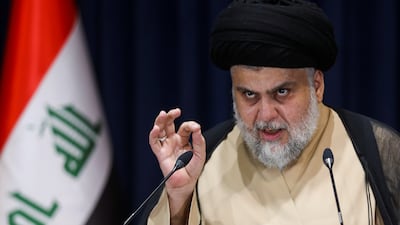
Shiite cleric Moqtada Al Sadr speaks after preliminary results of Iraq’s parliamentary election were announced in Najaf on October 11. Reuters


Shortly after the election results were announced, Mr Al Sadr formed an alliance with influential Kurds and Sunnis who won the most votes in their communities.
They are the Kurdish Democratic Party and two leading Sunni parties – Taqaddum, also known as the Progress Party, and Azm. Yet Mr Al Sadr is still marginally short of reaching quorum in parliament.
“No to all forms of consensus,” he said.
Complicating matters, Ishraqat Alliance, a small, pro-reform party, has also suggested boycotting the vote as a protest against Iraq’s political system.
Sadr’s brinkmanship
Mr Al Sadr has been one of the major political players since the removal of Saddam Hussein’s regime by a US-led invasion. His prominence on the political scene has led many Iraqis to blame him, along with other post-2003 elites, for problems country has endured ever since.
He has promised to introduce sweeping changes, chiefly a departure from the political tradition of forming consensus governments in which posts are shared among parties based on the sects, ethnicity and religions of the country’s population.
Instead, Mr Al Sadr eyes a majority government that can shoulder the responsibility of introducing badly needed reforms in all fields.
He also wants to free Iraq of what he calls foreign meddling, mainly from Iran itself and Tehran-backed Shiite militias.
For his Iran-backed rivals, who endured a major blow in the elections, Mr Al Sadr has offered only limited representation in the coming government.
His Save the Nation Alliance now holds more than 160 seats. To achieve the needed quorum, 220 of 329 seats, they managed to convince some independent and opposition politicians the vote in the Saturday session, but only 202 attended.
The session on Wednesday attracted only 180 people, MP Mishaan Al Jabouri said.
Call for compromise
Amid the deadlock, Mr Al Sadr’s rival Co-ordination Framework, composed mainly of Iran-backed groups, is seeking concessions.
“We call on all partners in the political process to sit around the same table to come out with real understanding to run the state,” said MP Falih Al Khazaali of Fatah Alliance, a Co-ordination Framework member.
“There is no other choice but to hear other partners and run the government together.”
Mr Al Sadr rejected that option.
“What you call as political deadlock is easier [to me] than agreeing with you and better than sharing the cake with you,” he said in his statement.
“There is no good in a consensus government based on sects.”
Without a president, the government formation process has hit an impasse. Once elected, the president must ask the prime ministerial nominee of the largest bloc to form the government.
Based on a long-standing informal agreement, the post is reserved for Kurdish parties, while the Prime Minister is reserved for Iraq’s majority Shiites and the Parliament Speaker is set aside for Sunnis.
Parliament has until April 6 to elect the country’s new president or face a constitutional vacuum. If they fail again, parliament may have to be dissolved, leading to another round of elections.

