A sand storm in the southern port city of Basra. Iraq is taking steps to assess and address its water problems. AFP

Iraq lays out plans to tackle climate change and address water supply problems


Mina Aldroubi
  • English
  • Arabic

Iraq will prepare a green paper to tackle climate change as reduced water flow and high temperatures take their toll on the country's livelihood.

Iraq is one of the most climate-vulnerable places on earth. Warming is expected to cut annual rainfall there, which will increase the frequency of dust storms, diminish water supplies and take a toll on agricultural activity.

This will have a knock-on effect on the health of Iraqis and on the country’s economy.

Baghdad played host to the second International Water Conference on Saturday, and on Sunday Prime Minister Mustafa Al Kadhimi announced that a committee was set up to draft a green paper for a climate change strategy.

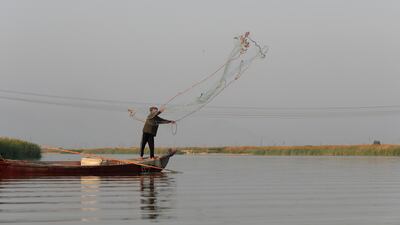
  • A man paddles his boat at the Chebayesh marsh, Dhi Qar province, Iraq. All photos: Thaier al-Sudani / Reuters
    A man paddles his boat at the Chebayesh marsh, Dhi Qar province, Iraq. All photos: Thaier al-Sudani / Reuters
  • Iraq's 2020-2021 rainfall season was the second driest in 40 years, according to the United Nations.
    Iraq's 2020-2021 rainfall season was the second driest in 40 years, according to the United Nations.
  • The dry season causes the salinity of the wetlands to rise to dangerous levels.
    The dry season causes the salinity of the wetlands to rise to dangerous levels.
  • Buffalos drink less and produce less milk when the water quality drops.
    Buffalos drink less and produce less milk when the water quality drops.
  • Sabah Thamer al-Baher and his family are Marsh Arabs, the wetlands' indigenous population that was displaced in the 1990s when Saddam Hussein dammed and drained the marshes to flush out rebels hiding in the reeds.
    Sabah Thamer al-Baher and his family are Marsh Arabs, the wetlands' indigenous population that was displaced in the 1990s when Saddam Hussein dammed and drained the marshes to flush out rebels hiding in the reeds.
  • After Saddam Hussein was overthrown in 2003, the marshes were partly reflooded and many Marsh Arabs returned, including Baher's family.
    After Saddam Hussein was overthrown in 2003, the marshes were partly reflooded and many Marsh Arabs returned, including Baher's family.
  • In 2019, the government said five million cubic metres a day of raw sewage water were being pumped directly into the Tigris, one of the rivers that feed Iraq's marshes.
    In 2019, the government said five million cubic metres a day of raw sewage water were being pumped directly into the Tigris, one of the rivers that feed Iraq's marshes.
  • Iraq's neighbours are also suffering from droughts and rising temperatures, which has led to regional water disputes.
    Iraq's neighbours are also suffering from droughts and rising temperatures, which has led to regional water disputes.
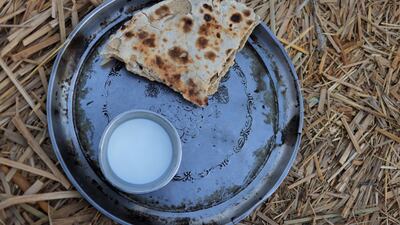
  • Buffalo milk and bread is seen on a tray.
    Buffalo milk and bread is seen on a tray.
  • Men pray at the Chebayesh marsh.
    Men pray at the Chebayesh marsh.
  • Baher prepares animal medicine to give to a buffalo.
    Baher prepares animal medicine to give to a buffalo.
  • Children play at the Chebayesh marsh.
    Children play at the Chebayesh marsh.
  • Buffaloes wade in the water of the Chebayesh marsh.
    Buffaloes wade in the water of the Chebayesh marsh.

"Iraq is the country most exposed to the impact of climate change,” Mr Al Kadhimi said.

He stressed a need for "co-ordination of the international community to manage the crises and share the damage”.

“Improving the management of water resources and their equitable sharing is a must to meet Sustainable Development Goals,” Mr Al Kadhimi said.

“Water security and climate change must be included in the strategies of countries.”

Several United Nations agencies also took part in the conference.

Last year, there was record low rainfall in Iraq, water flow was reduced and increased water stress, meaning a lack of resources to meet demand.

Water salinity in wetlands rose to dangerous levels.

Salinity occurs naturally in surface water but can accumulate quickly in hot climates when there is not enough rainwater to wash it away. At high levels it can render soil barren.

The UN said that annual evaporation varies from 2.5 to 3 metres, sharply reducing river flows supplying the marshlands, resulting in their area being substantially reduced.

Fears have heightened that a dry season will hit Iraq for the third year in a row, cutting the area of viable land that can be planted with core crops such as wheat and barley.


The six points:

1. Ministers should be in the field, instead of always at conferences

2. Foreign diplomacy must be left to the Ministry of Foreign Affairs and International Co-operation

3. Emiratisation is a top priority that will have a renewed push behind it

4. The UAE's economy must continue to thrive and grow

5. Complaints from the public must be addressed, not avoided

6. Have hope for the future, what is yet to come is bigger and better than before

The biog

Favourite film: Motorcycle Dairies, Monsieur Hulot’s Holiday, Kagemusha

Favourite book: One Hundred Years of Solitude

Holiday destination: Sri Lanka

First car: VW Golf

Proudest achievement: Building Robotics Labs at Khalifa University and King’s College London, Daughters

Driverless cars or drones: Driverless Cars

How Islam's view of posthumous transplant surgery changed

Transplants from the deceased have been carried out in hospitals across the globe for decades, but in some countries in the Middle East, including the UAE, the practise was banned until relatively recently.

Opinion has been divided as to whether organ donations from a deceased person is permissible in Islam.

The body is viewed as sacred, during and after death, thus prohibiting cremation and tattoos.

One school of thought viewed the removal of organs after death as equally impermissible.

That view has largely changed, and among scholars and indeed many in society, to be seen as permissible to save another life.

Mercer, the investment consulting arm of US services company Marsh & McLennan, expects its wealth division to at least double its assets under management (AUM) in the Middle East as wealth in the region continues to grow despite economic headwinds, a company official said.

Mercer Wealth, which globally has $160 billion in AUM, plans to boost its AUM in the region to $2-$3bn in the next 2-3 years from the present $1bn, said Yasir AbuShaban, a Dubai-based principal with Mercer Wealth.

Within the next two to three years, we are looking at reaching $2 to $3 billion as a conservative estimate and we do see an opportunity to do so,” said Mr AbuShaban.

Mercer does not directly make investments, but allocates clients’ money they have discretion to, to professional asset managers. They also provide advice to clients.

“We have buying power. We can negotiate on their (client’s) behalf with asset managers to provide them lower fees than they otherwise would have to get on their own,” he added.

Mercer Wealth’s clients include sovereign wealth funds, family offices, and insurance companies among others.

From its office in Dubai, Mercer also looks after Africa, India and Turkey, where they also see opportunity for growth.

Wealth creation in Middle East and Africa (MEA) grew 8.5 per cent to $8.1 trillion last year from $7.5tn in 2015, higher than last year’s global average of 6 per cent and the second-highest growth in a region after Asia-Pacific which grew 9.9 per cent, according to consultancy Boston Consulting Group (BCG). In the region, where wealth grew just 1.9 per cent in 2015 compared with 2014, a pickup in oil prices has helped in wealth generation.

BCG is forecasting MEA wealth will rise to $12tn by 2021, growing at an annual average of 8 per cent.

Drivers of wealth generation in the region will be split evenly between new wealth creation and growth of performance of existing assets, according to BCG.

Another general trend in the region is clients’ looking for a comprehensive approach to investing, according to Mr AbuShaban.

“Institutional investors or some of the families are seeing a slowdown in the available capital they have to invest and in that sense they are looking at optimizing the way they manage their portfolios and making sure they are not investing haphazardly and different parts of their investment are working together,” said Mr AbuShaban.

Some clients also have a higher appetite for risk, given the low interest-rate environment that does not provide enough yield for some institutional investors. These clients are keen to invest in illiquid assets, such as private equity and infrastructure.

“What we have seen is a desire for higher returns in what has been a low-return environment specifically in various fixed income or bonds,” he said.

“In this environment, we have seen a de facto increase in the risk that clients are taking in things like illiquid investments, private equity investments, infrastructure and private debt, those kind of investments were higher illiquidity results in incrementally higher returns.”

The Abu Dhabi Investment Authority, one of the largest sovereign wealth funds, said in its 2016 report that has gradually increased its exposure in direct private equity and private credit transactions, mainly in Asian markets and especially in China and India. The authority’s private equity department focused on structured equities owing to “their defensive characteristics.”

World record transfers

1. Kylian Mbappe - to Real Madrid in 2017/18 - €180 million (Dh770.4m - if a deal goes through)
2. Paul Pogba - to Manchester United in 2016/17 - €105m
3. Gareth Bale - to Real Madrid in 2013/14 - €101m
4. Cristiano Ronaldo - to Real Madrid in 2009/10 - €94m
5. Gonzalo Higuain - to Juventus in 2016/17 - €90m
6. Neymar - to Barcelona in 2013/14 - €88.2m
7. Romelu Lukaku - to Manchester United in 2017/18 - €84.7m
8. Luis Suarez - to Barcelona in 2014/15 - €81.72m
9. Angel di Maria - to Manchester United in 2014/15 - €75m
10. James Rodriguez - to Real Madrid in 2014/15 - €75m

COMPANY PROFILE
Name: ARDH Collective
Based: Dubai
Founders: Alhaan Ahmed, Alyina Ahmed and Maximo Tettamanzi
Sector: Sustainability
Total funding: Self funded
Number of employees: 4
The%20end%20of%20Summer
%3Cp%3EAuthor%3A%20Salha%20Al%20Busaidy%3C%2Fp%3E%0A%3Cp%3EPages%3A%20316%3C%2Fp%3E%0A%3Cp%3EPublisher%3A%20The%20Dreamwork%20Collective%C2%A0%3C%2Fp%3E%0A

COMPANY PROFILE

Name: N2 Technology

Founded: 2018

Based: Dubai, UAE

Sector: Startups

Size: 14

Funding: $1.7m from HNIs

SPECS
%3Cp%3E%3Cstrong%3EEngine%3A%20%3C%2Fstrong%3E2.4-litre%204-cylinder%20turbo%20hybrid%0D%3Cbr%3E%3Cstrong%3EPower%3A%3C%2Fstrong%3E%20366hp%0D%3Cbr%3E%3Cstrong%3ETorque%3A%20%3C%2Fstrong%3E550Nm%0D%3Cbr%3E%3Cstrong%3ETransmission%3A%20%3C%2Fstrong%3ESix-speed%20auto%0D%3Cbr%3E%3Cstrong%3EPrice%3A%3C%2Fstrong%3E%20From%20Dh360%2C000%0D%3Cbr%3E%3Cstrong%3EAvailable%3A%20%3C%2Fstrong%3ENow%0D%3C%2Fp%3E%0A
Updated: March 07, 2022, 6:39 PM