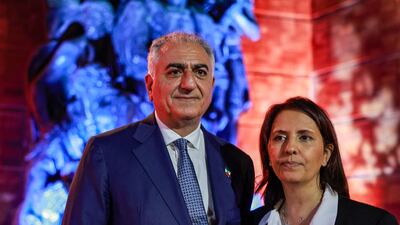
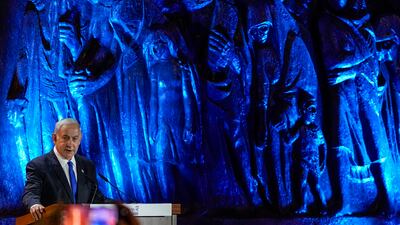
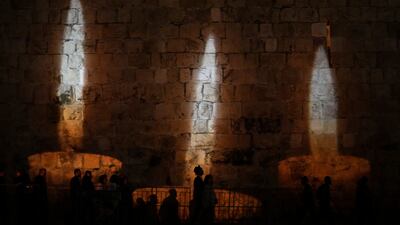
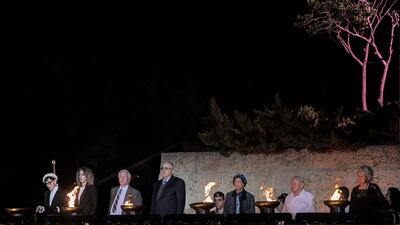
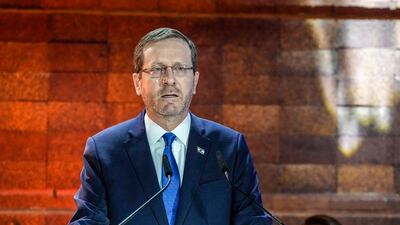
Reza Pahlavi at a ceremony marking Yom HaShoah, Holocaust Remembrance Day, in Jerusalem. AFP

Former Iranian crown prince Reza Pahlavi visits Israel for Holocaust Remembrance Day


  • English
  • Arabic

Former Iranian crown prince Reza Pahlavi arrived in Israel on Monday to attend a Holocaust Remembrance Day ceremony and hold talks with Israeli officials, amid tense relations between the two nations.

Mr Pahlavi was welcomed by Minister of Intelligence Gila Gamliel, who posted a photo on Twitter of herself at the airport with the former Iranian royal and his wife, Yasmine.

"Together, we will renew the ties between the nations, for the sake of future generations," Ms Gamliel wrote before the Yom HaShoah ceremony.

"We are very happy to be here and are dedicated to working toward the peaceful and prosperous future that the people of our region deserve," Mr Pahlavi said in a Twitter post announcing his arrival.

A statement released before his arrival described Mr Pahlavi as “the most prominent Iranian to visit Israel in history”.

He will hold meetings with officials and leaders about politics, the Iranian diaspora and water and agricultural technology.

“I want the people of Israel to know that the Islamic Republic does not represent the Iranian people,” Mr Pahlavi said in a Twitter post before his visit.

“The ancient bond between our people can be rekindled for the benefit of both nations. I’m going to Israel to play my role in building toward that brighter future.”

There have been concerns about rising tensions between the two countries in recent months, with concerns of war.

Meanwhile, Iran has continued its uranium enrichment efforts after failed nuclear deal discussions.

Mr Pahlavi, the son of former shah of Iran Mohammad Reza Pahlavi, is exiled as an opposition figure.

He was the last crown prince and heir to the throne when the 1979 Iranian Revolution occurred.

Mr Pahlavi has called for parliamentary democracy in Iran.

He also spread messages of unity during anti-government protests in the country in the past six months.

Mr Pahlavi “will deliver remarks outlining his vision for an Iranian democracy that celebrates freedoms of speech and religion, safeguards human rights, protects its natural resources, and invests its treasure in Iranian people rather than foreign terrorist groups,” his statement said.

His trip will also focus on meeting Israeli experts on water technology, where Mr Pahlavi said he hopes to learn from their work and experience to help address Iran's water crisis.


UAE currency: the story behind the money in your pockets
Why are asylum seekers being housed in hotels?

The number of asylum applications in the UK has reached a new record high, driven by those illegally entering the country in small boats crossing the English Channel.

A total of 111,084 people applied for asylum in the UK in the year to June 2025, the highest number for any 12-month period since current records began in 2001.

Asylum seekers and their families can be housed in temporary accommodation while their claim is assessed.

The Home Office provides the accommodation, meaning asylum seekers cannot choose where they live.

When there is not enough housing, the Home Office can move people to hotels or large sites like former military bases.

THE BIO

Born: Mukalla, Yemen, 1979

Education: UAE University, Al Ain

Family: Married with two daughters: Asayel, 7, and Sara, 6

Favourite piece of music: Horse Dance by Naseer Shamma

Favourite book: Science and geology

Favourite place to travel to: Washington DC

Best advice you’ve ever been given: If you have a dream, you have to believe it, then you will see it.

Mercer, the investment consulting arm of US services company Marsh & McLennan, expects its wealth division to at least double its assets under management (AUM) in the Middle East as wealth in the region continues to grow despite economic headwinds, a company official said.

Mercer Wealth, which globally has $160 billion in AUM, plans to boost its AUM in the region to $2-$3bn in the next 2-3 years from the present $1bn, said Yasir AbuShaban, a Dubai-based principal with Mercer Wealth.

Within the next two to three years, we are looking at reaching $2 to $3 billion as a conservative estimate and we do see an opportunity to do so,” said Mr AbuShaban.

Mercer does not directly make investments, but allocates clients’ money they have discretion to, to professional asset managers. They also provide advice to clients.

“We have buying power. We can negotiate on their (client’s) behalf with asset managers to provide them lower fees than they otherwise would have to get on their own,” he added.

Mercer Wealth’s clients include sovereign wealth funds, family offices, and insurance companies among others.

From its office in Dubai, Mercer also looks after Africa, India and Turkey, where they also see opportunity for growth.

Wealth creation in Middle East and Africa (MEA) grew 8.5 per cent to $8.1 trillion last year from $7.5tn in 2015, higher than last year’s global average of 6 per cent and the second-highest growth in a region after Asia-Pacific which grew 9.9 per cent, according to consultancy Boston Consulting Group (BCG). In the region, where wealth grew just 1.9 per cent in 2015 compared with 2014, a pickup in oil prices has helped in wealth generation.

BCG is forecasting MEA wealth will rise to $12tn by 2021, growing at an annual average of 8 per cent.

Drivers of wealth generation in the region will be split evenly between new wealth creation and growth of performance of existing assets, according to BCG.

Another general trend in the region is clients’ looking for a comprehensive approach to investing, according to Mr AbuShaban.

“Institutional investors or some of the families are seeing a slowdown in the available capital they have to invest and in that sense they are looking at optimizing the way they manage their portfolios and making sure they are not investing haphazardly and different parts of their investment are working together,” said Mr AbuShaban.

Some clients also have a higher appetite for risk, given the low interest-rate environment that does not provide enough yield for some institutional investors. These clients are keen to invest in illiquid assets, such as private equity and infrastructure.

“What we have seen is a desire for higher returns in what has been a low-return environment specifically in various fixed income or bonds,” he said.

“In this environment, we have seen a de facto increase in the risk that clients are taking in things like illiquid investments, private equity investments, infrastructure and private debt, those kind of investments were higher illiquidity results in incrementally higher returns.”

The Abu Dhabi Investment Authority, one of the largest sovereign wealth funds, said in its 2016 report that has gradually increased its exposure in direct private equity and private credit transactions, mainly in Asian markets and especially in China and India. The authority’s private equity department focused on structured equities owing to “their defensive characteristics.”

Ways to control drones

Countries have been coming up with ways to restrict and monitor the use of non-commercial drones to keep them from trespassing on controlled areas such as airports.

"Drones vary in size and some can be as big as a small city car - so imagine the impact of one hitting an airplane. It's a huge risk, especially when commercial airliners are not designed to make or take sudden evasive manoeuvres like drones can" says Saj Ahmed, chief analyst at London-based StrategicAero Research.

New measures have now been taken to monitor drone activity, Geo-fencing technology is one.

It's a method designed to prevent drones from drifting into banned areas. The technology uses GPS location signals to stop its machines flying close to airports and other restricted zones.

The European commission has recently announced a blueprint to make drone use in low-level airspace safe, secure and environmentally friendly. This process is called “U-Space” – it covers altitudes of up to 150 metres. It is also noteworthy that that UK Civil Aviation Authority recommends drones to be flown at no higher than 400ft. “U-Space” technology will be governed by a system similar to air traffic control management, which will be automated using tools like geo-fencing.

The UAE has drawn serious measures to ensure users register their devices under strict new laws. Authorities have urged that users must obtain approval in advance before flying the drones, non registered drone use in Dubai will result in a fine of up to twenty thousand dirhams under a new resolution approved by Sheikh Hamdan bin Mohammed, Crown Prince of Dubai.

Mr Ahmad suggest that "Hefty fines running into hundreds of thousands of dollars need to compensate for the cost of airport disruption and flight diversions to lengthy jail spells, confiscation of travel rights and use of drones for a lengthy period" must be enforced in order to reduce airport intrusion.

The Cockroach

 (Vintage)

Ian McEwan 
 

Updated: April 18, 2023, 6:36 AM