

Iran’s atomic energy body has dismissed claims by senior diplomats that UN weapons inspectors have detected uranium in Iran enriched almost to the purity required to build a nuclear bomb.
Atomic Energy Organisation of Iran spokesman Behrouz Kamalvandi told state-linked Fars news website late on Sunday that particles with purity no higher than 60 per cent had been found by inspectors.
On Sunday, two senior diplomats said that International Atomic Energy Agency weapons inspectors had detected uranium of 84 per cent purity in Iran, Bloomberg reported.
Experts say that uranium must be enriched to about 90 per cent to be classed as “weapons grade,” or pure enough to make a nuclear weapon, although they warn that 60 per cent is close to a “breakout” level — meaning it is one technical step away from weapons grade.
Mr Kamalvandi said the findings were nothing out of the ordinary.
“So far, we have not enriched to more than 60 per cent,” he said.
“It is unfortunate that the International Atomic Energy Agency is still being misused as a political tool to put pressure on [Iran].
“The existence of a uranium particle or particles with a purity above 60 per cent during the enrichment process does not mean that it has been enriched to over 60 per cent. This is something that is very natural, possibly even due to a drop in the feed of the centrifuge stages at a time.
“The important thing is that the end product. We have so far not tried to get richer than 60 per cent.”
He said the report showed that the IAEA has “long since left its professional and neutral position”.
-
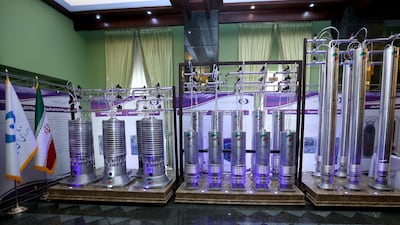
New generation Iranian centrifuges on display for Iran's National Nuclear Energy Day in Tehran, in April 2021. Iranian Presidency Office / Wana -

President Ebrahim Raisi, second right, is accompanied by Atomic Energy Organisation of Iran chief Mohammad Eslami, at Nuclear Technology Day in Tehran in April 2022. Iranian presidency / AFP -
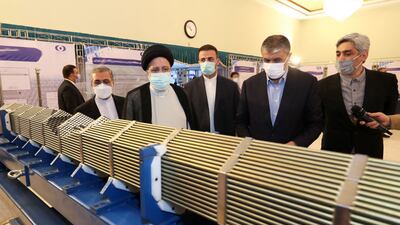
Mr Raisi and Mr Eslami at the April 2022 event. Iranian presidency / AFP -
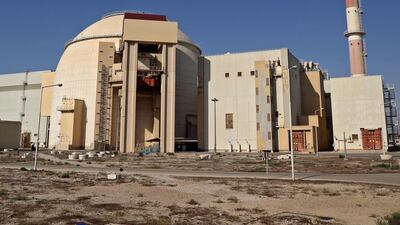
The Bushehr Nuclear Power Plant during a visit by Mr Raisi in October 2021. Iranian Presidency / AFP -
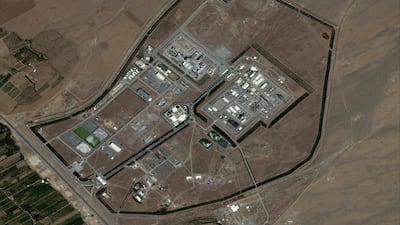
Iran's Arak Heavy Water Reactor complex, south of the capital Tehran in January 2020. Maxar Technologies / AFP -
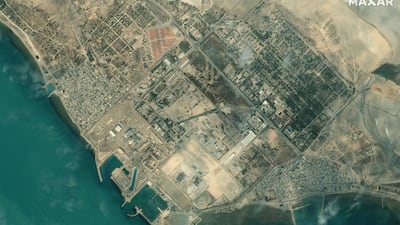
A satellite image of Iran's Bushehr Nuclear Power Plant in January 2020. Maxar Technologies / AFP -
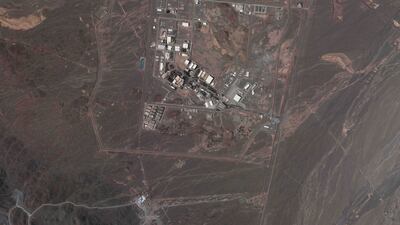
A satellite image of Iran's underground Natanz nuclear site in May 2022. Planet Labs PBC / AP -
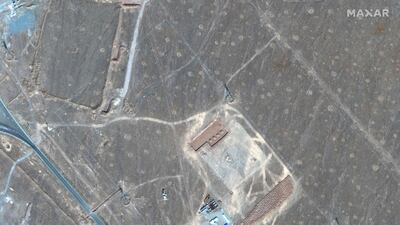
A satellite image in January 2020 of Iran's Fordow Fuel Enrichment Plant, north-east of the city of Qom. Maxar Technologies / AFP -
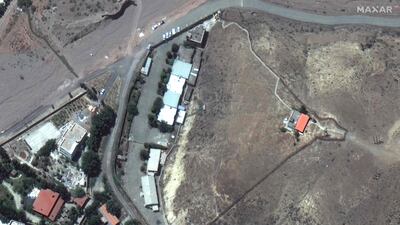
The Sanjarian nuclear centre, east of Tehran, in May 2021. Maxar Technologies / AFP


Nuclear devices can be made with levels slightly lower that 90 per cent, analysts from the US Institute for Scientific and Security Studies have said. Uranium for civilian use in nuclear reactors is typically enriched below five per cent.
On Sunday, Fars reported that Iranian President Ebrahim Raisi had criticised western parties for bowing out of the negotiations on the revival of the 2015 nuclear agreement.
He repeated accusations that they were to blame for riots that erupted in the country during the past six months.
Mr Raisi was speaking at a meeting between ambassadors from Muslim countries and Supreme Leader Ayatollah Ali Khamenei on Saturday.
He said Iran would achieve its goals through constructive dialogue with international bodies and overcome economic problems caused by western sanctions.
Violent protests erupted in several Iranian cities in September following the death of Mahsa Amini in police custody in September.

