

Two prominent regime critics have been released on bail in Iran as the government tries to defuse a national protest movement that has rallied for radical reform, and in some cases regime change, since mid-September.
Voria Ghafouri, an Iranian-Kurd who played for Iran’s national team between 2015 and 2019, and Hossein Ronaghi, a prominent human rights activist, were both jailed for supporting protests that followed the death of Mahsa Amini, 22, after being beaten by police.
-

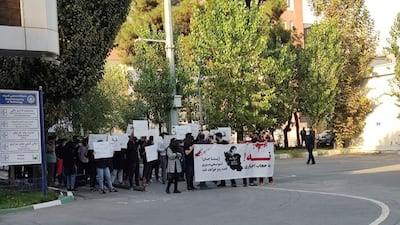
Iranians protest in Tehran after the death of 22-year-old Mahsa Amini after she was detained by the morality police in September. AP Photo -
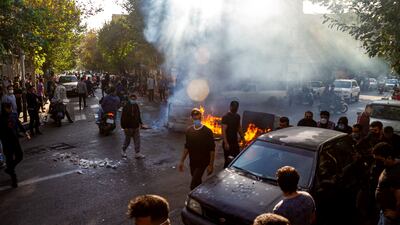
Protests have intensified despite a vicious government crackdown that has left as many as 200 people dead, although estimates of the toll by rights groups vary. AP Photo -
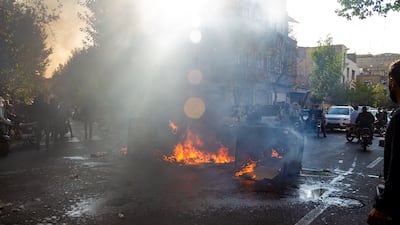
At least eight members of the security forces have also been killed or wounded during the unrest and there are signs that violent resistance could be intensifying. AP Photo -
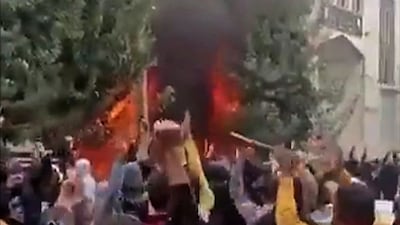
A fire burns at the office of the governor of Mahabad, in the West Azerbaijan province of Iran. AFP -
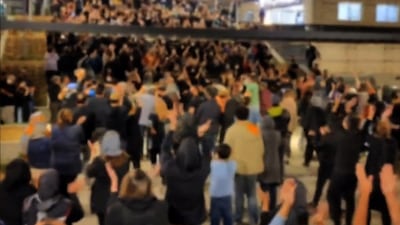
Protesters gather in the a courtyard of Chitgar complex in western Tehran. AFP -

Iranian protesters continue to defy a deadly crackdown by security forces. AFP -

A woman cuts her hair at the grave site of Nika Shahkarami in the city of Khorramabad, during a reported memorial held to mark 40 days since the death of the 16-year-old. AFP -
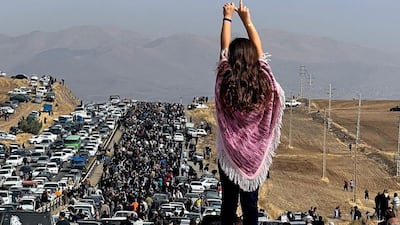
A woman not wearing a headscarf stands on top of a vehicle as thousands make their way towards Saqez, Mahsa Amini's home town, to mark 40 days since her death in police custody. AFP -
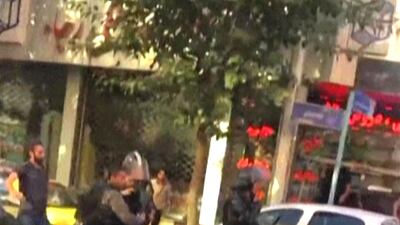
Iranian riot police prepare to confront protesters the capital, Tehran. AFP -
Iranian protesters surge forward amid clashes with riot police in Tehran. AFP -
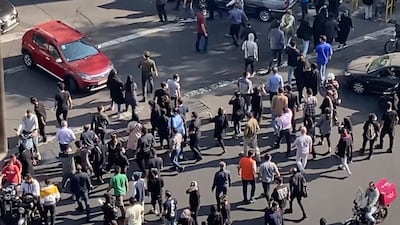
A crowd blocks an intersection during a protest to mark 40 days since Amini's death in custody. AP Photo -
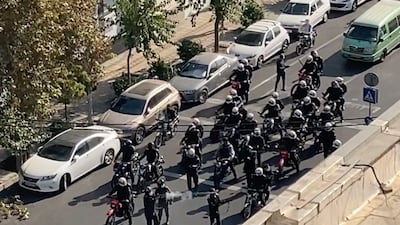
Iranian police arrive to disperse a protest in Tehran. AP Photo -
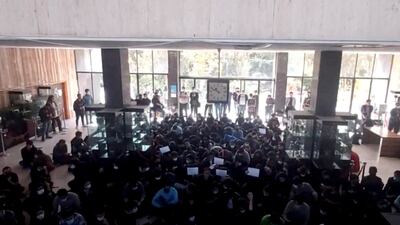
Protesters chant at a vigil for Amini at the Khajeh Nasir Toosi University of Technology in Tehran. Reuters -
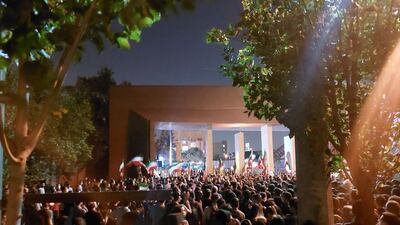
Students at Sharif University of Technology attend a protest. AP Photo -

Police outside Sharif University during a student protest. AP Photo -
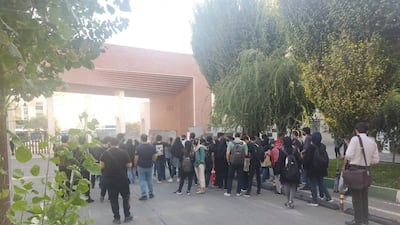
Students at the university protest over the death of Amini, who was in 'morality police' custody for allegedly breaking strict rules on head coverings for women. AP Photo -
The students' banner says: 'No to mandatory hijab'. AP Photo


Kurdish-Iranian Amimi had been accused of violating the country’s strict dress code for women, sparking protests in the Kurdish region of Iran.
Demonstrators called for greater rights for women but the street protests soon became a movement against the country’s 40 years of theocratic rule, while calling for better living standards amid an ongoing economic crisis.
At least 400 people have been killed in the unrest, mostly protestors but also some security forces, including militiamen from the notorious Basij force, an internal security organisation, and the Islamic Revolutionary Guard Corps, a branch of the armed forces.
The bloody state crackdown has led to increasing international criticism. Earlier this month, Europe and the US said they would co-ordinate to sanction Iranians involved in human rights abuses, amid a rising death toll and fears that many of the estimated 14,000 people detained could face the death penalty.
Within Iran, the niece of Ayatollah Ali Khamenei released a video message calling on foreign governments to cut all ties with Tehran following the crackdown.
A video of a statement by Farideh Moradkhani, an engineer whose late father was a prominent opposition figure married to Ayatollah Khamenei's sister, was being widely shared online after what activist news agency HRANA said was her arrest on November 23.
"O free people, be with us and tell your governments to stop supporting this murderous and child-killing regime," Ms Moradkhani said in the video.
Rights activists say dozens of children have died in the protests after demonstrations and security crackdowns spread to schools.
"This regime is not loyal to any of its religious principles and does not know any rules except force and maintaining power," she said.
Hunger strike
Mr Ronaghi was detained shortly after the protests began, and concern had been growing about his health after he mounted a hunger strike lasting two months.
"Voria Ghafouri and Hossein Ronaghi were released on bail," Iran's Fars news agency said on its social media accounts.
The Iranian newspaper Shargh also said that Mr Ghafouri had been released following his arrest during a training session on Thursday.
"Hossein was released tonight on bail to undergo treatment," Mr Ronaghi's brother Hassan wrote on Twitter.
Their father Ahmad posted a picture of Mr Ronaghi in hospital, saying he had been released after a hunger strike that lasted 64 days.
Among others detained are dozens of prominent journalists, cultural figures, lawyers and sportspeople.
Mr Ghafouri, an outspoken figure who played 28 times for Iran up until 2019, was arrested after a club training session over accusations that he spread "propaganda" against the government, Fars said on Thursday.
Originally from the Kurdish-populated city of Sanandaj in western Iran, Mr Ghafouri had been particularly critical of the crackdown in Kurdish-populated areas of western Iran where activists say dozens have been killed in the last 10 days.
Mr Ronaghi, 37, a contributor to The Wall Street Journal, has for years been one of the most fearless critics of the government still living in the country.
Mr Ronaghi was taken to Evin prison after his arrest on September 24.
His family had said he risks dying due to a kidney condition.
Other prominent figures remain in detention in the crackdown on the protests, which are seen as the biggest challenge to the country’s theocracy since the 1979 revolution ousted the rule of the Shah dynasty.
They include the prominent dissidents Arash Sadeghi and Majid Tavakoli as well as journalists Niloofar Hamedi and Elahe Mohammadi who helped expose the Amini case.
Renowned Iranian film-makers Jafar Panahi and Mohammad Rasoulof were detained this year before the current protests began.

