

Indirect talks between Iran and the US resumed in Vienna on Thursday with Tehran's chief nuclear negotiator meeting the EU's Enrique Mora to try salvage the 2015 nuclear deal.
The EU's foreign policy chief Josep Borrell has warned there is no room left for further major compromises as Tehran and Washington played down the prospect of a breakthrough in this round of talks.
Iran refuses to hold direct talks with the US, leaving Mr Mora to move between Ali Bagheri Kani and US special envoy for Iran Rob Malley, who tweeted on Wednesday he was going to Vienna with his expectations "in check."
Indicating there was little flexibility to resolve remaining thorny issues, Mr Bagheri Kani put the onus on the White House to compromise, saying in a tweet that the US should "show maturity and act responsibly".
White House national security spokesman John Kirby said the negotiations "are pretty much complete at this point".
"We're not going to wait forever for Iran to take the deal," Mr Kirby said in Washington on Thursday. "There's a deal on the table. They ought to take it.
"Time does appear to be getting very short in terms of being able to get to a deal."
Little remains of the 2015 deal, which lifted sanctions against Tehran in exchange for restrictions on its nuclear programme.
But then-president Donald Trump ditched the agreement in 2018 and reimposed harsh sanctions on Iran.
In response, Tehran breached the deal in several ways, including by rebuilding stocks of enriched uranium.
Iran's nuclear sites - in pictures
-
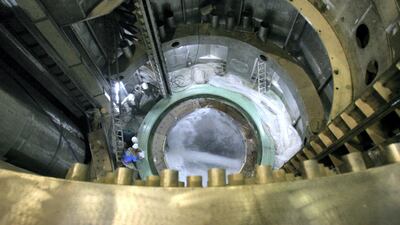
Russian contractors work at the Bushehr nuclear reactor site in 2007. The plant opened four years later. Bloomberg -
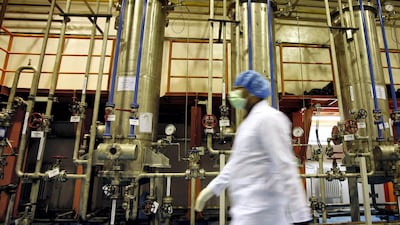
An Iranian technician at the International Atomic Energy Agency inspects the country's Isfahan plant in 2007. Tehran is no longer co-operating with the agency at nuclear sites across the country. EPA -

Workers wait to begin constructing a second reactor at the Bushehr nuclear power plant in 2019. AFP -
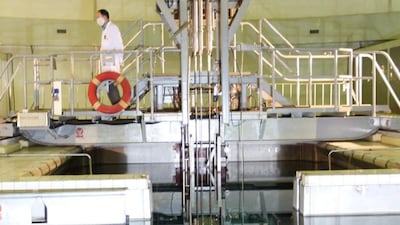
A metal-encased rod with 20 per cent enriched nuclear fuel is inserted into a reactor in Tehran in 2012. AFP -
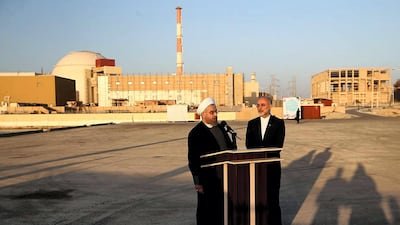
Fomer Iranian President Hassan Rouhani and the country's Atomic Energy Organisation chief Ali Akbar Salehi speak at the Bushehr nuclear site in 2015. AFP -
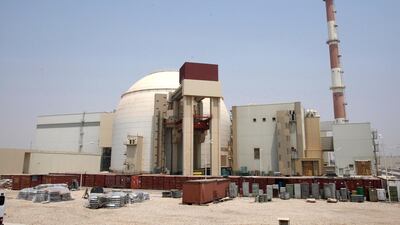
Iran's Bushehr nuclear plant has been restarted. EPA -
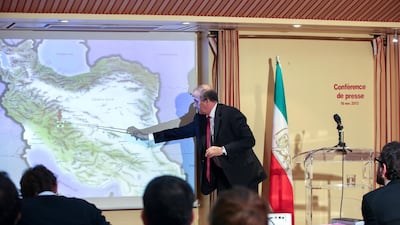
Mehdi Abrichamtchi, chairman of the Peace and Security Committee at the National Council of Resistance of Iran, shows journalists the location of a secret nuclear site in Iran in 2013. AFP -
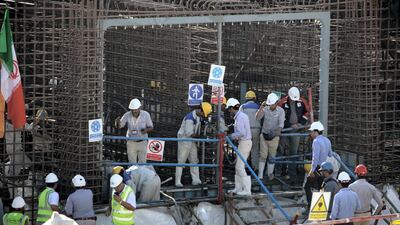
Workers prepare to begin the construction of a second reactor at the Bushehr site. AFP


After 11 months of indirect talks in Vienna between Tehran and US President Joe Biden's administration, however, the broad outline of a revived deal was essentially agreed on in March.
But talks broke down, mainly because of Tehran’s demand that Washington remove its Islamic Revolutionary Guard Corps (IRGC) from a US terrorism list and the US refusal to do so.
To overcome the impasse, Mr Borrell in July proposed a new draft text, which two Iranian officials said Tehran "was not happy" with.
"Iran has shown enough flexibility," a senior Iranian official told Reuters. "Now it is up to Biden to make a decision.
"We have our own suggestions that will be discussed in the Vienna talks, such as lifting sanctions on the Guards gradually."
Other points of contention include Tehran's demand that Washington provide guarantees that no US president would abandon the deal as Mr Trump did.
But Mr Biden cannot promise this because the 2015 pact is a non-binding political understanding, not a legally binding treaty.
US and Israel pledge to deny Iran nuclear weapons - video
"If they want to revive the pact, Washington should secure Iran's economic benefits and not only until the end of Biden's term," another Iranian official said.
Iran also insists the International Atomic Energy Agency drop its claims about Tehran's nuclear work, objecting to last year's assertion by the UN nuclear watchdog that it had failed to fully explain uranium traces at undeclared sites.

