

The European Union's co-ordinator for talks between Iran and world powers over restoring a frayed 2015 nuclear deal will visit Tehran this week, the Iranian Foreign Ministry confirmed on Monday.
Enrique Mora has acted as an intermediary between the United States and Iran during a year of on-off negotiations in Vienna to revive the pact.
The talks have been stalled since March, and Iran called on April 25 for a meeting to revive the dialogue "as soon as possible".
Foreign Ministry spokesman Saeed Khatibzadeh said Mr Mora would meet Iran’s chief nuclear negotiator Ali Bagheri.
"The agenda for talks in Tehran is nearly finalised," Mr Khatibzadeh told a weekly press briefing.
He did not say when Mr Mora would arrive but local press reported the EU official was expected on Tuesday.
The 2015 nuclear deal gave Iran sanctions relief in exchange for curbs on its atomic programme to guarantee that it could not develop a nuclear weapon, something Tehran has always denied wanting to do.
It was agreed between Iran and the five permanent United Nations Security Council members China, Russia, the US, UK and France, alongside Germany.
The US unilaterally withdrew in 2018 under then-president Donald Trump and reimposed biting economic sanctions, prompting Iran to begin rolling back its own commitments.
The talks in the Austrian capital have focused on bringing Washington back into the deal and lifting its sanctions, while ensuring Tehran abides by its commitments.
-
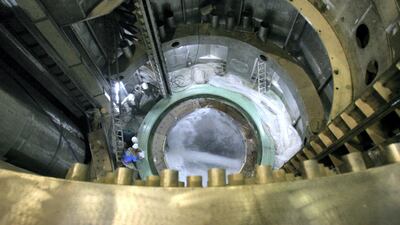
Russian contractors work at the Bushehr nuclear reactor site in 2007. The plant opened four years later. Bloomberg -
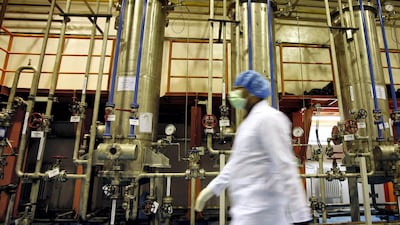
An Iranian technician at the International Atomic Energy Agency inspects the country's Isfahan plant in 2007. Tehran is no longer co-operating with the agency at nuclear sites across the country. EPA -

Workers wait to begin constructing a second reactor at the Bushehr nuclear power plant in 2019. AFP -
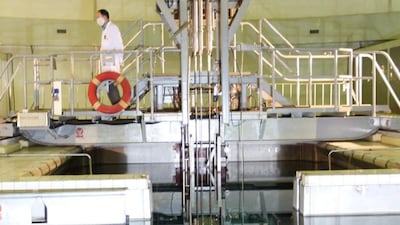
A metal-encased rod with 20 per cent enriched nuclear fuel is inserted into a reactor in Tehran in 2012. AFP -
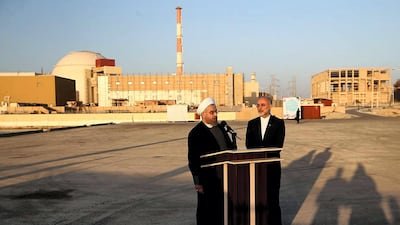
Fomer Iranian President Hassan Rouhani and the country's Atomic Energy Organisation chief Ali Akbar Salehi speak at the Bushehr nuclear site in 2015. AFP -
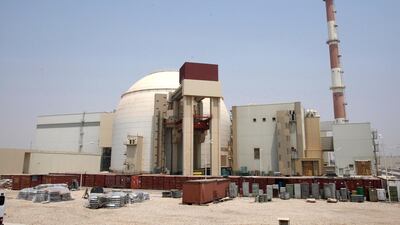
Iran's Bushehr nuclear plant has been restarted. EPA -
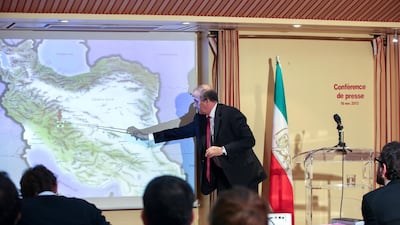
Mehdi Abrichamtchi, chairman of the Peace and Security Committee at the National Council of Resistance of Iran, shows journalists the location of a secret nuclear site in Iran in 2013. AFP -
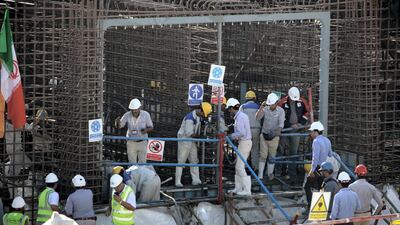
Workers prepare to begin the construction of a second reactor at the Bushehr site. AFP


Adversaries for decades, Iran and the US have been engaged in negotiations indirectly through Mr Mora, while Tehran has negotiated directly with the remaining parties to the deal.
"Mora's trip moves the talks in the right direction," Mr Khatibzadeh said, noting that messages are "constantly exchanged between Iran and the United States via the European Union".
Among the remaining sticking points is Iran's demand that Washington removes the Islamic Revolutionary Guard Corps from its terrorist list.
Mr Khatibzadeh said the media "must not reduce the issues between Iran and the United States to a single issue, such as the Guards".
"If the United States decides today to respect the rights of the Iranian people, we can go to Vienna after Mora's visit and sign the agreement," he said.
In an interview with the Financial Times published on Saturday, EU foreign policy chief Josep Borrell said he was seeking a "middle way" to bridge the gap between Tehran and Washington.
He described the EU's diplomatic push as "the last bullet" in attempts to salvage the deal.
"We cannot continue like this forever, because in the meantime Iran continues developing their nuclear programme," he said.

