

Iran is five years away from developing a nuclear weapon and international talks due to restart next week will do nothing to slow it down, Israel's Prime Minister Naftali Bennett warned on Tuesday.
Mr Bennett said that Israel reserved the right to act to protect itself.
Indirect negotiations to revive the 2015 accord, under which Iran agreed to curbs on its nuclear programme in return for the lifting of international sanctions, are expected to resume in Vienna next Monday after a five-month pause. The head of the International Atomic Energy Agency (IAEA), the UN nuclear watchdog, arrived in Tehran on Monday to discuss the negotiations.
Israel has long been opposed to the nuclear deal. However, Mr Bennett's government, in power since June, previously said it could be open to a new deal with tougher restrictions. In remarks on Tuesday to a security forum, however, he was less accommodating.
-
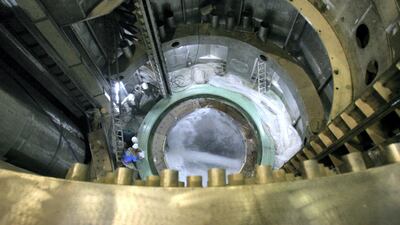
Russian contractors work at the Bushehr nuclear reactor site in 2007. The plant opened four years later. Bloomberg -
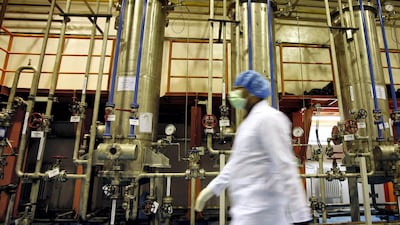
An Iranian technician at the International Atomic Energy Agency inspects the country's Isfahan plant in 2007. Tehran is no longer co-operating with the agency at nuclear sites across the country. EPA -

Workers wait to begin constructing a second reactor at the Bushehr nuclear power plant in 2019. AFP -
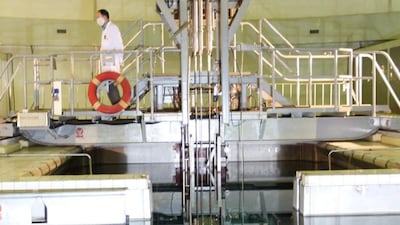
A metal-encased rod with 20 per cent enriched nuclear fuel is inserted into a reactor in Tehran in 2012. AFP -
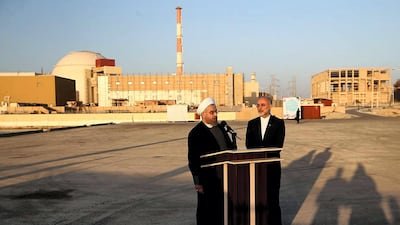
Fomer Iranian President Hassan Rouhani and the country's Atomic Energy Organisation chief Ali Akbar Salehi speak at the Bushehr nuclear site in 2015. AFP -
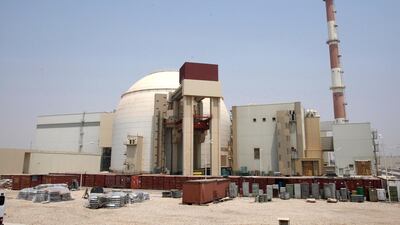
Iran's Bushehr nuclear plant has been restarted. EPA -
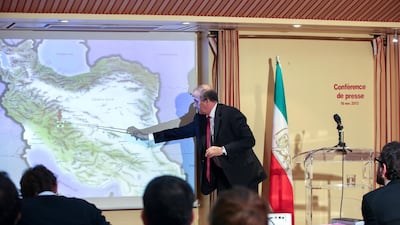
Mehdi Abrichamtchi, chairman of the Peace and Security Committee at the National Council of Resistance of Iran, shows journalists the location of a secret nuclear site in Iran in 2013. AFP -
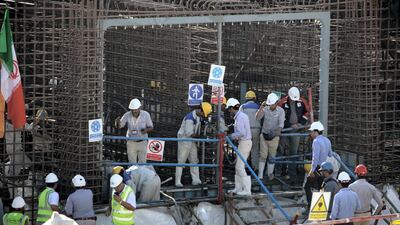
Workers prepare to begin the construction of a second reactor at the Bushehr site. AFP


Mr Bennett described Iran, which denies it is pursuing nuclear arms, as being at “the most advanced stage” of a nuclear weapons programme.
“In any event, even if there is a return to a deal, Israel is of course not a party to the deal and Israel is not obligated by the deal,” he told the conference, hosted by Reichman University.
Finance Minister Avigdor Lieberman said: “With or without an agreement, Iran will be a nuclear state and have a nuclear weapon within five years, tops.”
Israel, itself widely believed to have nuclear weapons, has long argued that the 2015 deal was too weak to prevent Iran from pursuing a bomb. Former US president Donald Trump abandoned the deal in 2018, describing it as too soft, and Iran responded by violating some of the deal's restrictions.
President Joe Biden's administration aims to revive it.
Israel, along with a number of Gulf states and others, has also complained that the nuclear agreement does nothing to rein in Iran's missile programme, or hostile activity by Iranian-backed militia.
“The Iranians have encircled the State of Israel with missiles while they sit safely in Tehran”, Mr Bennett said.
“To chase the terrorist du-jour sent by the [Iranian covert] Quds Force does not pay off any more. We must go for the dispatcher.”
Speaking separately, the chief of Israel's air force offered co-operation with Gulf Arab partners against Iranian-made attack drones, a rare public airing of the possibility of joint operations.
Saudi Arabia, which has no official ties with Israel, faces near-daily drone attacks launched by Iranian-backed Houthi militants in Yemen. Several attacks in recent years on shipping in the Gulf — that Iran has been accused of carrying out — have also used drones.

