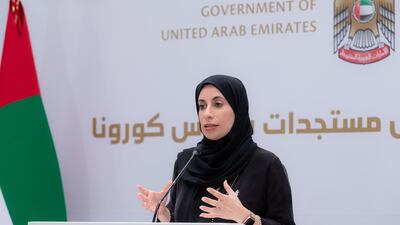
Health experts from the three countries that have become world leaders in Covid-19 vaccinations shared notes on Tuesday on the best ways to run mass vaccination campaigns.
Dr Farida Al Hosani, spokeswoman for UAE government's health authorities, joined colleagues from Israel and Bahrain in a virtual meeting at the Atlantic Council think tank to trade experiences.
Israel has administered at least one of its double-dose vaccines to 58 per cent of its people, compared with 35 per cent in the UAE and 10 per cent in Bahrain, according to data compiled by Our World in Data.
The UAE’s vaccination programme benefited from joined-up government action, including strong leadership, public awareness campaigns and simple vaccination registration procedures, said Dr Al Hosani.
“All of this has helped to ensure that we reach the highest level of coverage for our community in the shortest possible time.”
Dr Al Hosani was joined in the virtual briefing by Dr Manaf Al Qahtani, from the Bahrain National Taskforce for Combating Coronavirus, and Dr Shoshy Goldberg, the chief nursing officer from Israel’s Ministry of Health.
Israel, the UAE and Bahrain are understood to have benefited from having relatively small populations and ready-made universal healthcare systems, as well as ordering early batches of vaccines.
The three countries normalised relations last year. Dr Al Hosani said this had helped pave the way for co-operation on tackling the pandemic.
“We do have a very strong infrastructure when it comes to international flights [and] storage. We are already a regional hub for many pharmaceutical vaccines for commercial use,” she said.
Covid-19 has infected more than 103 million people worldwide and claimed the lives of 2.2 million people. The rollout of quickly-developed vaccines has raised hopes of life going back to normal later this year.

Company%20profile
%3Cp%3E%3Cstrong%3ECompany%20name%3A%20%3C%2Fstrong%3EHakbah%0D%3Cbr%3E%3Cstrong%3EStarted%3A%20%3C%2Fstrong%3E2018%0D%3Cbr%3E%3Cstrong%3EFounder%3A%20%3C%2Fstrong%3ENaif%20AbuSaida%0D%3Cbr%3E%3Cstrong%3EBased%3A%20%3C%2Fstrong%3ESaudi%20Arabia%0D%3Cbr%3E%3Cstrong%3ESector%3A%20%3C%2Fstrong%3EFinTech%0D%3Cbr%3E%3Cstrong%3ECurrent%20number%20of%20staff%3A%20%3C%2Fstrong%3E22%20%0D%3Cbr%3E%3Cstrong%3EInitial%20investment%3A%20%3C%2Fstrong%3E%24200%2C000%0D%3Cbr%3E%3Cstrong%3EInvestment%20stage%3A%20%3C%2Fstrong%3Epre-Series%20A%0D%3Cbr%3E%3Cstrong%3EInvestors%3A%20%3C%2Fstrong%3EGlobal%20Ventures%20and%20Aditum%20Investment%20Management%0D%3Cbr%3E%3Cbr%3E%3C%2Fp%3E%0A
RESULTS
6.30pm Maiden (TB) Dh82.500 (Dirt) 1,400m
Winner Meshakel, Royston Ffrench (jockey), Salem bin Ghadayer (trainer)
7.05pm Handicap (TB) Dh87,500 (D) 1,400m
Winner Gervais, Connor Beasley, Ali Rashid Al Raihe.
7.40pm Handicap (TB) Dh92,500 (Turf) 2,410m
Winner Global Heat, Pat Cosgrave, Saeed bin Suroor.
8.15pm Handicap (TB) Dh105,000 (D) 1,900m
Winner Firnas, Royston Ffrench, Salem bin Ghadayer.
8.50pm UAE 2000 Guineas Trial (TB) Conditions Dh183,650 (D) 1,600m
Winner Rebel’s Romance, William Buick, Charlie Appleby
9.25pm Dubai Trophy (TB) Conditions Dh183,650 (T) 1,200m
Winner Topper Bill, Richard Mullen, Satish Seemar
10pm Handicap (TB) Dh102,500 (T) 1,400m
Winner Wasim, Mickael Barzalona, Ismail Mohammed.
Our legal columnist
Name: Yousef Al Bahar
Advocate at Al Bahar & Associate Advocates and Legal Consultants, established in 1994
Education: Mr Al Bahar was born in 1979 and graduated in 2008 from the Judicial Institute. He took after his father, who was one of the first Emirati lawyers
The Voice of Hind Rajab
Starring: Saja Kilani, Clara Khoury, Motaz Malhees
Director: Kaouther Ben Hania
Rating: 4/5
It's up to you to go green
Nils El Accad, chief executive and owner of Organic Foods and Café, says going green is about “lifestyle and attitude” rather than a “money change”; people need to plan ahead to fill water bottles in advance and take their own bags to the supermarket, he says.
“People always want someone else to do the work; it doesn’t work like that,” he adds. “The first step: you have to consciously make that decision and change.”
When he gets a takeaway, says Mr El Accad, he takes his own glass jars instead of accepting disposable aluminium containers, paper napkins and plastic tubs, cutlery and bags from restaurants.
He also plants his own crops and herbs at home and at the Sheikh Zayed store, from basil and rosemary to beans, squashes and papayas. “If you’re going to water anything, better it be tomatoes and cucumbers, something edible, than grass,” he says.
“All this throwaway plastic - cups, bottles, forks - has to go first,” says Mr El Accad, who has banned all disposable straws, whether plastic or even paper, from the café chain.
One of the latest changes he has implemented at his stores is to offer refills of liquid laundry detergent, to save plastic. The two brands Organic Foods stocks, Organic Larder and Sonnett, are both “triple-certified - you could eat the product”.
The Organic Larder detergent will soon be delivered in 200-litre metal oil drums before being decanted into 20-litre containers in-store.
Customers can refill their bottles at least 30 times before they start to degrade, he says. Organic Larder costs Dh35.75 for one litre and Dh62 for 2.75 litres and refills will cost 15 to 20 per cent less, Mr El Accad says.
But while there are savings to be had, going green tends to come with upfront costs and extra work and planning. Are we ready to refill bottles rather than throw them away? “You have to change,” says Mr El Accad. “I can only make it available.”
