
When an Israeli bomb fell near the house that seven-year-old Nariman lived in with her family in Gaza, they were lucky to escape with their lives.
After the air strike severely damaged the building, footage of Nariman searching for her beloved pets in the mess of concrete and broken furniture went viral on social media.
Several of her pets survived the blast, but the image of one of her goldfish, found lying in the debris, has become an unlikely symbol of a conflict in which the suffering of children has been well documented.
Like many in Gaza, Nariman has been confronted with loss and hardship at an early age and is learning to live with the threat of further air attacks.
"I'm happy that I have saved the other one and my two canaries, but so sad Hurriya has died," Nariman told The National at what was left of her house in Khan Yunis, southern Gaza.
The fish that died was named Hurriya, Arabic for freedom.
In the footage, Nariman can be seen smiling with her cousin after they retrieved her other pets: another goldfish, named Rouh, the Arabic word for soul, and two canaries.
The Israeli strike hit the nearby Islamic National Bank, allegedly used by Hamas, the militant group that rules Gaza.
Nariman’s father, Bassam Al Akkad, recalled the minutes that preceded the so-called big blow, the term used by the Gazans to describe the Israeli air strikes that follow phone calls and signal rockets warning people to stay away from buildings in the cross-hairs.
“I went to the mosque near by for the fajr [dawn] prayer, then my neighbours were quickly warning several houses in our street to leave immediately after one of them received a phone call,” said Mr Al Akkad, who owns a local grocery shop.
“I took Nariman, her sister, their two brothers and my wife and left everything behind and forgot about the bowl of fish and the two birds.”
The Israeli military was monitoring the target area before the strike, he said, warning people to get out of the way.
“The caller said they could see our 90-year-old neighbour still in front of his house and asked us to make him leave immediately. Then they struck the bank, which is just four metres from our house. All of this happened in 25 minutes,” he said.
Nariman said she insisted on going to their house immediately after the strike in search of her pets.
Mr Al Akkad said he felt guilty for having left them behind and went with her to look.
“To our surprise we found the two canaries in their cage intact while the fish bowl was a bit cracked and lost some of its water,” he said.
Mr Al Akkad said looking after the fish had helped Nariman learn how to be responsible and patient in life.
But, he said, they had now helped to teach her an even more important lesson.
“The air strikes always remind us of what we do have in our lives, rather than what we don’t,” he said. “We know many families who lost their sons and daughters in the war. But, if there’s one lesson learnt for us as Palestinians in Gaza, it’s that we always tell our children: ‘Never take life for granted here'.”
Health officials in Gaza say at least 230 people, including 65 children, have been killed in the coastal enclave since the fighting began on May 10.
Many fear the death toll could be higher, because some of the casualties are buried in collapsed buildings.
At least 10 people were killed by rockets landing in Israel, including a five-year-old boy in the southern town of Sderot, and another child.
Repeated rocket attacks caused panic and sent people rushing into shelters.
Israel says it is targeting Hamas’s military infrastructure in the densely populated Gaza Strip.
-
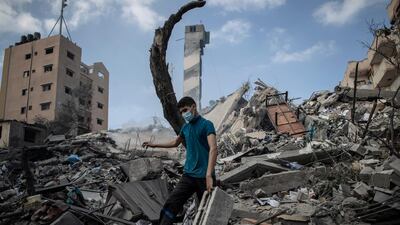
A Palestinian man inspects the damage of a six-storey building destroyed by an early morning Israeli air strike in Gaza city. AP Photo -
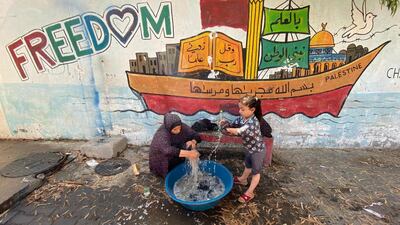
Palestinians, who fled their homes due to Israeli air and artillery strikes, wash their clothes at a UN-run school in Gaza city. Reuters -
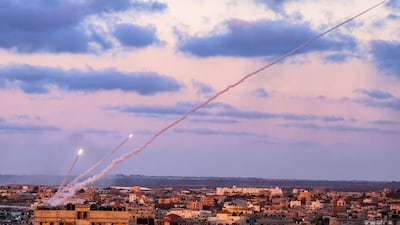
Rockets are launched towards Israel from the southern Gaza Strip. AFP -
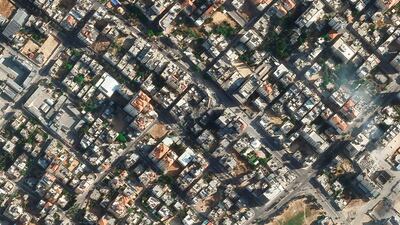
A satellite image shows the rubble of a Gaza Strip high-rise building. AP Photo -
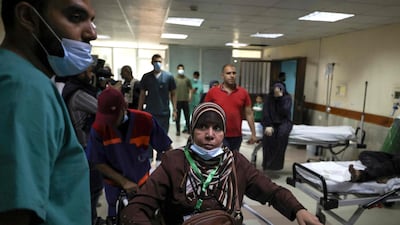
A member of the Palestinian Abu Dayer family receives treatment at Al-Shifa Hospital following an Israeli air strike on their home in Gaza city. AFP -
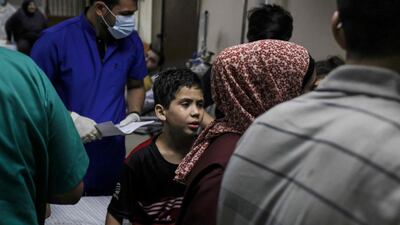
More than 200 people, most of them Palestinians, have been killed in the attacks. AFP -
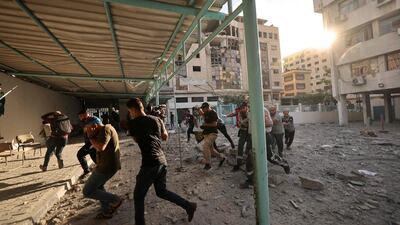
Palestinians run amid Israeli air strikes on Gaza city. AFP -
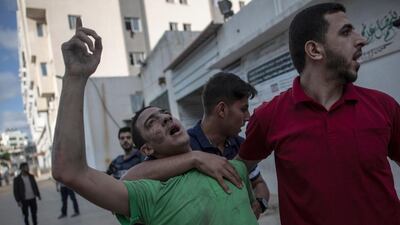
A Palestinian man reacts to the death of his father who was killed by an Israeli airstrike that destroyed the upper floors of a commercial building and caused damage to a health ministry and prime health care clinic in Gaza city. AP Photo -
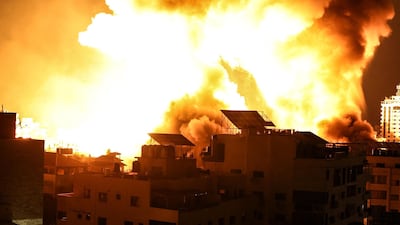
A ball of fire explodes above buildings in Gaza city as Israeli forces shell the Palestinian enclave. AFP -
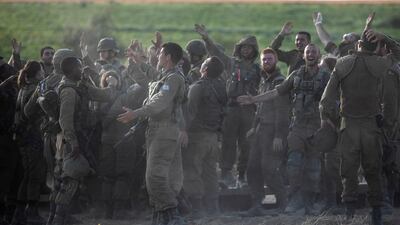
Israeli soldiers cheer as they take photos at an artillery position along the Israel-Gaza border. AP Photo -
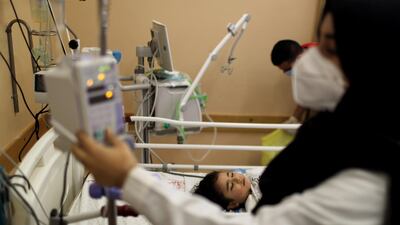
Wounded Palestinian girl Sara Al-Metrabeeay lies on a bed in Shifa Hospital in Gaza city. Reuters -
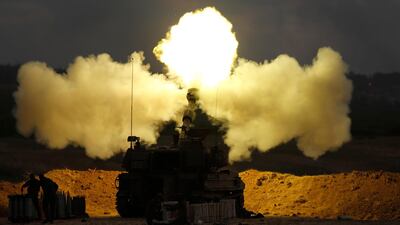
Fighting continues between the Israeli Army and Hamas forces at the Gaza border, Israel. EPA -
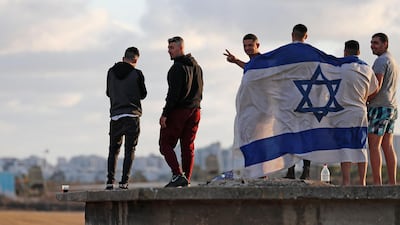
Israelis gather to watch the Iron Dome aerial defence system launch a missile to intercept a rocket launched from the Gaza Strip, above the city of Ashdod. AFP -
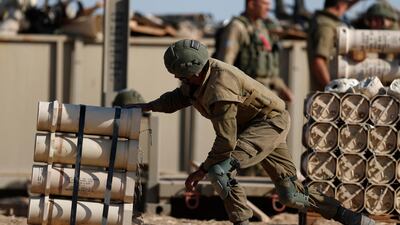
An Israeli artillery soldier carries shells as their unit aims at targets in the Gaza Strip. EPA -
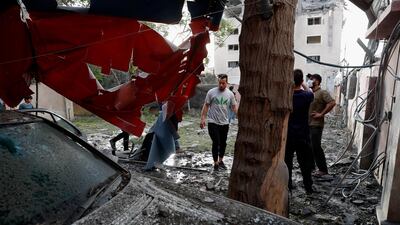
People inspect a destroyed car inside a house, following an Israeli airstrike on the upper floors of a commercial building in Gaza city. AP Photo



